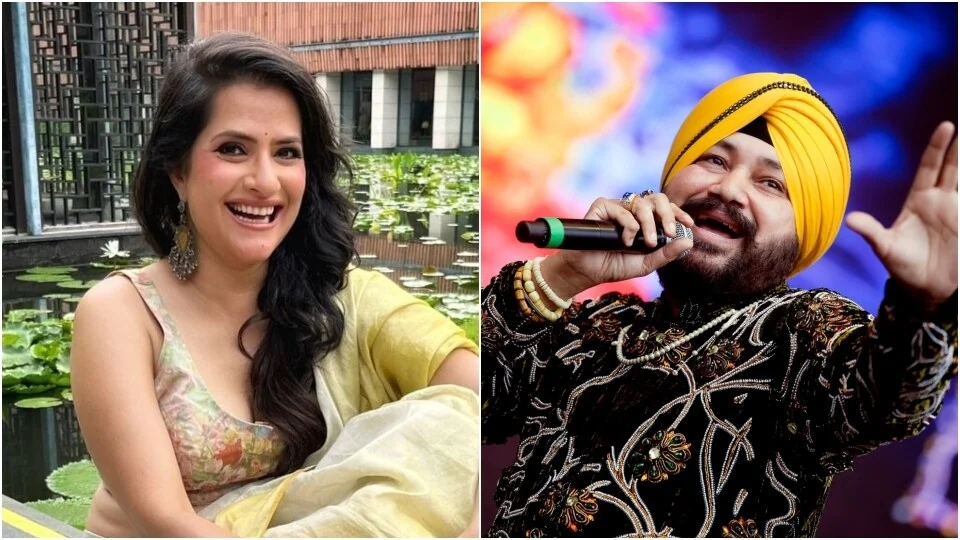
Sona Mohapatra Doubles Down on Daler Mehndi Remarks Amid Industry Support for Singer
Singer Sona Mohapatra has stood by her criticism of Daler Mehndi‘s performances, questioning whether an artist’s legacy should outweigh professional accountability. As several celebrities express support for the veteran Punjabi singer following his controversial Uttarakhand performance, Mohapatra says audiences deserve respect, honesty and consideration.
Singer Sona Mohapatra has reiterated her position on the controversy surrounding fellow singer Daler Mehndi, even as members of the film and music fraternity have rallied behind him.
The controversy began after an onstage confrontation between Mehndi and Uttarakhand Cabinet minister Subodh Uniyal during the Siddhpeeth Maa Kunjapuri Tourism and Development Fair in New Tehri. The minister questioned the singer’s performance, and videos of the exchange subsequently circulated on social media, triggering widespread discussion.
While several public figures expressed sympathy for Mehndi, Mohapatra introduced a different perspective by recalling her experience of watching him perform at the Sufi Heritage Festival in Delhi earlier this year.
In a detailed social media post, she questioned why professional accountability can become secondary when an established artist receives public support. Her argument was not that a veteran performer should be denied dignity or compassion, but that these considerations should not automatically silence legitimate questions about the quality of a performance.
The singer’s remarks have consequently widened the discussion beyond one concert, raising questions about artists’ responsibilities, audience expectations and the tendency to defend familiar public figures without examining the circumstances of a controversy.
Sona Mohapatra Questions the Outpouring of Support for Daler Mehndi
Mohapatra addressed the contrasting reactions to her earlier comments in a lengthy Instagram note, acknowledging that the scale of support for Mehndi had made her reflect on the music industry’s response.
She wrote that she had shared her own perspective on the incident and then watched what appeared to be an overwhelming number of artists speak in the opposite direction. She described the contrast as difficult to ignore and questioned whether it was easier to follow the prevailing sentiment than to express an uncomfortable opinion.
Her central concern was the relationship between empathy and accountability.
Mohapatra questioned whether performers’ gratitude towards the audiences and organisers who make their careers possible had been overshadowed by the instinct to protect fellow artists. She also challenged what she described as a tendency to prioritise sentiment over critical thought.
The singer maintained that compassion for an individual does not require the suspension of judgement. People can acknowledge an artist’s contribution, understand that difficult circumstances may arise and still ask whether professional responsibilities have been fulfilled.
Her comments came amid expressions of support for Mehndi from members of the entertainment industry. That response has become a significant part of the controversy, with the discussion increasingly focusing on how artists should respond when a colleague faces public criticism.
Mohapatra’s position is that disagreement with criticism should not automatically invalidate the questions being raised.
What Sona Mohapatra Said About Daler Mehndi’s Delhi Performance
The singer’s criticism was not based solely on the footage from Uttarakhand. She had previously described an experience of watching Mehndi perform at the second edition of the Sufi Heritage Festival in Delhi.
According to Mohapatra, she and her group stayed in the city to watch the veteran singer perform, having anticipated a distinctive Sufi-oriented set.
However, she described the performance as disappointing. From where she was watching, Mehndi appeared disoriented, struggled to sustain notes and repeatedly returned to the same musical phrase. She also criticised the overall production and said she observed audience members gradually leaving the venue.
These are Mohapatra’s observations of a particular performance, rather than an independently established explanation of what caused the difficulties she described.
Her account nevertheless explains why she chose to speak publicly when the Uttarakhand incident attracted attention. She was presenting an experience that, in her view, raised questions about what audiences should reasonably expect from a live musical performance.
The distinction is important. A performance that disappoints an audience does not, by itself, establish why the artist struggled or whether a medical or other personal circumstance was involved.
Mohapatra’s broader argument concerns the responsibility to communicate honestly when a performance cannot meet expectations.
She has also acknowledged the importance of treating veteran artists with dignity, making her position more nuanced than a straightforward personal attack. Her concern is that respect for an artist should not become a reason to overlook the experience of the people who have come to watch them perform.
How the Daler Mehndi Controversy Began in Uttarakhand
The dispute intensified during Mehndi’s appearance at the Siddhpeeth Maa Kunjapuri Tourism and Development Fair in New Tehri on Sunday, October 18, 2026.
During the performance, Uniyal interrupted the singer on stage and questioned whether he was delivering the performance expected of an artist of his stature. The exchange was captured on video and circulated widely online, drawing attention to the minister’s remarks as well as Mehndi’s performance.
Uniyal subsequently said he was dissatisfied with what he had witnessed. In comments reported by The Indian Express, he alleged that Mehndi was under the influence of alcohol and unable to perform properly. The minister also questioned whether the singer was singing live or relying on a recorded track.
These allegations must be distinguished from established facts. The available reporting does not independently establish that Mehndi had consumed alcohol, and the circumstances behind the performance remain a separate question from the fact that the confrontation occurred.
In subsequent comments reported by The Times of India, Uniyal said the singer should have informed the organisers if he was unwell and that he had no personal intention to hurt him. He also said organisers had been asked to pay ₹35 lakh in advance and had arranged accommodation. These financial and logistical details were presented as the minister’s account of the arrangements, rather than independently verified contractual findings.
The incident therefore raised two related but distinct issues: the circumstances of Mehndi’s performance and the appropriateness of publicly confronting a performer on stage.
The first concerns the expectations attached to a professional engagement. The second concerns how disagreements should be handled, particularly when an artist’s reputation and dignity are at stake.
Why Other Singers and Celebrities Came Out in Support
The confrontation prompted a wave of support for Mehndi from people in the entertainment industry, including his brother, singer Mika Singh.
Several public figures expressed sympathy for the veteran performer, while reactions on social media reflected disagreement over the minister’s intervention and the allegations surrounding the event.
For supporters, the manner in which Mehndi was questioned on stage became an important part of the story. Even when an organiser or public representative has concerns about a performance, critics of the confrontation may argue that those concerns should be addressed privately and professionally.
There is a legitimate distinction between questioning a professional engagement and publicly humiliating the person involved.
An artist may deserve an opportunity to explain an unexpected performance, particularly when illness or another unforeseen circumstance could be relevant. At the same time, organisers and audiences have a reasonable interest in understanding whether an engagement has been delivered as agreed.
Support for Mehndi does not automatically resolve questions about the performance, just as criticism of the performance does not establish the allegations about alcohol consumption.
This distinction lies at the heart of Mohapatra’s intervention. She has questioned the tendency to treat criticism of an artist as an attack on the artist’s entire legacy.
A person’s contribution to music and the circumstances of a particular professional engagement can be evaluated separately. Neither has to erase the other.
Empathy Versus Accountability: What Is Mohapatra Really Arguing?
Mohapatra’s comments have resonated with a broader question about how audiences and the entertainment industry respond when a celebrated performer faces criticism.
Artists often develop strong relationships with their audiences over many years. Their songs can become part of people’s personal histories, family celebrations and cultural memories. This attachment can make criticism of a familiar performer feel more personal than an ordinary discussion about professional standards.
That emotional connection is not inherently a problem. Recognising an artist’s achievements and defending them against unfair treatment are understandable responses.
The difficulty arises when loyalty becomes a substitute for examining what actually happened.
Mohapatra’s argument is that empathy and accountability can coexist. A performer who has contributed significantly to music can still be expected to respect the people attending a concert. Similarly, an audience’s disappointment does not justify speculation about an artist’s health or personal conduct.
A balanced assessment would therefore consider several questions.
What was the audience promised? What did the performance deliver? Were there circumstances that affected the artist’s ability to perform? How did the organisers respond? And was the disagreement handled in a way that respected everyone involved?
The available information does not answer every one of these questions conclusively. That is precisely why it is important to distinguish direct observations, allegations and confirmed details.
Mohapatra’s comments are ultimately a call for a more considered response, rather than an invitation to reach conclusions without sufficient evidence.
Should an Artist’s Legacy Change Audience Expectations?
Mehndi has enjoyed a long career in Punjabi pop music, with a distinctive vocal style and energetic performances helping establish his public identity. For many listeners, his music carries memories that extend well beyond an individual concert.
That legacy deserves recognition. However, the expectations surrounding a live performance also involve the audience’s experience in the present.
People attend concerts expecting to hear the artist they have come to see. Event organisers, meanwhile, make arrangements involving performance schedules, venues, travel and accommodation. When a performance falls short of expectations, questions about communication and professional responsibility can arise.
This does not mean that artists must deliver identical performances regardless of their circumstances. Live entertainment is inherently unpredictable, and illness or other unforeseen difficulties can affect even experienced performers.
The more relevant consideration is how such situations are managed.
If a performer becomes unwell, communicating the problem and discussing the available options may help organisers decide whether a show should be postponed, modified or cancelled. If a performance cannot proceed as planned, an explanation may help audiences understand what happened.
The specific response will depend on the circumstances and the terms of the engagement. It would be premature to draw conclusions about contractual obligations in the Mehndi case without examining the relevant agreement.
Nevertheless, the broader principle is clear: professional respect works in both directions. Artists deserve fair treatment, while audiences and organisers deserve honest communication.
Why the Controversy Needs a Fact-Based Discussion
The Daler Mehndi controversy also illustrates how quickly allegations can become accepted as facts once a video begins circulating online.
Footage of an onstage confrontation can show what was said and how people reacted. It cannot necessarily establish why a performer appeared to struggle, whether illness was involved or whether allegations about alcohol consumption are accurate.
Those questions require evidence beyond an audience member’s impression or a social media interpretation.
The distinction matters because public criticism can affect an artist’s reputation long after the original event has ended. It also matters for audiences, who deserve an accurate account of a dispute rather than competing assumptions presented as established facts.
A responsible discussion should therefore separate three elements: the observable incident, the claims made by the people involved and the explanations that remain unverified.
Mohapatra’s account of the Delhi festival is relevant because it explains her own perspective. It does not independently establish the cause of the Uttarakhand performance.
Similarly, the minister’s criticism explains his dissatisfaction, but his allegations should not be treated as conclusive proof of the singer’s condition.
The response from Mehndi’s supporters is also relevant to understanding the controversy, although expressions of loyalty cannot independently settle disputed factual questions.
This approach allows the public to discuss professional accountability without making unsupported claims about an individual’s personal circumstances.
What Happens Next in the Daler Mehndi and Sona Mohapatra Row?
The immediate controversy has developed into a wider discussion about artistic legacy, audience expectations and professional conduct.
Mohapatra has made clear that she does not believe empathy should require silence. Her comments challenge the assumption that supporting a fellow artist means defending every aspect of their conduct or dismissing criticism of a performance.
At the same time, the debate has highlighted the importance of addressing complaints without unnecessary public humiliation.
For event organisers, the episode serves as a reminder of the importance of clear performance arrangements, communication procedures and contingency plans when an artist cannot deliver a show as expected.
For audiences, it reinforces the value of distinguishing disappointment with a performance from unverified claims about its cause.
For artists, the discussion raises questions about how professional responsibilities can be balanced with the unpredictable realities of live performance.
Whether the controversy leads to any broader changes in industry practices remains to be seen. What it has already demonstrated is that public support and professional accountability are not necessarily opposing ideas.
Conclusion: Respect for Artists and Audiences Must Go Together
Sona Mohapatra’s renewed comments on Daler Mehndi have brought attention to an uncomfortable question in the entertainment industry: can an artist’s achievements and public image make it harder to discuss concerns about a particular performance?
Her answer is that empathy should not eliminate accountability.
The controversy began with Mehndi’s performance at a cultural event in Uttarakhand and the minister’s decision to confront him on stage. It subsequently expanded as celebrities expressed support for the veteran singer and Mohapatra shared her own experience of watching him perform in Delhi.
The circumstances of both performances, however, should not be conflated, and allegations about alcohol consumption remain unverified in the available reporting.
The larger issue is the need to balance compassion with fair expectations. Artists deserve dignity and recognition for their contributions, but audiences also deserve respect. When something goes wrong, transparent communication and a measured response can be more constructive than either unquestioning defence or public condemnation.
Ultimately, respect for an artist’s legacy and accountability for professional commitments can coexist. Mohapatra’s intervention has brought that distinction into focus, encouraging a discussion that goes beyond celebrity loyalties and towards the responsibilities shared by performers, organisers and audiences.
For breaking news and live news updates, like us on Facebook or follow us on Twitter and Instagram. Read more on Latest Entertainment on thefoxdaily.com.






COMMENTS 0