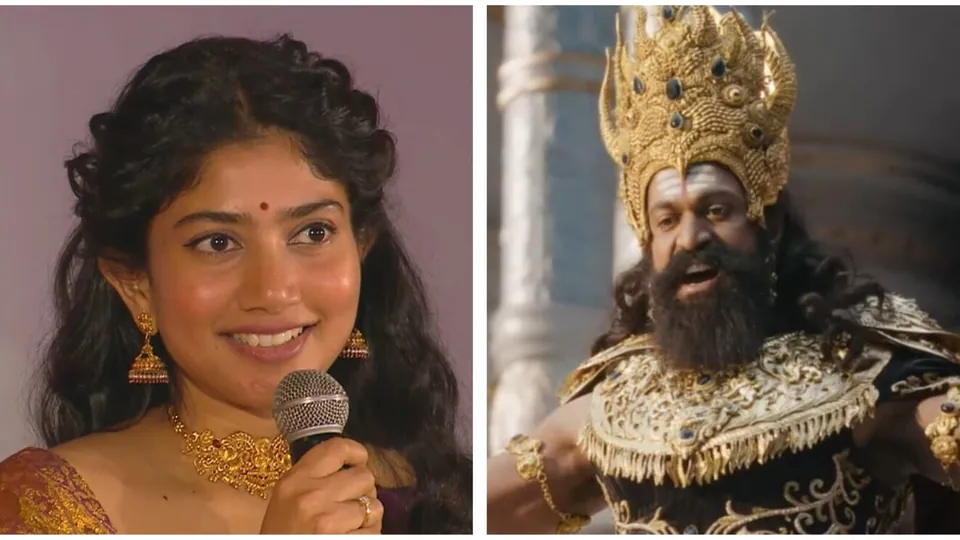
Sai Pallavi Says ‘Ravana Is Not All Bad’, Shares Key Lesson From Ramayana
Actor Sai Pallavi has shared a thought-provoking perspective on the character of Ravana in Ramayana, saying the ancient Indian epic encourages people to recognise both good and bad within themselves and work towards becoming better over time. At the Los Angeles premiere of the upcoming film adaptation, she explained that one of the story’s important lessons is to identify the “Ravana” within and make conscious efforts to change.
“If you are a believer, and you would see, try to introspect, and see what good and bad exists in you, and you learn to correct yourself over time,” Sai Pallavi said while discussing the film. “Because Ravana is not all bad. And it’s important that we spot the Ravana in us, and we make changes over time.”
Her comments came as the cast and director of Ramayana gathered at the Academy Museum of Motion Pictures in Los Angeles for the film’s world premiere on October 27, 2026. Ranbir Kapoor, Sai Pallavi, Yash and director Nitesh Tiwari attended the event ahead of the first instalment’s scheduled theatrical release on November 5, 2026.
Sai Pallavi’s remarks have brought attention to the moral complexity of the epic’s characters and the relevance of its lessons for contemporary audiences.
Sai Pallavi Explains What Audiences Can Take Away From Ramayana
During the red-carpet conversation, Sai Pallavi was asked what she hoped international audiences would discover through the film, particularly viewers in the United States who might be less familiar with Indian epics.
She said the movie could serve as an introduction to Indian culture and the Ramayana, especially for people curious about the country’s literary and spiritual traditions.
“If one is curious about Indian culture, Indian epics, I think this could be the start where you see the best version of Ramayana that exists,” she said.
The actor also highlighted the film’s technical ambition, pointing to the experienced technicians involved in the production and its use of advanced visual effects.
However, her message went beyond the film’s scale and cinematic presentation. She also encouraged viewers who approach the epic as a scripture to reflect on their own behaviour and recognise areas where they could improve.
Her interpretation centres on introspection rather than simply judging characters as entirely good or entirely bad. Through Ravana, she suggested, audiences can examine their own weaknesses and consider how personal change happens over time.
The idea gives the ancient narrative a contemporary dimension, inviting viewers to connect its moral questions with their own decisions and conduct.
‘Ravana Is Not All Bad’: Why Sai Pallavi Wants Viewers to Look Within
Ravana is traditionally remembered in the Ramayana as the king of Lanka who abducts Sita, setting in motion the central conflict that leads to his defeat by Lord Rama. Yet his character is also associated in various retellings with learning, power, devotion and exceptional abilities.
Sai Pallavi’s observation that “Ravana is not all bad” draws attention to this complexity without dismissing the significance of his actions in the epic.
Her larger point is that recognising negative qualities in a character can also prompt people to examine similar tendencies in themselves. Rather than treating the story only as a battle between opposing figures, viewers can use it as an opportunity to think about their own strengths, weaknesses and choices.
The actor’s reference to spotting the “Ravana” within us can be understood as a metaphor for identifying qualities that may lead to harmful behaviour, such as pride, anger, selfishness or an unwillingness to change. These are illustrative interpretations of her broader message, rather than a list she specifically provided in the interview.
Self-reflection does not mean treating every person as equivalent to a mythological character. Instead, it encourages people to recognise that personal growth often begins with acknowledging mistakes and taking responsibility for them.
Sai Pallavi also emphasised that change happens over time. Her remarks suggest that understanding one’s shortcomings is only the first step; the next is making a genuine effort to correct them.
How Ramayana Encourages Self-Reflection and Personal Growth
The Ramayana has been interpreted across generations through religious traditions, literature, theatre, television and cinema. Its characters and conflicts have inspired discussions about duty, loyalty, responsibility, justice and the consequences of individual choices.
Sai Pallavi’s comments highlight another way to engage with the epic: using its characters as starting points for personal reflection.
Her message encourages audiences to ask themselves whether their actions align with their values. It also invites them to consider how qualities that may appear admirable in one situation can become harmful when taken to an extreme or used without regard for others.
The idea of personal change is central to this approach. People can acknowledge their flaws without assuming that those flaws define them permanently. Recognising a mistake can create an opportunity to behave differently in the future.
For viewers who approach the Ramayana as a spiritual text, this may connect with a broader practice of examining one’s conduct and trying to live according to ethical principles. For audiences approaching it as literature or mythology, the same idea can offer a way to reflect on human behaviour and the consequences of decisions.
Sai Pallavi’s remarks therefore frame the film as more than a visual retelling of a familiar epic. They point towards the possibility of using its story to start conversations about accountability, self-awareness and personal development.
Sai Pallavi on Introducing Indian Epics to International Audiences
The Los Angeles premiere provided an opportunity to introduce the film to an international audience ahead of its theatrical release.
Sai Pallavi said viewers interested in Indian culture and epics could find the film a starting point for exploring the Ramayana. She also highlighted the technical expertise and visual effects involved in bringing the story to the screen.
Adapting an ancient epic for a contemporary global audience presents several challenges. The filmmakers must translate a culturally significant narrative into a cinematic experience while retaining the themes and characters that have made it meaningful across generations.
Visual effects can help portray the scale of the story’s world, its battles and its larger-than-life characters. However, the emotional and ethical questions at the heart of the narrative also remain important to how audiences understand it.
Sai Pallavi’s comments suggest that the film’s potential impact lies in both its presentation and its underlying message. While the production aims to offer a large-scale cinematic experience, the actor hopes audiences will also think about what the story says about human nature.
Her emphasis on introspection may be particularly relevant for viewers encountering the epic for the first time, as it provides a way to connect with its themes beyond cultural familiarity.
Ramayana Cast: Ranbir Kapoor as Rama, Sai Pallavi as Sita and Yash as Ravana
Directed by Nitesh Tiwari, Ramayana is planned as a two-part cinematic adaptation of the ancient Indian epic.
Ranbir Kapoor plays Lord Rama, Sai Pallavi portrays Sita, and Yash takes on the role of Ravana. The cast also includes Sunny Deol as Hanuman and Ravi Dubey as Lakshman.
The casting brings together performers from different areas of Indian Cinema for a story with a long-standing place in the country’s cultural and religious traditions.
Ranbir’s portrayal of Rama carries particular significance because of the figure’s revered status among millions of people. Yash’s role as Ravana places him at the centre of the epic’s principal conflict, while Sai Pallavi’s portrayal of Sita is central to the story’s emotional and narrative arc.
The film is produced by Namit Malhotra and Yash, with music by AR Rahman and Hans Zimmer.
The combination of a large ensemble, high-profile creative talent and advanced visual effects has made the project one of the closely watched Indian film releases. The two-part structure is intended to give the filmmakers room to bring the expansive story to the screen across separate instalments.
Ramayana Budget and Release Date
The film has reportedly been mounted on a budget of approximately ₹4,000 crore, according to the supplied report. The production is backed by Namit Malhotra and Yash and is planned as a two-part franchise.
The first instalment is scheduled to release in theatres on November 5, 2026. The second part is expected to arrive around Diwali 2027.
The reported budget has attracted attention because of the scale associated with the project. However, the figure should be treated as a reported estimate unless confirmed through an official production statement.
The Los Angeles premiere on October 27, 2026, marked a major promotional milestone ahead of the first film’s planned release. The event brought together the principal cast, director and producer as the team introduced the adaptation to an international audience.
As anticipation builds, attention will focus on how the film presents the familiar characters, the world of the epic and the moral conflicts that underpin the narrative.
Sai Pallavi’s comments have added another dimension to that conversation by drawing attention to the personal lessons viewers may take from the story.
What Sai Pallavi’s Comments Mean for the Film’s Message
Sai Pallavi’s observation that Ravana is not entirely defined by evil invites audiences to consider the complexity of human character. Her emphasis, however, is not simply on reassessing one figure from the epic. It is on using the story to examine one’s own behaviour.
Her message encourages viewers to recognise shortcomings, take responsibility for them and work towards change. That process, she suggested, is gradual rather than immediate.
The perspective also offers a way to connect an ancient narrative with present-day experiences. Questions about pride, responsibility, ethical choices and the ability to acknowledge mistakes remain relevant in everyday life, regardless of whether someone approaches the Ramayana through faith, literature or cinema.
As the film prepares for release, Sai Pallavi hopes audiences will look beyond its visual scale and consider the ideas that have kept the epic part of cultural conversations for generations.
For her, one of the most important takeaways is the need for self-awareness: recognising the qualities within ourselves that may need to change and making a sustained effort to become better over time.
For breaking news and live news updates, like us on Facebook or follow us on Twitter and Instagram. Read more on Latest Entertainment on thefoxdaily.com.






COMMENTS 0