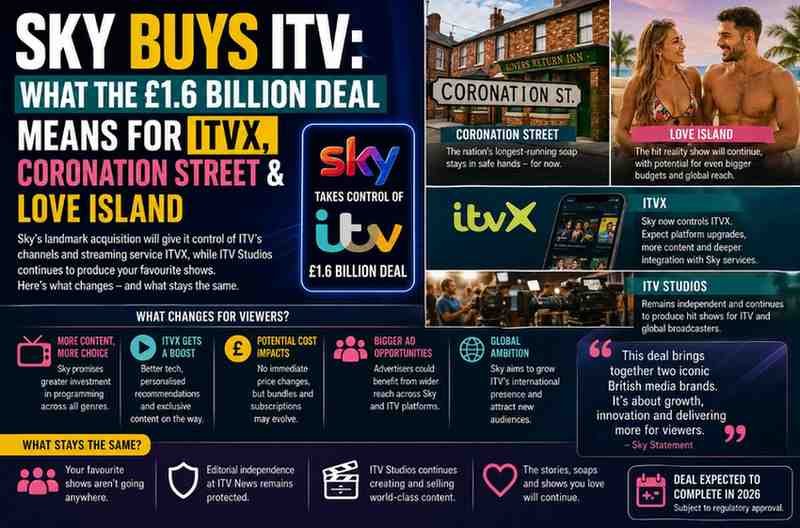
If you’ve spent any Saturday night glued to Love Island or followed Coronation Street for decades, there’s a corporate shake-up happening behind the scenes that’s worth understanding even if your remote control experience barely changes on day one. Comcast-owned Sky has agreed terms to acquire ITV’s Media & Entertainment division, the arm that runs ITV’s broadcast channels and its ITVX streaming platform, in a deal reportedly worth around £1.6 billion ($2.1 billion). The agreement is currently being finalised by lawyers, with an announcement possible within weeks, according to Reuters.
Who: Comcast’s UK pay-TV arm Sky, and British broadcaster ITV. What: Sky acquiring ITV’s linear television channels and its ITVX streaming service, while ITV Studios the production business behind many of the shows on those channels splits off as a standalone company. When: terms were agreed in late June 2026, following talks that first became public in November 2025. Where: this is a UK media deal, though it has implications for how British shows reach international streamers too. Why it matters: because this restructures who owns the pipes that deliver your favourite programmes, even as the studio making many of those programmes stays independent.
Background: How We Got Here
Speculation about a Sky-ITV tie-up isn’t new, but it moved from rumour to reality gradually. ITV first confirmed it was in preliminary discussions with Sky back in November 2025. By May 2026, both companies acknowledged they remained in active talks, with insiders describing an agreement as “weeks away.” That timeline held roughly true: by late June, Reuters reported the two sides had agreed terms, with lawyers now finalising the paperwork.
The structure of the deal is the part viewers most need to understand. ITV as a company is effectively splitting in two. Its Media & Entertainment division the actual TV channels and the ITVX streaming platform would be sold to Sky. Meanwhile, ITV Studios, the production business responsible for making shows both for ITV and for other broadcasters and streamers, would remain a standalone, independently owned company, run separately from the newly Sky-owned channels.
Deal at a Glance
| Detail | Information |
|---|---|
| Buyer | Sky (owned by Comcast) |
| What’s Being Sold | ITV’s Media & Entertainment division: linear channels and ITVX streaming platform |
| Deal Value | Approximately £1.6 billion ($2.1 billion), plus a potential earn-out worth around £200 million |
| What Stays Independent | ITV Studios, the production arm behind many ITV, Channel 4 and Netflix shows |
| Side Transaction | ITV Studios acquires Sky-owned Love Productions (Bake Off, The Piano), valued at £80–120 million |
| Regulatory Approvals Needed | Ofcom and the Competition and Markets Authority; final decision rests with the Culture Secretary |
| Timeline | Talks confirmed November 2025; terms agreed June 2026; announcement possible within weeks |
What Happens to Your Favourite Shows?
Here’s the reassuring part for viewers: shows like Coronation Street, Emmerdale, Love Island, I’m a Celebrity… Get Me Out of Here!, and The Voice aren’t disappearing or changing production teams overnight. ITV Studios, which makes these programmes, would continue producing them for the ITV channel under a separate Content Supply Agreement a contractual arrangement that ensures the newly Sky-owned channels keep receiving the same shows from the same production teams, even though ownership of the broadcaster itself has changed hands.
There’s an interesting wrinkle involving Channel 4’s The Great British Bake Off and The Piano. Both are currently produced by Love Productions, which is owned by Sky. Under this deal, Love Productions would move over to ITV Studios instead, valued at somewhere between £80 million and £120 million. That means two shows that air on a rival broadcaster, Channel 4, would end up being made by a production company owned by ITV Studios rather than Sky a reminder that studio ownership and channel ownership don’t always align with where a show actually airs.
ITV Studios’ international portfolio also matters here. The company produces content for streamers well beyond the UK, including Netflix’s Squid Game: The Challenge, and none of that international production business changes hands as part of this deal, since it lives with ITV Studios rather than the channels being sold to Sky.
Why Sky Wants This and Why ITV Is Willing to Sell
The logic behind this deal is fundamentally about scale in an increasingly crowded streaming market. ITV has been pouring investment into ITVX as viewers and advertisers continue drifting away from traditional linear television, but competing against global giants like Netflix, YouTube, Amazon Prime Video, and Disney+ requires resources that a single national broadcaster increasingly struggles to match alone. Folding ITV’s channels and streaming platform into Sky, which already has substantial subscriber infrastructure and Comcast’s backing, creates a combined operation better positioned to compete at that scale.
For ITV, splitting off the more capital-intensive broadcast and streaming side lets the company refocus on ITV Studios, its production business, which has actually been the stronger-performing half of the company recently. According to ITV’s own Q1 figures, the Media & Entertainment division saw revenue decline slightly to £477 million, while ITV Studios grew 4% to £400 million. That performance gap helps explain why ITV shareholders might welcome a deal that separates a struggling broadcast arm from a growing production business letting each be valued and run according to its own trajectory rather than being weighed down together.
The Regulatory Hurdles Standing in the Way
This deal isn’t a done one just because terms have been agreed. It still needs approval from both Ofcom, the UK’s media regulator, and the Competition and Markets Authority, with the final call ultimately resting with the government’s Culture Secretary. That’s a meaningful hurdle: rival broadcasters Channel 4 and Channel 5, both of which rely heavily on advertising revenue, are expected to oppose the deal on competition grounds, since a combined Sky-ITV entity would command a significantly larger share of the UK’s television advertising and audience market.
There’s also a subtler complication buried in ITV’s structure: the broadcaster holds a 40% stake in ITN, the news provider that supplies output not just to ITV but to Channel 4 and Channel 5 as well. Untangling how that stake is treated, given ITV’s split into two separate businesses, adds another layer of regulatory complexity that could affect how quickly this deal actually closes.
It’s also worth noting the broader regulatory climate this deal is landing in. UK media consolidation is under heightened scrutiny right now, with the government already signalling it may intervene in Paramount Skydance’s separate, much larger $110 billion acquisition of Warner Bros Discovery. That environment suggests regulators may take a particularly close look at the Sky-ITV deal too, rather than waving it through quickly.
Real-World Impact: What This Means for UK Television
Assuming the deal clears regulatory review, the most immediate effect for viewers is likely to be behind-the-scenes rather than visible on screen: your favourite ITV shows keep being made by the same teams, but the company controlling how and where you watch them the channel itself and the ITVX app now sits within Sky and, by extension, Comcast’s global media empire. Over time, that could mean tighter integration between ITVX and Sky’s existing streaming products, potentially changing how content is bundled, priced, or cross-promoted across Sky’s platforms.
For the wider industry, this deal reflects a broader trend of media consolidation happening globally, as broadcasters conclude that going it alone against Netflix-scale competitors isn’t sustainable long-term. Expect more traditional broadcasters in mid-sized markets to pursue similar splits — separating content production from distribution — as a way of surviving in a streaming-dominated landscape without abandoning the shows and franchises that built their audiences in the first place.
Conclusion: A Structural Shift, Not (Yet) a Programming One
For now, the headline takeaway for viewers is reassuring: Coronation Street, Emmerdale, Love Island, and the rest of ITV’s biggest shows aren’t going anywhere, and the teams making them aren’t changing either. What’s shifting is who owns the channels and streaming platform delivering those shows into your living room a distinction that matters enormously to media executives and regulators, even if it barely registers for someone just trying to catch the next episode. Whether this deal ultimately reshapes the UK television landscape as significantly as its backers hope will depend on how regulators respond in the weeks ahead and on whether rival broadcasters succeed in slowing it down.
For breaking news and live news updates, like us on Facebook or follow us on Twitter and Instagram. Read more on Latest Entertainment on thefoxdaily.com.

COMMENTS 0