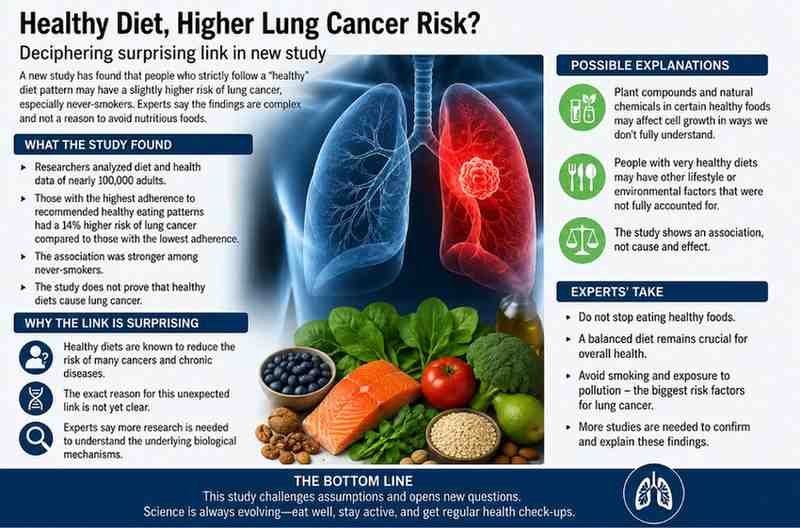
The idea that a healthy diet could somehow be linked to a higher risk of Lung Cancer sounds counterintuitive. After all, fruits, vegetables, whole grains and other nutrient-rich foods have long been associated with better health and lower risks of chronic diseases. Yet a recent study has sparked intense discussion after reporting an unexpected relationship between healthier eating habits and a modest increase in lung cancer incidence among certain groups.
Before anyone rushes to replace salads with fast food, experts emphasize an important point: an association does not prove causation. The findings open the door to new scientific questions rather than overturn decades of nutritional knowledge. Understanding what the study means and what it does not mean is essential.
Why the Study Has Generated So Much Attention
Lung cancer remains one of the leading causes of cancer-related deaths worldwide, and smoking continues to be its most significant risk factor. For decades, healthy diets have been considered protective against numerous diseases, including several forms of cancer.
Therefore, a study suggesting a possible link between healthier eating patterns and increased lung cancer risk naturally attracted widespread attention. The results challenge conventional assumptions and highlight how complex nutrition science can be.
Researchers themselves stress that the findings should be viewed as a starting point for further investigation rather than definitive evidence.
Association Does Not Mean Cause and Effect
One of the most misunderstood aspects of health studies is the difference between correlation and causation. Just because two factors appear connected does not mean one directly causes the other.
For example, individuals who follow healthy diets may also share characteristics that researchers cannot fully account for. Environmental exposures, genetic factors, occupational hazards, air pollution, and past smoking history can all influence cancer risk.
In scientific research, separating these variables is extremely difficult, which is why experts caution against drawing dramatic conclusions from a single study.
How Lung Cancer Develops: It Is More Than a Smoking Disease
While smoking remains the biggest contributor to lung cancer, it is not the only one. Increasingly, doctors are recognizing that non-smokers can also develop lung cancer.
Several factors contribute to the disease:
- Tobacco use and secondhand smoke exposure
- Air pollution
- Radon gas exposure
- Occupational exposure to harmful chemicals
- Genetic predisposition
- Chronic lung diseases
- Environmental toxins
- Age-related changes in cells
This complexity means that no single factor, including diet, can fully explain an individual’s risk.
What Scientists Already Know About Diet and Cancer
Decades of research have consistently shown that healthy eating patterns are associated with reduced risks of obesity, cardiovascular disease, diabetes, and several cancers. Diets rich in fruits, vegetables, legumes, whole grains and healthy fats contribute to overall wellness.
Nutrition affects inflammation, immunity, metabolism and hormone regulation—all of which play important roles in disease prevention.
Therefore, one unexpected finding should not overshadow the broader body of evidence supporting balanced nutrition.
| Dietary Pattern | Established Health Benefits |
|---|---|
| Mediterranean Diet | Improved heart health and reduced inflammation |
| High Fruit and Vegetable Intake | Rich in antioxidants and fiber |
| Whole Grain-Based Diet | Better metabolic health |
| Balanced Protein Intake | Supports muscle and immune function |
| Reduced Processed Foods | Lower risk of obesity and chronic diseases |
Possible Explanations Behind the Unexpected Findings
Scientists are exploring several theories that may explain the surprising association. One possibility is residual confounding, where factors not fully captured in the analysis influence results.
Another explanation involves environmental exposures. Individuals with healthier lifestyles may differ in occupation, urban living patterns or healthcare access, creating hidden variables.
Some researchers also believe that biological interactions between nutrients and genetic pathways are far more complex than previously understood.
Importantly, none of these theories suggest that healthy food itself causes lung cancer.
Why Air Pollution May Be a Bigger Concern
Air pollution is emerging as one of the most significant risk factors for lung cancer among non-smokers. Fine particulate matter, vehicle emissions and industrial pollutants have been linked to increased cancer risk.
In countries with rapidly urbanizing populations, exposure to polluted air may play a larger role than diet in determining lung health.
This raises an important question: are lifestyle patterns being confused with environmental factors that are harder to measure?
The Growing Burden of Lung Cancer Among Non-Smokers
Doctors around the world are observing an increasing number of lung cancer cases among people who have never smoked. This trend has prompted researchers to investigate causes beyond tobacco.
Genetics, indoor pollution, cooking fumes, occupational exposure and environmental contaminants are all under scrutiny.
The new study adds another layer to this conversation, reminding scientists that cancer biology remains extraordinarily complex.
Why Nutrition Studies Often Produce Conflicting Headlines
Nutrition science is notoriously challenging because food consumption involves thousands of variables. People do not eat nutrients in isolation; they consume entire dietary patterns influenced by culture, income, geography and lifestyle.
As a result, individual studies sometimes produce surprising findings that appear to contradict previous knowledge.
Experts generally rely on the totality of evidence rather than isolated reports when making dietary recommendations.
Comparison: Proven Risk Factors Versus Emerging Questions
| Risk Factor | Strength of Evidence |
|---|---|
| Smoking | Very Strong |
| Secondhand Smoke | Strong |
| Air Pollution | Strong |
| Occupational Chemicals | Strong |
| Genetics | Moderate to Strong |
| Healthy Diet Association | Requires Further Research |
Should People Change Their Eating Habits?
The short answer is no. Experts emphasize that there is currently no evidence suggesting people should abandon healthy diets because of these findings.
In fact, balanced nutrition remains one of the cornerstones of disease prevention and healthy aging. Replacing fruits and vegetables with processed foods would likely create far greater health risks.
Rather than changing eating habits based on a single study, individuals should focus on overall wellness, including regular exercise, avoiding tobacco and minimizing exposure to air pollution.
A Bigger Lesson About Scientific Research
One of the strengths of science is its willingness to challenge assumptions. Unexpected findings are not failures—they are opportunities to ask better questions.
The history of medicine is filled with discoveries that initially appeared confusing but eventually improved understanding of human health.
The current findings may ultimately reveal new insights about metabolism, genetics or environmental interactions. Or they may simply highlight the difficulties of studying complex diseases.
What Future Research Could Reveal
Scientists are likely to conduct larger studies involving diverse populations and more detailed analyses of dietary patterns. Advances in genetic testing, biomarker analysis and artificial intelligence may help uncover relationships that traditional research methods cannot detect.
Future investigations could also examine how nutrition interacts with pollution, inflammation and individual genetic differences.
These developments may provide more personalized approaches to disease prevention in the coming decade.
Conclusion
The recent study linking healthy diets with a slightly higher risk of lung cancer has sparked important discussions, but it does not rewrite decades of nutritional science. The findings represent an association, not proof that nutritious foods are harmful.
Smoking, air pollution and environmental exposures remain far more established risk factors. Meanwhile, healthy eating continues to offer well-documented benefits for cardiovascular health, metabolism and overall longevity.
The study serves as a reminder that science is rarely simple. Sometimes the most surprising results are not answers but invitations to explore deeper questions. Until stronger evidence emerges, experts agree on one thing: maintaining a balanced diet remains one of the best investments people can make for long-term health.
For breaking news and live news updates, like us on Facebook or follow us on Twitter and Instagram. Read more on Latest Health on thefoxdaily.com.


COMMENTS 0