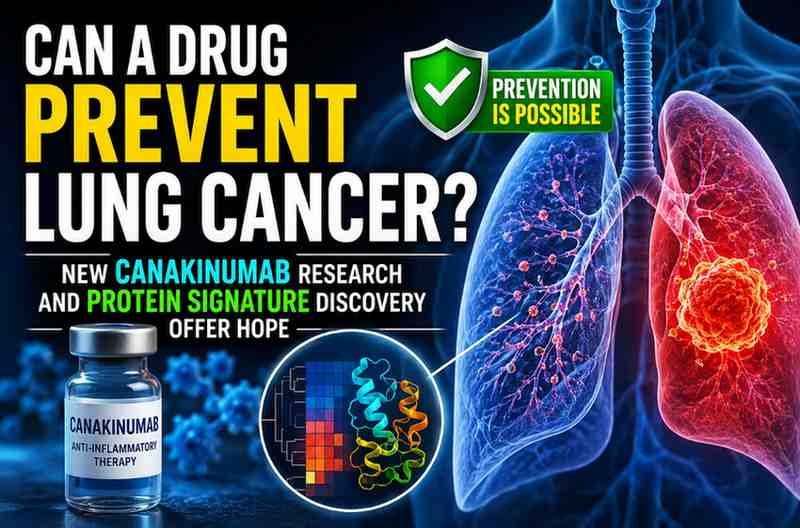
Lung Cancer remains the leading cause of cancer-related deaths worldwide, largely because the disease is often diagnosed at an advanced stage. Despite advances in targeted therapies and immunotherapy, survival rates remain heavily dependent on early detection. This has fueled growing interest in an intriguing question: could lung cancer be prevented before it develops?
Recent research involving the anti-inflammatory drug Canakinumab has revived hopes that certain cancers might one day be intercepted before they become clinically apparent. More importantly, scientists have identified a protein signature that could potentially pinpoint people at particularly high risk of developing lung cancer, opening the door to more precise screening strategies.
However, researchers emphasize that enthusiasm should be balanced with caution. While the findings are promising, there is still no definitive proof that Canakinumab itself prevents lung cancer or slows its progression.
Why Preventing Lung Cancer Has Become a Major Scientific Goal
Most cancer treatments are designed to fight disease after it has already developed. Preventing cancer altogether represents a much bigger challenge—and potentially a far greater opportunity.
Lung cancer is particularly difficult because:
- Symptoms often appear late.
- Many cases are diagnosed at advanced stages.
- High-risk populations are large.
- Current screening programs have limitations.
- Smoking history alone does not explain every case.
Researchers increasingly believe that understanding biological changes occurring years before cancer emerges may provide opportunities for prevention.
What Is Canakinumab?
Canakinumab is a monoclonal antibody that targets interleukin-1 beta (IL-1β), an inflammatory molecule involved in the body’s immune response.
Originally developed to treat certain inflammatory conditions, the drug attracted attention after earlier studies suggested a surprising possibility: people receiving Canakinumab appeared to experience fewer cases of lung cancer than expected.
This observation sparked interest in the role chronic inflammation might play in cancer development.
Why Inflammation Matters in Cancer
Inflammation is a natural defense mechanism, but persistent inflammation can damage tissues and create conditions that may support tumor formation.
Scientists have long suspected links between chronic inflammation and several cancers.
Inflammation may contribute to:
- DNA damage.
- Cellular stress.
- Abnormal cell growth.
- Changes in immune responses.
- Tumor progression.
Targeting inflammation could therefore represent an entirely new approach to cancer prevention.
The Protein Signature Discovery Explained
One of the most important aspects of recent research is not necessarily the drug itself, but the identification of a protein signature associated with elevated lung cancer risk.
This discovery raises the possibility of identifying individuals who might benefit most from closer monitoring and earlier interventions.
If validated, such biomarkers could improve the efficiency of screening programs by focusing resources on those with the highest likelihood of developing disease.
How Lung Cancer Screening Works Today
Current lung cancer screening primarily relies on low-dose CT scans for people considered at high risk, especially those with significant smoking histories.
Although screening saves lives, challenges remain:
- Not everyone eligible undergoes screening.
- False-positive results can occur.
- Many cancers still escape early detection.
- Risk assessment based mainly on smoking history may miss some individuals.
Protein-based biomarkers could potentially complement existing methods and improve precision.
Comparison: Traditional Screening vs Biomarker-Based Screening
| Feature | Current Screening Approach | Future Biomarker Approach |
|---|---|---|
| Main risk factor | Smoking history | Biological protein markers |
| Method | Low-dose CT scan | Blood-based analysis plus imaging |
| Precision | Moderate | Potentially higher |
| Target population | Broad high-risk groups | More personalized risk assessment |
| Current status | Established | Still under investigation |
Can Canakinumab Actually Prevent Lung Cancer?
At present, scientists do not have a definitive answer.
While earlier observations raised hopes, subsequent studies have produced mixed results, and researchers continue to investigate whether the association reflects a true preventive effect.
Several questions remain unanswered:
- Does the drug reduce the incidence of lung cancer?
- Can it slow tumor progression?
- Which patients would benefit most?
- Are the benefits large enough to justify long-term use?
- How do risks and costs compare with existing strategies?
Until these questions are resolved, Canakinumab cannot be considered a proven lung cancer prevention therapy.
An Insight Competitors Often Miss: The Biggest Breakthrough May Be Risk Prediction, Not the Drug
Much of the public attention focuses on the possibility of a “cancer prevention pill.” But researchers suggest that the more important advance may lie elsewhere.
The discovery of protein signatures capable of identifying individuals at elevated risk could fundamentally transform cancer screening.
Instead of applying the same approach to everyone, medicine may increasingly use biological markers to personalize prevention strategies.
This shift toward precision prevention could have implications far beyond lung cancer.
Why Prevention Is More Complicated Than Treatment
Treating existing cancer and preventing future cancer are very different challenges.
Preventive drugs must meet exceptionally high safety standards because they are given to individuals who are otherwise healthy.
Any potential side effects, costs, and long-term consequences must be carefully weighed against the benefits.
This is why proving cancer prevention requires large studies and years of follow-up.
What Still Matters Most for Reducing Lung Cancer Risk?
Despite exciting scientific developments, experts agree that established risk-reduction measures remain essential.
- Avoiding tobacco use.
- Quitting smoking.
- Reducing exposure to secondhand smoke.
- Testing homes for radon where appropriate.
- Maintaining occupational safety standards.
- Participating in recommended screening programs.
These interventions continue to offer the strongest evidence for reducing lung cancer risk.
The Future of Cancer Prevention
The concept of preventing cancer through drugs is no longer science fiction. Researchers are increasingly exploring how inflammation, immune pathways, genetics, and biomarkers might allow earlier interventions.
Future approaches may combine:
- Blood-based protein signatures.
- Artificial intelligence-assisted risk assessment.
- Personalized screening schedules.
- Targeted preventive therapies.
- Precision medicine strategies.
The ultimate goal is to identify cancer before it develops—or stop it from appearing altogether.
Conclusion
Recent research involving Canakinumab and newly identified protein signatures has opened an exciting chapter in the search for lung cancer prevention. While the findings suggest that biological markers could improve risk prediction and make screening more efficient, evidence that the drug itself prevents lung cancer remains incomplete.
The most significant breakthrough may not be a single medicine but the emergence of precision prevention an approach that combines biomarkers, imaging, and personalized risk assessment to intervene earlier than ever before.
For now, scientists remain optimistic but cautious. The dream of preventing lung cancer before it begins is closer than it once seemed, but proving that vision will require more evidence, longer studies, and careful scientific scrutiny.
For breaking news and live news updates, like us on Facebook or follow us on Twitter and Instagram. Read more on Latest Health on thefoxdaily.com.





COMMENTS 0