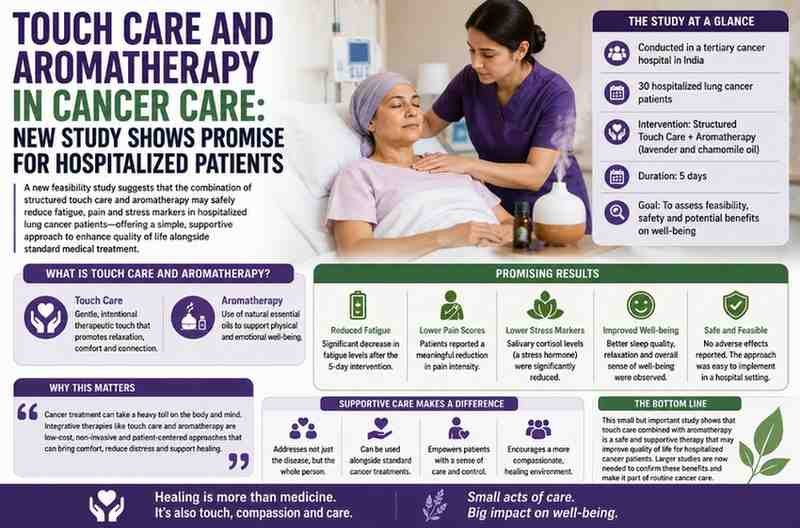
Hospital rooms are not known for being restfulplaces. Beeping monitors, frequent vital checks, and the physical grind ofchemotherapy or radiotherapy can leave patients with thoracic cancers exhaustedlong before the disease itself takes its toll. A newly published feasibilitystudy out of Japan is now adding weight to a question that integrative oncologyresearchers have asked for years: can something as simple as a foot massagepaired with a calming scent actually help?
The answer, according to researchers publishing inthe Asia-Pacific Journal of Oncology Nursing in2026, is a cautious but encouraging yes. The study, led by Tamai andcolleagues, enrolled 87 hospitalized patients with thoracic malignancies including non-small cell lung cancer, small-cell lung cancer, thymic cancer,and malignant pleural mesothelioma to test whether a combined touch care andaromatherapy intervention was safe, tolerable, and worth pursuing in largertrials. Every single patient completed the protocol, and the side-effectprofile was minimal. That alone is notable in a patient population where morethan half had stage IV disease.
Here is the essential breakdown:who 87 hospitalized adults with thoraciccancers, most with advanced disease; what a20-minute foot touch care session combined with chest-placed aromatherapysachets; when the findings were published in2026, based on a prospective single-arm design;where an inpatient oncology setting, indicatingapplicability to hospital-based Cancer Care systems generally;why to determine whether a low-cost,non-pharmacological supportive care option could be safely layered ontostandard cancer treatment; and how by measuringboth patient-reported symptoms and objective physiological markers like heartrate variability and stress hormones before and after theintervention.
Why Supportive Care Is Becoming a Bigger Part ofthe Cancer Conversation
To understand why this study matters, it helps tostep back and look at where oncology has been heading over the last decade.Cancer treatment has traditionally focused almost entirely on tumor control shrinking it, removing it, or slowing its spread. But there has been a steadyand deliberate shift toward treating the whole patient, not just the disease.This is the philosophy behind palliative and supportive care programs that nowexist alongside chemotherapy and radiotherapy in most major cancer centers.
Fatigue, pain, insomnia, and psychological distressare not just uncomfortable side effects; they are directly linked to treatmentadherence, hospital readmission rates, and even survival outcomes in somestudies. A patient who is too fatigued or anxious to complete a full course ofchemotherapy is a patient whose treatment plan is compromised. This isprecisely the gap that low-burden interventions like touch therapy andaromatherapy are designed to fill.
What makes this particular study stand out is itsattention to safety-first design. The essential oil was never applied directlyto the skin. Instead, it was delivered through an aroma bead sachet placed onthe chest, a deliberate choice to reduce the risk of irritation in patientswhose skin is often already compromised by chemotherapy or radiotherapy. Thisis the kind of practical, patient-centered engineering that separates aclinically useful intervention from a wellness trend.
The Numbers: What Actually Improved
The results were measured across two categories:subjective symptoms reported by patients, and objective physiological datacollected by the research team. Both told a consistent story.
| Symptom orMeasure | Improvement Rate / Change |
|---|---|
| Cold feet | Improvedin 94.4% of affected patients |
| Heaviness of legs orbody | Improved in 100% of affectedpatients |
| Pain | Improved in75.7% of affected patients |
| Fatigue | Improved in74.1% of affected patients |
| Heartrate | Significant decreasepost-intervention |
| Heart rate variability (HF, SDNN,RMSSD) | Significant increase, indicating parasympatheticactivation |
| Salivary cortisol andalpha-amylase | Significant decrease, indicating reducedphysiological stress |
| Intervention-related adverseevents | 5.7% of patients, all minor andmanageable |
The physiological data is arguably the mostcompelling part of this research. Self-reported symptom relief can always bepartly explained by attention effects or a patient’s desire to please the careteam. But heart rate variability and cortisol are not subject to that kind ofbias. A measurable shift toward parasympathetic (“rest and digest”)nervous system activity, paired with a drop in stress hormones, suggests thebody itself is registering a genuine relaxation response, not just a placebo-drivenmood boost.
Reading Between the Lines: What the Study Doesn’tProve
It would be easy for headlines to run away withthis data, so it is worth pumping the brakes a little. This was a single-armfeasibility study with no control group. That means there is no way to isolatehow much of the improvement came from the touch care and aromatherapy itselfversus simply lying still for 20 minutes, receiving focused attention from anurse, or natural fluctuation in symptoms throughout a hospital stay. Theresearchers themselves were upfront about this limitation, and it is the reasonthey are calling for randomized controlled trials before drawing firmconclusions about efficacy.
There is also the matter of scale. Eighty-sevenpatients across a single institution is a solid starting point for afeasibility trial, but it is not enough to generalize across differenthealthcare systems, cultural attitudes toward touch-based therapy, or cancertypes beyond thoracic malignancies. What worked in this cohort may nottranslate identically to, say, breast cancer or colorectal cancer patients,whose symptom burdens and treatment side effects differ meaningfully.
The real value of this study is not adefinitive answer, but a green light: it shows the door is open for larger,controlled research into touch-based supportive care, without the safetyconcerns that might otherwise have stalled that research at the startingline.
How This Compares to Other Non-Drug Interventionsin Oncology
Touch care and aromatherapy don’t exist in avacuum. They join a growing list of non-pharmacological interventions beingstudied in cancer care, including guided imagery, acupuncture,mindfulness-based stress reduction, and music therapy. What sets this interventionapart is its simplicity and low resource requirement. Unlike acupuncture, itdoes not require a specially licensed practitioner. Unlike mindfulnessprograms, it does not require sustained patient engagement over multiple weeksto see an effect. A single 20-minute session produced measurable physiologicalchange, which is a meaningful advantage for busy inpatient oncology wards wherenursing time is already stretched thin.
Compared to pharmacological options for fatigue oranxiety, such as anxiolytics or stimulants, touch care and aromatherapy carryessentially none of the drug interaction risks that matter so much in patientsalready juggling complex chemotherapy regimens. That is not a small thing.Polypharmacy is one of the quiet dangers in advanced cancer care, and anyintervention that reduces symptom burden without adding another medication tothe chart has real clinical appeal.
The Bigger Picture: Why This Could Matter forHospitals and Patients Alike
If future randomized trials confirm these findings,the implications extend beyond individual patient comfort. Hospitals are underconstant pressure to improve patient satisfaction scores, reduce length ofstay, and manage nursing workload efficiently. An intervention that isinexpensive, requires no specialized equipment beyond aroma sachets, and can bedelivered by trained nursing staff during a routine care window is the kind oflow-cost, high-impact addition that hospital administrators tend to favor oncethe evidence base is strong enough.
There is also a psychological dimension worthnaming directly. Patients with stage IV thoracic cancer are often navigating atreatment landscape defined by uncertainty, difficult prognoses, and physicaldecline. An intervention that reliably improves feelings of well-being, warmth,and relaxation, as this one did across five of six subjective measures, offerssomething that chemotherapy alone cannot: a sense of comfort and agency in abody that often feels like it is working against them.
A Reasonable Prediction for Where This ResearchGoes Next
Given the clean safety profile and the consistencybetween subjective and objective results, it is a reasonable bet that arandomized controlled trial comparing touch care and aromatherapy againststandard care alone will follow within the next two to three years, likely fromthe same Japanese research group or a collaborating oncology nursing network.If that trial replicates even a fraction of the effect sizes seen here,particularly the reduction in cortisol and improvement in heart ratevariability, it could support the inclusion of structured touch-based therapyprotocols in national supportive care guidelines for thoracic cancer patients,similar to how music therapy and acupuncture have gradually earned mention inoncology society guidelines over the past decade.
Conclusion: A Small Study With OutsizedImplications
This feasibility study will not change clinicalpractice overnight, and it was never designed to. What it does accomplish ismore foundational: it demonstrates that combining touch care with aromatherapyis safe, well-tolerated, and physiologically active in a vulnerable populationof hospitalized cancer patients. The minor adverse events reported, occurringin less than 6% of participants and resolved simply by repositioning an aromasachet, underscore just how low-risk this intervention is compared to mostsupportive care options available today.
For patients living with the physical and emotionalweight of advanced thoracic cancer, and for the nurses and care teams lookingfor tools beyond medication charts, this research offers a genuinely hopefulsignal. The next step is clear: larger, randomized, controlled studies that canconfirm whether the comfort patients felt in this trial translates intomeasurable, lasting benefit. Until then, this study stands as solid proof thatgentle, human-centered care and rigorous science are not mutually exclusive;sometimes, they belong in the same hospital room.
For breaking news and live news updates, like us on Facebook or follow us on Twitter and Instagram. Read more on Latest Health on thefoxdaily.com.





COMMENTS 0