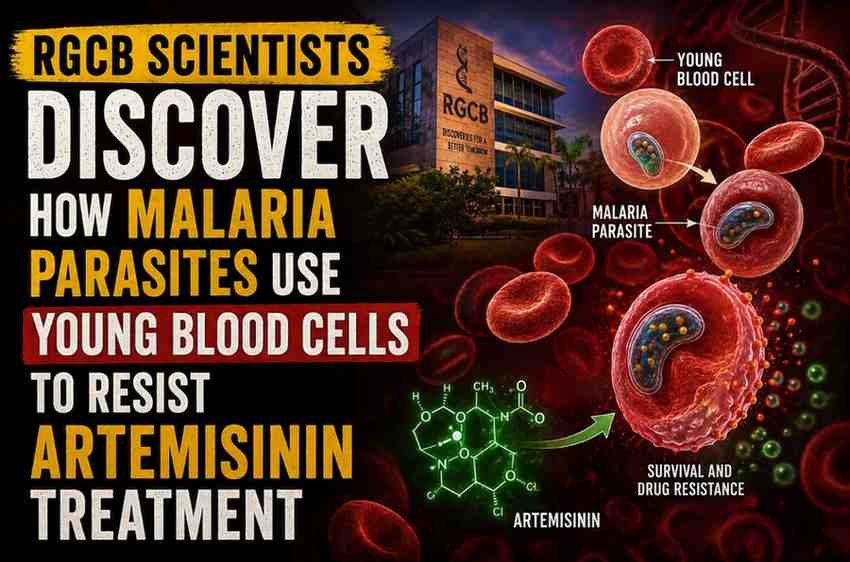
Scientists at the Rajiv Gandhi Centre for Biotechnology (RGCB) have uncovered a previously unknown mechanism that helps Malaria parasites withstand treatment with artemisinin-based drugs, the cornerstone of modern malaria therapy. The findings shed light on how the parasite adapts to hostile conditions inside the human body and could pave the way for new strategies to combat drug resistance.
The study found that when malaria parasites infect reticulocytesimmature red blood cells they gain access to a uniquely protective environment that allows them to grow more rapidly and better tolerate the oxidative stress induced by artemisinin treatment. This discovery adds a crucial piece to the puzzle of why some parasites survive despite exposure to highly effective antimalarial drugs.
At a time when drug resistance threatens decades of progress against malaria, understanding these survival mechanisms has become increasingly important.
Why Artemisinin Resistance Is a Global Concern
Artemisinin-based combination therapies (ACTs) have transformed malaria treatment and saved millions of lives worldwide. These medicines act quickly, reducing parasite levels and preventing severe disease.
However, resistance to artemisinin has emerged as one of the most serious challenges facing malaria elimination efforts.
Drug resistance can result in:
- Delayed parasite clearance.
- Prolonged illness.
- Increased transmission.
- Higher risk of severe complications.
- Greater pressure on healthcare systems.
Understanding exactly how parasites evade treatment is essential for preserving the effectiveness of existing therapies.
What Are Reticulocytes and Why Do They Matter?
Reticulocytes are immature red blood cells produced by the bone marrow before they mature into fully developed erythrocytes. Although they make up only a small proportion of circulating blood cells, they differ from mature red cells in important ways.
These young cells contain:
- Higher metabolic activity.
- Residual cellular machinery.
- Enhanced antioxidant capacity.
- Nutrient-rich environments.
- Greater protection against oxidative stress.
According to the RGCB study, malaria parasites take advantage of these characteristics to improve their survival under drug pressure.
How the Parasite Uses Reticulocytes to Survive
Artemisinin kills parasites partly by generating oxidative stress, which damages essential cellular components. But when parasites infect reticulocytes, they appear to benefit from the cell’s natural protective systems.
The study suggests that this environment enables parasites to:
- Grow more efficiently.
- Reduce oxidative damage.
- Recover faster after drug exposure.
- Enhance survival under treatment.
- Potentially contribute to drug resistance.
This mechanism provides an entirely new perspective on how malaria parasites adapt to hostile conditions.
| Mature Red Blood Cells | Reticulocytes |
|---|---|
| Limited metabolic activity | High metabolic activity |
| Lower antioxidant capacity | Enhanced antioxidant defenses |
| Less supportive environment | Nutrient-rich environment |
| Greater vulnerability to oxidative stress | Improved protection against oxidative damage |
| Standard parasite growth conditions | Faster parasite growth and survival |
An Overlooked Reality: Drug Resistance Is Not Just About Genetic Mutations
Much of the discussion surrounding antimalarial resistance has focused on genetic changes within the parasite itself. While mutations remain critically important, the RGCB findings highlight another factor: the environment in which parasites live.
Drug resistance is not solely determined by genes. The host cell environment can also influence how parasites respond to treatment.
This broader understanding suggests that parasite survival results from a complex interaction between biology, genetics, and the cellular ecosystem.
Why Oxidative Stress Matters in Malaria Treatment
Oxidative stress refers to damage caused by highly reactive molecules generated during normal metabolism or by certain medications.
Artemisinin’s effectiveness partly depends on producing such oxidative damage inside parasites.
If parasites can shield themselves from this stress, they may survive long enough to recover and continue reproducing.
The RGCB study suggests that reticulocytes provide exactly such protection, potentially explaining why some parasites tolerate treatment better than expected.
Implications for Future Antimalarial Drugs
The discovery opens several promising avenues for research.
Scientists may now explore therapies designed to:
- Target parasite metabolism inside reticulocytes.
- Disrupt protective antioxidant pathways.
- Enhance oxidative damage selectively.
- Develop new combination treatments.
- Improve strategies to prevent resistance.
Such approaches could complement existing therapies and prolong the effectiveness of current medicines.
Why This Discovery Matters Beyond India
Malaria remains a global health challenge, particularly in tropical regions where millions remain at risk.
As resistant strains spread across borders, discoveries that reveal new survival mechanisms have international significance.
Understanding how parasites exploit host cells may help researchers worldwide design better diagnostics and therapies.
In the long term, these findings could contribute to more effective malaria elimination programs.
The Bigger Picture: An Evolutionary Arms Race
The struggle between humans and malaria parasites is a constant evolutionary contest. Every new treatment creates pressure on parasites to adapt, while scientific advances seek to stay one step ahead.
The RGCB study demonstrates that parasites employ sophisticated survival strategies extending beyond simple genetic mutations.
This realization underscores the importance of continued investment in research and surveillance.
Conclusion
The discovery by RGCB scientists provides valuable new insights into how malaria parasites survive artemisinin treatment by exploiting the protective environment inside reticulocytes. By revealing a mechanism that helps parasites tolerate oxidative stress, the study broadens our understanding of drug resistance and opens the door to innovative treatment strategies.
As malaria control enters an increasingly challenging era, such discoveries remind us that defeating one of humanity’s oldest diseases will require not only new drugs but also a deeper understanding of the remarkable adaptability of the parasite itself.
For breaking news and live news updates, like us on Facebook or follow us on Twitter and Instagram. Read more on Latest Health on thefoxdaily.com.





COMMENTS 0