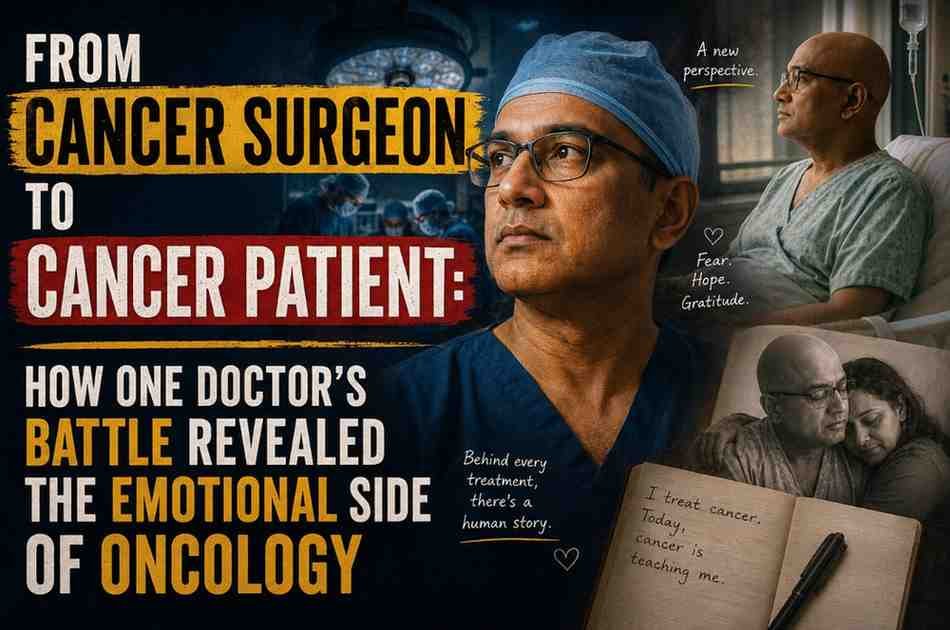
For years, cancer was something seen through the operating table—a disease to diagnose, treat, and fight with scientific precision. Then, unexpectedly, the roles reversed. The doctor who had spent a career removing tumors and guiding patients through frightening diagnoses found himself facing the same words he had delivered countless times before.
The diagnosis itself did not come as a surprise. Experience had already pointed toward the likely outcome. There was no panic, only calm acceptance. But as treatment progressed, emotions that had been neatly compartmentalized as a physician surfaced with unexpected intensity. Moments of resilience alternated with moments of breakdown, and the certainty that medicine often seeks gave way to a simpler philosophy: fight with everything possible and leave the rest to fate.
His story is not merely about cancer. It is about how illness transforms identity, how doctors become patients, and how facing mortality changes one’s understanding of life itself.
When Medical Knowledge Meets Personal Reality
Doctors spend years learning to make difficult decisions while maintaining emotional distance. Clinical training demands objectivity, but becoming a patient dismantles that protective barrier.
Suddenly, familiar terms acquire entirely different meanings.
- Scans become sources of anxiety.
- Waiting rooms become emotionally charged spaces.
- Side effects become personal experiences.
- Treatment statistics become deeply human realities.
- Hope and uncertainty coexist every day.
Many physicians who later become patients describe this transition as humbling, forcing them to confront the same fears and questions they once helped others navigate.
The Emotional Stages Are Rarely Linear
Popular narratives often portray cancer journeys as stories of unwavering courage. Reality is far more complex.
Patients frequently experience:
- Shock and disbelief.
- Periods of calm acceptance.
- Fear and frustration.
- Moments of emotional breakdown.
- Renewed hope and determination.
- Periods of exhaustion and resilience.
Experts emphasize that these emotions are normal and do not reflect weakness. Emotional vulnerability is part of the healing journey.
The Hidden Burden of Being a Doctor-Patient
Physicians diagnosed with serious illnesses often face unique challenges.
Medical knowledge can be both a blessing and a burden.
On one hand, understanding the disease helps with informed decision-making. On the other, knowing every possible complication and outcome can intensify anxiety.
Many doctor-patients struggle with:
- Relinquishing control.
- Accepting help from colleagues.
- Balancing optimism with realism.
- Managing expectations of family and friends.
- Navigating the emotional impact of uncertainty.
For someone accustomed to being the healer, becoming the one in need of healing can be profoundly disorienting.
| Life as a Cancer Surgeon | Life as a Cancer Patient |
|---|---|
| Making treatment decisions | Trusting others to make decisions |
| Providing reassurance | Seeking reassurance |
| Explaining risks to patients | Living with uncertainty personally |
| Remaining professionally composed | Experiencing emotional vulnerability |
| Fighting disease through expertise | Fighting disease through resilience and hope |
An Overlooked Truth: Cancer Changes Time Itself
One of the most profound changes cancer patients describe is their relationship with time.
Before illness, life often revolves around long-term plans, ambitions, and schedules. A diagnosis can narrow focus dramatically, shifting attention to the present moment.
Simple experiences begin to carry greater meaning:
- Conversations with loved ones.
- Ordinary routines.
- A symptom-free day.
- Moments of laughter.
- Small victories during treatment.
Many survivors and patients say cancer teaches them to value the ordinary in ways they never imagined.
Breaking Down Is Part of Fighting Back
Society often celebrates strength and positivity in cancer narratives. But oncologists and psychologists increasingly stress that resilience does not mean suppressing emotions.
Crying, feeling overwhelmed, and acknowledging fear are not signs of defeat.
Research shows that emotional expression can help patients:
- Reduce stress.
- Improve coping mechanisms.
- Strengthen support systems.
- Process uncertainty more effectively.
- Maintain psychological well-being.
Resilience is not the absence of pain—it is the ability to continue despite it.
How Serious Illness Changes a Doctor’s Perspective
Many physicians who experience illness firsthand later describe becoming more empathetic clinicians.
They gain deeper appreciation for:
- The anxiety patients feel while awaiting test results.
- The impact of side effects on daily life.
- The importance of communication and compassion.
- The emotional burden carried by families.
- The value of listening beyond symptoms.
Such experiences often reinforce the understanding that medicine is as much about humanity as it is about science.
The Meaning Behind “Que Sera Sera”
The phrase “Que sera sera”—whatever will be, will be—does not imply surrender. Rather, it reflects acceptance of life’s uncertainties.
Modern medicine can offer treatments, extend survival, and improve quality of life, but it cannot eliminate uncertainty.
Many patients discover peace not by controlling every outcome, but by focusing on what remains within their power:
- Adhering to treatment.
- Maintaining hope.
- Seeking support.
- Living meaningfully.
- Fighting with dignity.
Why Stories Like These Matter
Personal experiences bridge the gap between statistics and humanity. They remind society that behind every diagnosis lies a person navigating fear, hope, relationships, and dreams.
Such stories also challenge the misconception that cancer journeys are solely medical battles. They are emotional, psychological, social, and deeply personal experiences.
Most importantly, they demonstrate that vulnerability and courage are not opposites—they often coexist.
Conclusion
For a surgeon who spent years operating on cancer patients, becoming a patient himself brought unexpected lessons about uncertainty, resilience, and the value of living in the present. The calm acceptance that accompanied diagnosis eventually gave way to moments of pain and emotional breakdown, but also to a renewed appreciation for life itself.
In the end, perhaps the greatest lesson cancer teaches is not about mortality, but about humanity—that while medicine can fight disease, it is hope, love, and the ability to embrace each day that sustain the spirit. And beyond that, as the saying goes, que sera sera.
For breaking news and live news updates, like us on Facebook or follow us on Twitter and Instagram. Read more on Latest Health on thefoxdaily.com.






COMMENTS 0