- The Overlooked Link Between Smoking and Depression
- Does Quitting Smoking Really Help Mental Health?
- Why Smoking Feels Helpful (But Isn’t)
- The Hardest Part: The First Few Weeks
- What Actually Improves After You Quit
- Getting Help When Things Feel Too Heavy
- Tools That Make Quitting Easier
- The Bigger Picture: Mental Health Beyond Habits
- What Most Articles Don’t Tell You
- Conclusion: A Difficult Step That Changes More Than You Expect
Who: People dealing with depression, stress, or emotional burnout especially those who smoke or are trying to quit.
What: The connection between smoking, Mental Health, and how quitting can lead to long-term emotional improvement.
When: At any stage whether you’re thinking about quitting or already struggling with both habits and mental health.
Where: Across everyday life at home, work, and social environments where habits and stress overlap.
Why: Because smoking often feels like relief but quietly worsens mental health over time.
How: By understanding the science behind nicotine, mood, and behavior and using the right support systems to quit.
The Overlooked Link Between Smoking and Depression
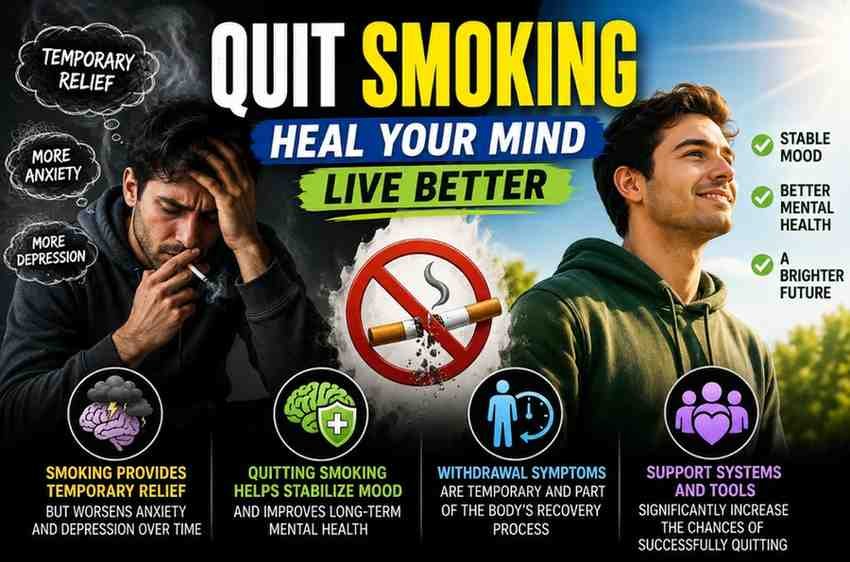
For many people, smoking feels like a coping mechanism. A cigarette during stress, after a long day, or in moments of anxiety can feel like a quick escape. But here’s the uncomfortable truth: what feels like relief is often part of the problem.
Nicotine works fast. It temporarily boosts certain brain chemicals, creating a short lived sense of calm or focus. But that effect fades quickly, leaving the brain craving more. Over time, this cycle can actually increase anxiety, irritability, and emotional instability.
That’s why many people feel stuck smoking to feel better, but slowly feeling worse overall.
Does Quitting Smoking Really Help Mental Health?
Yes and this is where things get interesting.
Research consistently shows that people who quit smoking often experience improvements in mood, reduced anxiety, and better overall mental health over time. While the first few days or weeks can feel difficult, the long-term impact tends to move in a positive direction.
In simple terms, quitting removes the constant cycle of nicotine highs and crashes. This allows the brain to gradually stabilize, leading to more consistent emotional balance.
Insight: Many people expect quitting to make them feel worse forever. In reality, the discomfort is temporary—the mental clarity and stability that follow are long-lasting.
Why Smoking Feels Helpful (But Isn’t)
It’s easy to believe that smoking helps manage stress or depression. After all, it seems to “work” in the moment. But what’s actually happening is more complex.
- Nicotine reduces withdrawal symptoms, not the original stress
- It creates a temporary dopamine boost, followed by a drop
- It reinforces a dependency loop rather than solving the problem
Over time, this loop can make emotional lows feel deeper and more frequent.
| Short Term Effect | Long Term Impact |
|---|---|
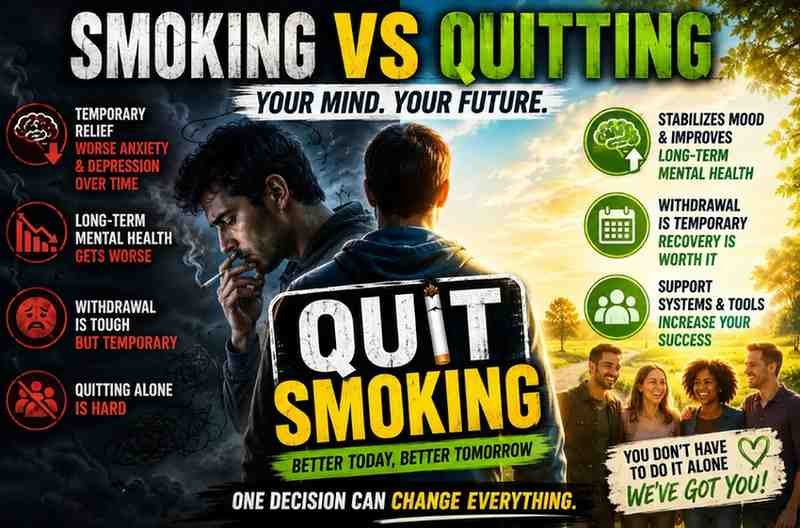
| Temporary calm or relief | Increased anxiety over time |
| Improved focus for a short period | Dependence on nicotine for concentration |
| Reduced withdrawal discomfort | Stronger addiction cycle |
The Hardest Part: The First Few Weeks
Let’s be honest the beginning of quitting is not easy.
People often experience irritability, mood swings, restlessness, or trouble sleeping. This isn’t because life is getting worse it’s because the body is adjusting after being used to nicotine.
The key thing to remember is that this phase is temporary. Most withdrawal symptoms peak within the first couple of weeks and gradually fade.
Real world insight: The discomfort of quitting is often mistaken as proof that smoking was helping. In reality, it’s just the body resetting.
What Actually Improves After You Quit
Once the initial adjustment period passes, many people start noticing subtle but meaningful changes.
- More stable mood throughout the day
- Reduced baseline anxiety
- Better sleep quality
- Improved concentration without dependency
- Greater sense of control over habits
These changes don’t happen overnight but they build over time, often in ways people don’t expect.
Getting Help When Things Feel Too Heavy
There are moments when depression or emotional distress can feel overwhelming especially during major changes like quitting smoking.
In those moments, the most important thing to remember is this: you are not meant to handle everything alone.
Reaching out whether to a professional or someone you trust can help you feel supported and grounded.
- Speak with a doctor, therapist, or counselor
- Reach out to a close friend or family member
- Visit a nearby hospital or healthcare provider if needed
- Talk to someone you trust in your community
Simple truth: Asking for help is not a sign of weakness it’s a practical step toward feeling better.
Tools That Make Quitting Easier
Quitting smoking isn’t just about willpower. In fact, the most successful attempts usually involve support systems.
Today, there are more tools than ever to help people quit:
- Telephone-based quitlines that provide guidance and encouragement
- Text programs that send daily reminders and tips
- Mobile apps that track progress and reduce cravings
- Online platforms with community support
These tools help break the isolation many people feel during the process.
Comparison insight: People who rely only on willpower often struggle more than those who combine effort with support systems.
The Bigger Picture: Mental Health Beyond Habits
Quitting smoking is not just about removing a habit it’s about creating space for better mental health.
When the brain is no longer cycling through nicotine highs and crashes, it becomes easier to build healthier coping strategies. Things like movement, better sleep, structured routines, and social connection start to have a stronger impact.
This shift is subtle but powerful. It’s not just about quitting something it’s about gaining stability.
What Most Articles Don’t Tell You
Here’s something often overlooked: quitting smoking doesn’t automatically fix everything.
But it removes a major barrier that can make mental health harder to manage.
Think of it this way if your emotional system is constantly being disrupted by nicotine cycles, even the best coping strategies struggle to work effectively. Once that cycle is gone, those same strategies become more effective.
Unique insight: Quitting is less about instant transformation and more about creating the right conditions for improvement.
Conclusion: A Difficult Step That Changes More Than You Expect
Depression and smoking are deeply connected in ways that aren’t always obvious.
While smoking can feel like temporary relief, it often adds to the long-term emotional burden. Quitting, on the other hand, may feel uncomfortable at first but it opens the door to more stable and lasting mental health.
Future outlook: As awareness grows, more people are beginning to understand that mental health isn’t just about thoughts it’s also about habits, biology, and daily patterns.
If you’re considering quitting, you don’t need to have everything figured out. Even small steps combined with the right support can lead to meaningful change over time.
And sometimes, that one decision can quietly improve more areas of your life than you expected.
]
For breaking news and live news updates, like us on Facebook or follow us on Twitter and Instagram. Read more on Latest Health on thefoxdaily.com.






COMMENTS 0