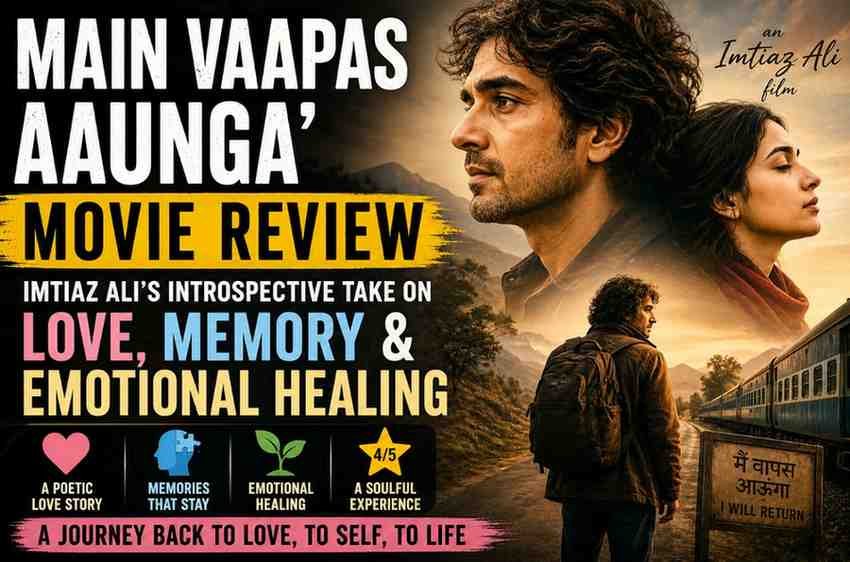
With ‘Main Vaapas Aaunga’, filmmaker Imtiaz Ali returns to familiar emotional terrain—love that is not loud or linear, but fragmented, reflective, and deeply human. Anchored by the commanding presence of Naseeruddin Shah, the film unfolds less like a conventional love story and more like an emotional memory that refuses to fade.
Rather than relying on dramatic twists or formulaic romance beats, the film leans into silence, subtext, and emotional restraint. The result is a cinematic experience that feels less like storytelling and more like reliving something you cannot fully explain but cannot forget either.
A Love Story Told Through Absence and Memory
At its core, ‘Main Vaapas Aaunga’ is not just about love found or lost—it is about love remembered.
Imtiaz Ali structures the narrative in a non-linear emotional rhythm, where moments from the past and present bleed into each other. Instead of asking what happens next, the film asks what remains after people leave each other’s lives.
The story unfolds through fragmented encounters, emotional echoes, and symbolic repetitions that suggest memory itself is a character in the film.
Naseeruddin Shah: The Emotional Anchor
The film is firmly held together by Naseeruddin Shah, whose performance adds gravity and lived-in authenticity to every frame he appears in.
Rather than performing emotion, Shah embodies it with restraint. His character becomes a vessel of regret, acceptance, and unspoken longing—qualities that align perfectly with the film’s meditative tone.
His presence ensures that even when the narrative drifts into abstraction, it never loses emotional grounding.
Imtiaz Ali’s Signature Style: Love as Inner Geography
Imtiaz Ali has long been known for portraying love as an internal journey rather than a destination. From earlier works that explored longing, identity, and emotional displacement, this film feels like a continuation of that thematic exploration only more restrained and introspective.
In ‘Main Vaapas Aaunga’, love is not celebrated as triumph but examined as transformation. Characters do not simply fall in or out of love; they evolve through it, often without closure.
Why the Film Feels Like a “Collective Ache”
One of the most striking aspects of the film is its emotional universality. It does not rely on specific plot mechanics to evoke feeling, but instead taps into shared human experiences—loss, regret, and the desire to reconnect with what is gone.
This is where the film resonates beyond its immediate story. It becomes less about two individuals and more about anyone who has ever tried to make sense of a relationship that ended without resolution.
The phrase “collective ache” is not accidental—it reflects how the film positions emotional pain as something communal rather than isolated.
Comparison: Conventional Romance vs Imtiaz Ali’s Narrative Approach
| Conventional Romance Films | ‘Main Vaapas Aaunga’ Approach |
|---|---|
| Linear love story arc | Non-linear emotional storytelling |
| Clear resolution or closure | Ambiguous emotional endings |
| External conflict-driven | Internal emotional conflict-driven |
| Dialogue-heavy expression of love | Silence and subtext as narrative tools |
| Romance as destination | Romance as memory and transformation |
Cinematography and Tone: Minimalism as Emotion
The film’s visual language supports its emotional restraint. Instead of visual spectacle, it relies on stillness, framing, and negative space to communicate meaning.
Muted tones, lingering shots, and carefully composed silence create an atmosphere where emotions feel suspended rather than expressed outright.
This minimalist approach allows viewers to project their own experiences onto the narrative, making it deeply personal and interpretive.
An Insight Competitors Often Miss: The Film Reflects a Modern Emotional Crisis
Beyond its romantic narrative, ‘Main Vaapas Aaunga’ subtly reflects a broader cultural condition: emotional fragmentation in contemporary life.
In an age of constant connectivity, relationships often remain incomplete, paused, or unresolved. The film mirrors this reality by refusing neat endings and instead embracing emotional ambiguity.
This makes it less of a traditional love story and more of a commentary on how modern relationships are experienced—intensely, briefly, and often imperfectly remembered.
The Role of Healing in the Narrative
Healing is not presented as a destination in the film but as an ongoing process.
Characters do not “recover” from love; they learn to coexist with its absence. This nuanced portrayal avoids clichés of emotional closure and instead emphasizes acceptance.
In this sense, the film aligns more with psychological realism than romantic fantasy.
Emotional Soundscape: Music as Memory
The soundtrack plays a subtle but crucial role in reinforcing the film’s emotional architecture.
Rather than dominating scenes, the music functions like memory fragments appearing, fading, and reappearing at unexpected moments.
This reinforces the idea that emotions, like music, are cyclical and often triggered by sensory recall rather than conscious thought.
Prediction: A Shift Toward Introspective Romance in Indian Cinema
Films like ‘Main Vaapas Aaunga’ point toward a growing appetite for introspective storytelling in mainstream cinema.
Future romantic narratives may increasingly focus on:
- Emotional psychology rather than plot resolution.
- Memory-driven storytelling structures.
- Ambiguous endings that reflect real-life relationships.
- Minimalist cinematic expression.
This shift suggests a maturing audience that is willing to engage with emotional complexity rather than formulaic romance arcs.
Conclusion
‘Main Vaapas Aaunga’ is less a conventional love story and more an emotional experience shaped by memory, silence, and introspection. Anchored by Naseeruddin Shah’s restrained yet powerful performance, Imtiaz Ali crafts a narrative that lingers long after it ends.
The film does not offer easy answers or neat conclusions. Instead, it reflects the complexity of human relationships—how they begin, how they fracture, and how they continue to exist in memory.
Ultimately, it is a film about return not to a person, but to an emotion you thought you had left behind.
For breaking news and live news updates, like us on Facebook or follow us on Twitter and Instagram. Read more on Latest Health on thefoxdaily.com.






COMMENTS 0