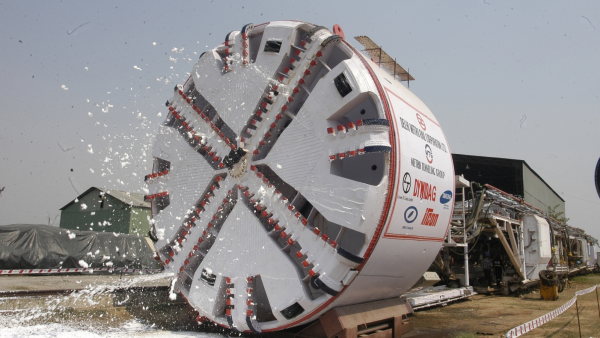
China has introduced new export controls on tunnel boring machines (TBMs), a key category of heavy equipment used to construct underground railways, road tunnels and other major infrastructure. The move could have implications for India, where TBMs are essential to several large-scale projects, including metro expansions and the Mumbai-Ahmedabad High-Speed Rail Corridor.
The restrictions come after previous disruptions in the supply of TBMs to India and amid wider trade tensions between New Delhi and Beijing. Under the new rules announced by China’s Ministry of Commerce on October 19, exporters will need to obtain licences in accordance with the country’s export-control laws and regulations governing dual-use items. The measures are scheduled to take effect on November 18, 2026.
Although the announcement does not automatically mean that all TBM exports to India will stop, the licensing mechanism gives Chinese authorities greater oversight of shipments. Its practical impact will depend on how the rules are implemented, which machines and related technologies are covered, and whether exporters can obtain the necessary approvals without significant delays.
What are tunnel boring machines, and why does India need them?
Tunnel boring machines are specialised engineering systems designed to excavate tunnels through soil, rock and other underground formations. Depending on the terrain and project requirements, they can cut through the ground while supporting the surrounding tunnel face and facilitating the installation of tunnel linings.
Some of these machines weigh around 3,000 tonnes and are built for specific geological conditions. Their size, technical complexity and specialised components make them difficult to replace quickly when a delivery is delayed.
TBMs are particularly important for underground metro projects, railway corridors and road tunnels, where conventional excavation methods may be less suitable. By enabling controlled excavation and supporting the tunnel as work progresses, they can help improve safety and construction efficiency compared with methods such as conventional blasting in appropriate settings.
For India, which is expanding its urban transport networks and investing in high-speed rail infrastructure, access to these machines is a practical requirement. A disruption in their supply can affect the sequencing of construction work, especially where a project depends on a specific machine designed for a particular tunnel section.
Why the Mumbai-Ahmedabad bullet train project matters
One of the most significant Indian infrastructure projects associated with TBMs is the 508-kilometre Mumbai-Ahmedabad High-Speed Rail Corridor, India’s first Bullet Train project.
The corridor includes a roughly 7-kilometre undersea tunnel, making specialised tunnelling equipment particularly important. Excavation beneath densely populated areas and through challenging geological conditions requires careful planning, precise engineering and suitable safety measures.
TBMs can help support controlled excavation in such environments, reducing reliance on methods that may be less appropriate for specific underground conditions. The equipment must, however, be selected according to the ground, tunnel design and technical requirements of each section.
Delays in the delivery of a machine can affect more than the excavation schedule. Tunnel construction involves interconnected activities, including preparatory work, equipment installation, excavation, lining and the construction of supporting infrastructure. When a key machine is unavailable, contractors may have limited scope to advance the affected section as planned.
China’s new export controls therefore raise questions about the reliability of equipment supply for major Indian infrastructure projects. The restrictions do not establish that the bullet train project will necessarily be delayed, but they add a regulatory factor that project planners and equipment suppliers may need to account for.
India has faced TBM import delays since 2024
The latest restrictions are significant partly because India has already experienced difficulties in obtaining tunnel boring machines routed through China. In 2024, concerns emerged over delayed deliveries of machines intended for Indian infrastructure projects.
During an interaction with Germany’s then Vice Chancellor Robert Habeck while travelling on a Delhi Metro train in 2024, Commerce Minister Piyush Goyal raised the issue of delayed TBM shipments. He explained that machines intended for India were being manufactured in China by German engineering company Herrenknecht, a major supplier of tunnelling equipment, but their delivery was being held up.
Herrenknecht told The Indian Express at the time that it had encountered what it described as “extraordinary circumstances” in customs-clearance processes for machines being shipped from China to India. The company said these difficulties had prevented it from meeting its delivery obligations for several months.
India subsequently received the delayed TBMs in March 2026, as tensions between the two countries had begun to ease somewhat. The episode nevertheless demonstrated how a disruption in one part of an international manufacturing and logistics network can affect infrastructure projects in another country.
The case also highlights an important distinction: a machine may be designed and supplied by a German company but still depend on manufacturing facilities, components or shipping arrangements connected to China. Restrictions affecting those stages can disrupt delivery even when the buyer’s commercial relationship is with a company headquartered elsewhere.
What China’s new export-control rules mean
China’s announcement introduces a formal licensing requirement for exports of tunnel boring machines under the country’s export-control framework. The rules are linked to controls on dual-use items, which are products, equipment or technologies that may have both civilian and potential military or security applications.
The new mechanism gives Chinese authorities a way to assess and regulate covered exports before they leave the country. The announcement is not, by itself, proof of a blanket ban on every TBM shipment to India or other destinations.
For Indian buyers and contractors, the immediate concern is whether the new process will add uncertainty to delivery schedules. If licence applications take longer than expected, equipment shipments could be delayed even when a commercial contract has already been signed.
That uncertainty matters because TBMs are highly specialised and are often manufactured or configured for individual projects. Replacing one machine with another supplier’s equipment may require changes in technical specifications, additional engineering assessments and new procurement arrangements.
Project developers may therefore need to account for possible approval delays when planning future orders. Suppliers, meanwhile, may have to review manufacturing locations, export routes and documentation requirements to determine how the new controls affect individual deliveries.
The precise consequences for India will depend on the scope of the rules, the licensing decisions made by Chinese authorities and the extent to which Indian projects rely on equipment or components covered by the restrictions.
How China could gain leverage through licensing
Export licensing gives a government greater control over the movement of strategically important equipment. Depending on how the mechanism is administered, it can influence the timing and conditions under which companies are permitted to ship covered products abroad.
For China, the new controls could increase its influence over an important segment of the global construction-equipment supply chain. However, the existence of a licensing requirement does not automatically establish that Beijing intends to use it against India or that every application will face restrictions.
For India, the main concern is the possibility that administrative decisions could affect the availability of equipment needed for major infrastructure projects. Even temporary uncertainty can complicate construction planning when a project relies on a limited number of specialised machines.
The restrictions also highlight the difference between commercial dependence and strategic vulnerability. Buying equipment from a foreign supplier is not necessarily a problem when deliveries are reliable and alternatives are available. The risk increases when a project depends on a narrow group of suppliers, specialised production facilities or routes that can be affected by political or regulatory decisions.
India’s experience with delayed TBM deliveries in 2024 makes the latest announcement particularly relevant. It suggests that project planners may need to consider not only the supplier’s identity but also where equipment is manufactured, how it is shipped and which export rules apply along the supply chain.
India-China relations: Efforts to rebuild ties continue
The new restrictions arrive at a time when India and China are attempting to manage their strained relationship while continuing economic engagement. Commerce Minister Piyush Goyal recently said India was working to develop the relationship with China again, while acknowledging that the outcome of the process remained uncertain.
His remarks reflect the challenge of balancing commercial cooperation with concerns over market access, supply-chain security and the wider bilateral relationship. India and China remain important trading partners, but their economic ties are also marked by disagreements over the conditions under which businesses can operate and sell goods in each other’s markets.
For India, the TBM issue is one example of how a dispute or regulatory change can affect sectors that might otherwise appear primarily commercial. Infrastructure equipment is directly connected to the delivery of public projects, including urban transport systems and major rail corridors.
The broader policy challenge is to maintain workable economic relations while reducing the risk that essential projects become vulnerable to disruptions beyond India’s control.
India’s growing trade deficit with China adds to concerns
India’s concerns over supply-chain dependence are compounded by its widening trade imbalance with China. The country’s trade deficit with China reached $69 billion in the first six months of the 2026-27 financial year, according to figures cited in recent reporting. That was 27% higher than in the corresponding period of the previous financial year.
A trade deficit occurs when the value of imports from a trading partner exceeds the value of exports to that country. A persistent imbalance can become a policy concern when it coincides with difficulties in gaining market access for domestic producers or heavy reliance on imported goods in strategically important sectors.
Finance Minister Nirmala Sitharaman has raised concerns about the scale of India’s trade imbalance with China, including the barriers Indian exporters face when seeking access to the Chinese market. Jaishankar has also highlighted the wider economic concerns associated with the relationship.
The growing deficit does not mean that all imports from China are economically undesirable. Imported machinery, components and industrial products can support domestic manufacturing and infrastructure development. The policy question is whether India can obtain reliable supplies while expanding its own industrial capabilities and export opportunities.
In the case of tunnel boring machines, the challenge is especially clear: India needs sophisticated equipment to build infrastructure, but delays or restrictions affecting imports can complicate project execution. Developing domestic capacity could help reduce this exposure over time, although manufacturing advanced TBMs requires substantial investment, engineering expertise and a dependable supplier ecosystem.
India is opening selected sectors to Chinese investment while tightening trade scrutiny
India’s approach to economic engagement with China combines selective openness with greater scrutiny of imports. The country has been opening certain strategic areas, including parts of the power sector, to Chinese investment while also using trade-remedy measures to address concerns about imported products.
Anti-dumping investigations examine whether imported goods are being sold at unfairly low prices and whether those imports are causing injury to domestic producers. Countervailing investigations, meanwhile, examine whether subsidies provided by another government are harming domestic industries.
According to the Swiss think tank Global Trade Alert, India initiated 18 anti-dumping and anti-subsidy investigations during the July-September quarter cited in the source report, more than any other country in that period. China was the single largest target.
These measures form part of a wider effort to address trade concerns and protect domestic producers where evidence supports intervention. They also demonstrate that India’s relationship with Chinese suppliers is not governed by a single policy of either openness or restriction; different sectors are subject to different commercial and strategic considerations.
For infrastructure equipment, the latest TBM controls could add urgency to discussions about domestic manufacturing, supplier diversification and the resilience of procurement arrangements. Any policy response, however, would need to account for the technical complexity of the machinery and the time required to build competitive production capabilities.
China’s trade surplus and growing tensions with major economies
China’s new export controls come amid wider trade tensions involving some of the world’s largest economies. Beijing has been engaged in high-level trade discussions with the United States and the European Union, both of which have raised concerns about the effects of Chinese exports on their domestic industries.
The United States and China have entered a temporary trade truce, while the European Union has pursued measures affecting Chinese-made electric vehicles and batteries and sought to protect its steel industry. These disputes reflect wider disagreements over market access, industrial competition and the role of government support in manufacturing.
China’s goods trade surplus reached approximately $1.2 trillion in 2025, according to the figures cited in the source material. The country’s large export base has become a major factor in global trade discussions, particularly as other economies assess how increased Chinese market share affects their own manufacturers and exporters.
A report by the Rhodium Group cited in the source material argued that countries with large trading economies and export profiles similar to China’s could face some of the greatest competitive pressures as China’s share of global trade grows.
The report estimated that by 2030, the United States could lose 1.2 percentage points of its share of global trade, Indonesia 0.8 percentage points, Canada 0.5 percentage points, Germany 0.4 percentage points and the Netherlands 0.4 percentage points. It projected that the rest of the world combined could lose 4.6 percentage points, broadly corresponding to China’s estimated gain of around eight percentage points.
These figures are projections rather than confirmed future outcomes. They nevertheless illustrate the concerns that China’s expanding export share could intensify competition for manufacturers and exporters in other economies.
Within this broader environment, export controls on specialised machinery are significant because they affect not only the movement of finished goods but also the availability of industrial capabilities that other countries need for infrastructure development.
What the restrictions could mean for India’s infrastructure plans
The immediate impact of China’s new controls on India will depend on the machinery covered, the licensing process and the extent of India’s reliance on affected supply chains. It would be premature to conclude that all metro, highway or high-speed rail projects will face delays as a direct result of the announcement.
Nevertheless, the rules create several practical issues for infrastructure developers. Buyers may need to allow more time for approvals, confirm whether existing orders are affected and examine whether alternative suppliers can meet the required technical specifications.
Contractors may also need to reassess procurement schedules to avoid a situation in which civil works are ready to proceed but the required tunnelling equipment has not arrived. Where a project depends on a machine designed for a particular geological setting, switching suppliers may not be straightforward.
Over the longer term, the restrictions could strengthen the case for diversifying equipment sources and developing domestic manufacturing capabilities. India could explore a wider range of international suppliers while supporting the engineering expertise and industrial infrastructure required to produce advanced tunnelling machinery locally.
Such a transition would take time. TBMs are complex systems that require specialised components, precision manufacturing, software and control technologies, and extensive testing. Domestic production would need to meet stringent safety and performance requirements while remaining commercially viable.
Can India reduce its dependence on imported TBMs?
Reducing dependence on a narrow group of foreign suppliers could make India’s infrastructure programme more resilient to export controls, customs delays and geopolitical disruptions. However, the objective is not simply to replace imported machines immediately but to build a dependable supply base capable of meeting the demands of large and technically challenging projects.
In the near term, procurement diversification and better visibility into manufacturing and shipping routes may offer practical ways to manage risk. Project authorities and contractors can assess supplier capacity, delivery commitments and the regulatory requirements that apply to equipment produced or transported through different countries.
Over time, investment in domestic engineering, manufacturing and component production could help India develop a stronger position in the tunnelling-equipment market. Partnerships with experienced international manufacturers may also offer a route to building technical expertise, provided they support sustainable local capabilities.
Any such strategy would need to balance reliability, cost, technical performance and delivery schedules. Domestic manufacturing cannot eliminate every supply-chain risk, but a broader set of suppliers and stronger local capabilities could reduce the consequences of disruption in any one country.
What happens next?
China’s export controls on tunnel boring machines are scheduled to take effect on November 18, 2026. The key question for India is how the licensing mechanism will operate in practice and whether it affects shipments needed for ongoing or planned infrastructure projects.
India’s earlier experience with TBM delivery delays shows why the implementation of the rules will matter as much as the announcement itself. Infrastructure agencies and contractors will need to understand the requirements for affected equipment and assess whether procurement plans need to be adjusted.
The restrictions also reinforce a wider lesson for India’s infrastructure expansion: access to specialised machinery is an important part of project readiness, alongside funding, land acquisition, engineering and construction. Disruptions in the supply of critical equipment can have consequences well beyond the shipment itself.
For now, the new controls do not establish that every Indian project using TBMs will be affected. Their significance lies in the additional uncertainty they introduce into an already complex supply chain and in the renewed focus they place on equipment diversification, domestic manufacturing and the management of strategic trade risks.
For breaking news and live news updates, like us on Facebook or follow us on Twitter and Instagram. Read more on Latest India on thefoxdaily.com.


COMMENTS 0