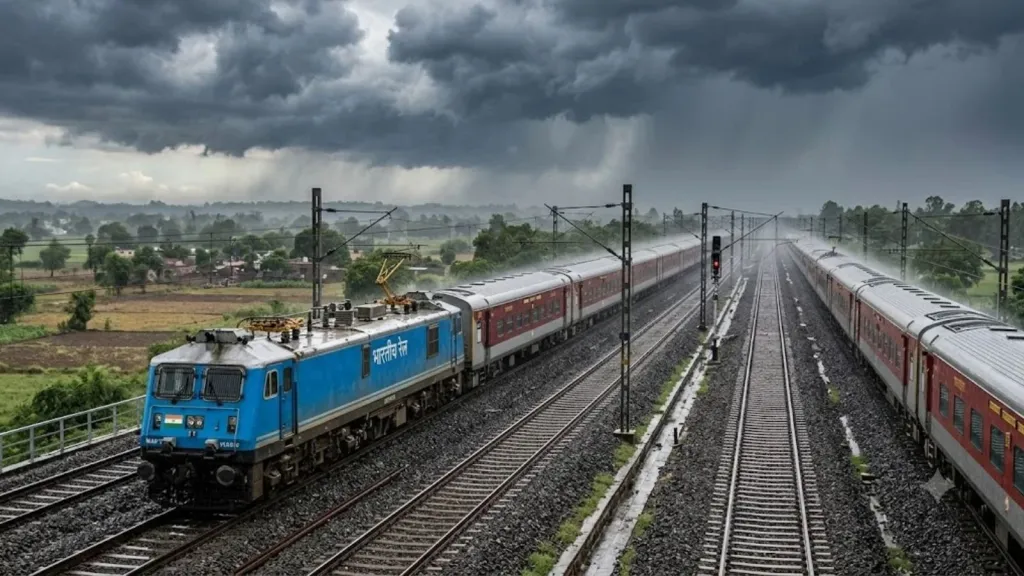
Indian Railways has issued a travel advisory as Cyclone Arnab approaches the north Andhra Pradesh coast, warning passengers that adverse weather conditions could disrupt train services across parts of southern and eastern India. The advisory urges travellers to check their train status before leaving for the station and monitor official announcements for changes to scheduled journeys.
According to the India Meteorological Department (IMD), the cyclone was located approximately 260 km southeast of Visakhapatnam, 300 km east-southeast of Kakinada and 460 km east of Bapatla. The weather system was expected to make landfall along the north Andhra Pradesh coast on Wednesday forenoon.
The anticipated impact extends beyond the coastline. Heavy rainfall warnings have been issued for several districts in Telangana, including areas where water accumulation and adverse weather could affect railway operations. South Central Railway (SCR) has warned that trains operating through vulnerable sections may be cancelled, diverted or rescheduled depending on the situation.
For passengers travelling during the cyclone alert, the main priority is to confirm whether their train is operating as scheduled. Travellers should also monitor SMS notifications, consult official railway platforms and contact railway authorities if they need clarification about their journey.
Cyclone Arnab Latest Update: Weather Alert and Possible Railway Disruptions
The approaching cyclone has prompted railway authorities to review safety arrangements and prepare for potential disruptions. When severe weather affects railway routes, operational decisions may need to be adjusted according to conditions along the track, bridges and other vulnerable infrastructure.
South Central Railway said the cyclone could affect areas in Telangana, Andhra Pradesh, Odisha and other regions. Depending on the developing weather situation, train operations may be modified to protect passengers and support the safe movement of trains.
The railway zone indicated that several trains passing through the affected direction and sections were expected to be cancelled or diverted. The final operational decisions may depend on local conditions, making it important for passengers to check the latest information rather than rely solely on their original timetable.
Districts under heavy rainfall warnings
The supplied weather update identifies five districts in Telangana under a red alert for October 28: Khammam, Bhadradri Kothagudem, Mulugu and Mahabubabad, with the source listing the first two names separately as Khammam and Bhadradri, Kothagudem.
Heavy rainfall was also expected over Warangal, Hanumakonda, Suryapet and Nalgonda on October 28 and 29. These warnings are relevant to travellers because weather-related disruptions can affect more than the immediate landfall area, particularly when railway routes pass through regions experiencing heavy rain.
However, a weather warning for a district does not automatically mean every train serving that area will be cancelled. Passengers need to check the status of their specific train and station before departure.
South Central Railway Reviews Cyclone Preparedness
South Central Railway has begun reviewing operational and safety arrangements ahead of the expected impact of Cyclone Arnab. The preparations focus on vulnerable railway sections, bridges, emergency response equipment and the availability of materials that may be needed if heavy rain affects railway infrastructure.
On Tuesday, Sanjay Kumar Srivastava, General Manager of South Central Railway, reviewed the preparations with Dr. R. Gopalakrishnan, Divisional Railway Manager of the Secunderabad Division, and other senior railway officials.
The review covered several important areas of railway safety and emergency preparedness.
Inspection of vulnerable railway sections and bridges
Railway officials reviewed vulnerable sections and bridges that may require additional monitoring during adverse weather. Such inspections are important because railway operations depend on track conditions and the safety of the infrastructure used by passenger and freight trains.
Officials also examined patrolling arrangements and the deployment of patrolmen and watchmen in vulnerable areas. These personnel form part of the railway’s monitoring arrangements during periods when weather conditions could create operational risks.
For passengers, these precautions underline why railway services may be modified at short notice. Safety assessments along a route can influence whether a train operates as scheduled, follows an alternative route or is temporarily suspended.
Monitoring water levels and preparing emergency materials
The preparedness review also covered water levels in tanks and the readiness of materials that could be required during weather-related emergencies.
South Central Railway reviewed the readiness of boulder, sandbag and ballast rakes. These resources may be required for railway maintenance and protective work, depending on the nature of any damage or operational problem.
Officials also checked the readiness of Accident Relief Trains (ARTs) and Accident Relief Medical Equipment (ARMEs) stationed at Kazipet and Dornakal. These resources are part of the railway’s emergency response arrangements.
Although the review demonstrates that preparations are underway, it does not establish that any particular railway line has been damaged or that a specific train has been cancelled. Passengers should distinguish between precautionary measures and confirmed service disruptions.
Cyclone Arnab Travel Advisory: Five Important Instructions for Train Passengers
South Central Railway has advised passengers to take precautions when planning journeys during the cyclone alert. The following steps can help travellers obtain reliable information and reduce the risk of unnecessary delays.
1. Plan your journey according to weather conditions
Passengers should consider the prevailing weather conditions before beginning their journey. Heavy rainfall and cyclonic weather may affect railway operations, so travellers should avoid assuming that a train will run according to its original timetable.
Anyone travelling through affected parts of Andhra Pradesh, Telangana, Odisha or other potentially impacted regions should pay particular attention to official announcements about their route.
Checking the train’s operating status before leaving home can help passengers avoid reaching a station unnecessarily if services have been suspended, diverted or rescheduled.
2. Check SMS notifications for changes to train services
Passengers with reserved tickets should monitor the mobile numbers provided during booking for SMS notifications from the railway authorities.
These messages may communicate changes involving train cancellations, diversions or rescheduling. Such notifications can be particularly useful when operational decisions change in response to weather conditions.
Travellers should ensure they can access the mobile number associated with their reservation. If they receive a notification, they should read the details carefully and confirm that the message relates to their train and journey.
3. Verify train status before leaving for the station
Passengers can check train running information through official railway platforms, including IRCTC, RailOne and the National Train Enquiry System (NTES). The railway enquiry helpline, 139, is another option for obtaining train-related information.
Checking the status of a specific train is more useful than relying on general reports about the cyclone. Weather conditions may differ between locations, and service decisions can vary by train and railway section.
Travellers should verify their train’s current status as close to departure as practical. A train that was scheduled to operate earlier may subsequently be affected by an updated operational decision.
4. Follow official railway announcements and social media updates
South Central Railway has advised passengers to use official railway websites and social media channels for information about service changes.
Updates may cover full cancellations, partial cancellations, diversions and rescheduling. These distinctions matter because a disruption does not necessarily affect every part of a train’s journey in the same way.
Passengers should rely on official announcements rather than unverified messages circulating on social media. When a report does not clearly identify the affected train or route, checking the railway’s official channels can help clarify the situation.
5. Contact the nearest railway station for assistance
Passengers who remain uncertain about their travel plans can contact officials at their nearest railway station. This is especially useful when they need clarification about a particular train or a service change affecting their intended route.
Travellers should have their train number, journey date and relevant reservation details available when making an enquiry. Providing this information can help railway personnel understand the specific service about which the passenger is asking.
Those already at a station should pay attention to announcements and instructions issued by railway staff, particularly if operational arrangements change while they are waiting to board.
What Train Cancellations, Diversions and Rescheduling Mean for Travellers
The South Central Railway advisory identifies three types of potential disruption: cancellations, diversions and rescheduling. Although these terms are often mentioned together, they describe different changes that can affect passengers.
Train cancellation
A cancellation means that the affected train service will not operate as scheduled. Passengers whose journeys depend on a cancelled train should check official railway information for instructions relevant to their booking and travel plans.
Travellers should not assume that another train will automatically provide an equivalent journey. They need to verify available services and determine whether their plans require adjustment.
Train diversion
A diversion means that a train follows a different route from its planned path. Depending on the alternative route and the stations served, this may affect where passengers can board or leave the train and how long the journey takes.
Passengers should therefore check the specific diversion notice rather than assume that their train will serve every station on its original route.
Train rescheduling
Rescheduling involves a change to the planned operating time. A departure may be delayed or moved to a different time, requiring passengers to adjust their arrival at the station.
During a weather alert, travellers should verify the latest departure information rather than relying exclusively on an older timetable, ticket message or previously viewed status.
The precise arrangements will depend on the official decision affecting each train. The advisory does not provide a complete list of affected services or confirm the status of every route.
How Cyclone Arnab Could Affect Travel Plans
The potential impact of Cyclone Arnab extends beyond people travelling directly to coastal destinations. Passengers using connecting services or travelling through affected railway sections may also need to reconsider their schedules if trains are diverted, cancelled or rescheduled.
For people travelling for work, education, medical appointments or family commitments, even a change to one service can complicate the rest of a journey. Travellers with connecting trains should pay particular attention to updated arrival and departure times.
Passengers should also avoid making assumptions based solely on the weather at their starting station. A train may pass through several locations, and conditions along its route may differ significantly from those at the point of departure.
At the same time, the cyclone alert does not mean that all railway services across Andhra Pradesh, Telangana and Odisha will necessarily be suspended. The extent of disruption will depend on the weather and the operational decisions taken by railway authorities.
What Passengers Should Check Before Travelling
Before starting a journey during the Cyclone Arnab alert, passengers should confirm a few essential details:
- Train running status: Check whether the train is operating on the intended date and whether its schedule has changed.
- Route information: Look for any official diversion or partial cancellation notice affecting the stations on the journey.
- Departure timing: Confirm the latest departure information before leaving for the railway station.
- Railway notifications: Monitor SMS alerts and announcements from official railway channels.
- Assistance: Contact the railway enquiry helpline at 139 or ask officials at the nearest station if the status remains unclear.
These checks are particularly important for passengers who have planned journeys around fixed appointments or onward connections. Keeping travel plans flexible may help reduce complications if the railway announces a change.
What Happens Next in the Cyclone Arnab Railway Advisory?
The next stage will depend on the cyclone’s movement, rainfall conditions and assessments of vulnerable railway infrastructure. South Central Railway has indicated that train operations may be modified according to the prevailing situation.
The railway’s review of vulnerable bridges, patrolling arrangements, water levels and emergency resources shows that preparedness is a central part of its response. However, the extent of any disruption cannot be determined from the preparedness review alone.
Passengers should therefore treat the advisory as a reason to verify their individual travel plans, not as confirmation that every train in the region has been cancelled. Official updates will be the most useful source for determining which services are affected and what changes travellers need to make.
For now, the most important precaution is simple: check your train’s latest status before leaving home, monitor official railway announcements and follow instructions issued by railway authorities. With heavy rainfall expected in parts of Telangana and the cyclone approaching the north Andhra Pradesh coast, staying informed can help passengers make better decisions while railway officials assess conditions and adjust services as necessary.
For breaking news and live news updates, like us on Facebook or follow us on Twitter and Instagram. Read more on Latest India on thefoxdaily.com.






COMMENTS 0