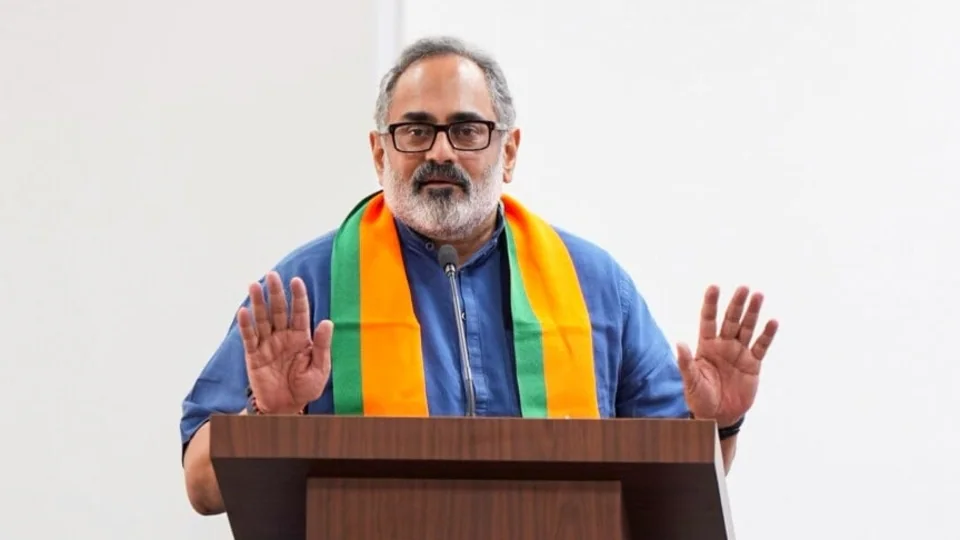
A Political Controversy has erupted in Kerala after a social media video alleged that a cafe in Fort Kochi serves beef and displays a statue of Muhammad Ali Jinnah, the founder of Pakistan. BJP state president Rajeev Chandrasekhar has accused Chief Minister VD Satheesan of practising “selective secularism”, escalating a debate over religious sentiments, freedom of expression and communal harmony in the state.
The controversy began after a YouTuber posted a video questioning the cafe’s name, its alleged food offerings and the presence of the Jinnah statue. The video drew criticism and prompted political leaders to respond. Satheesan and CPI(M) leader Pinarayi Vijayan condemned the alleged communal remarks, while Fort Kochi police registered a case against the YouTuber, Amrit Singh Darren, under relevant provisions of the Bharatiya Nyaya Sanhita (BNS).
Chandrasekhar subsequently questioned the Congress and the CPI(M) over what he described as their inconsistent approach to secularism and religious sensitivities. Congress leaders, meanwhile, accused the YouTuber of spreading communal suspicion and damaging Kerala’s image as a destination known for cultural diversity and tourism.
Why the Fort Kochi cafe controversy erupted
The dispute centres on a video in which the YouTuber allegedly claimed that the cafe was named after Kashi, a holy Hindu city, while displaying a statue of Jinnah and serving beef. The allegations triggered a wider political argument about whether the cafe’s name, display and menu should be interpreted as an affront to religious sentiments.
The supplied account does not establish the cafe’s full name, independently verify the allegations about its menu or explain the circumstances behind the display of the statue. The claims about the establishment therefore remain allegations in the reported controversy rather than independently established findings.
The reaction quickly extended beyond the cafe itself. Political leaders debated the limits of public criticism, the risks of communal polarisation and the responsibility of social media personalities when discussing religious and cultural issues.
Fort Kochi, a historic part of Kochi, is also associated with cultural exchange and tourism. That has added another dimension to the dispute, with Congress leaders arguing that attempts to frame local establishments through communal allegations could affect the area’s reputation.
BJP’s Rajeev Chandrasekhar alleges ‘selective secularism’
Responding to Satheesan on social media, Chandrasekhar said Kerala belonged to all Malayalees and that the people of the state had the right to decide its future, including matters involving food, culture and celebrations. He also emphasised that Kerala was part of India and that every Malayalee was an Indian.
Although he said he agreed with the chief minister’s sentiment, Chandrasekhar challenged what he described as a political culture that showed inconsistent concern for religious sensitivities.
He questioned why some people allegedly glorified Jinnah, whom he blamed for the Partition of India along religious lines. He also raised allegations about politicians defending or justifying proscribed terrorist organisations such as Hamas and their violence. In addition, he criticised political associations involving the Congress and the CPI(M) with Jamaat-e-Islami, which he described as anti-secular and anti-constitutional.
These remarks reflected Chandrasekhar’s political allegations and characterisation of the parties and organisations involved. They were presented as part of his criticism of what he considers inconsistent positions on secularism and communal harmony.
The BJP leader further alleged that some people believed they could make insulting or insensitive statements without facing consequences because they received what he called a “free-pass” from the Congress and CPI(M). He connected this criticism to the cafe controversy, particularly the allegation that the establishment was named after Kashi.
Chandrasekhar also posed a hypothetical question about how the chief minister might respond if a restaurant named after a Muslim holy city served pork. He argued that such a situation would provoke a strong political reaction, accusing Satheesan of applying different standards to different communities.
In his message, Chandrasekhar urged the chief minister not to encourage what he described as anti-India or anti-Hindu insults, discourse, actions or sentiment, including the glorification of Jinnah. He said the BJP would support opposition to such conduct but warned that what he termed selective secularism and selective appeals for communal harmony would face resistance.
Ramesh Chennithala says Kerala will not tolerate communal hatred
Home Minister Ramesh Chennithala also responded to the controversy, saying Kerala would not become a platform for communal hatred.
In a post on X, Chennithala said he had called for action against the vlogger over allegations that he was spreading falsehoods and creating communal suspicion about Varkala and Fort Kochi. He described the registration of a first information report by Fort Kochi police as a necessary step.
Chennithala stressed that Kerala’s temples, mosques, churches, art and diverse communities formed part of a shared cultural heritage. He argued that freedom of expression did not give anyone the right to incite communal enmity.
His response placed the focus on the distinction between criticism and speech that allegedly encourages hostility between communities. The police case marks a legal development in the dispute, although the supplied report does not detail the specific statutory provisions invoked or establish the outcome of the investigation.
Hibi Eden raises concerns over tourism and Kerala’s image
Congress leader and Ernakulam MP Hibi Eden alleged that the YouTuber’s remarks formed part of a planned effort to damage Kerala’s reputation and tourism prospects.
Eden argued that the video should not be considered in isolation. He said the allegations linking the Jinnah statue to the cafe’s reported beef offering needed to be examined alongside the YouTuber’s previous videos and statements.
He also highlighted the cultural significance of Fort Kochi and Mattancherry, describing the areas as important symbols of communal harmony. Their history of spice trade and cultural exchanges, he said, reflected the interaction of different communities over time.
Eden further pointed to Kochi’s association with the Kochi-Muziris Biennale, an international contemporary art event that attracts artists from around the world. In his view, the controversy risked overshadowing the city’s cultural identity and its appeal to visitors.
The concerns raised by Eden underline a broader question for tourism-dependent destinations: how political disputes and viral social media content can shape public perceptions of a place. However, the supplied information does not provide evidence of any measurable impact on bookings, visitor numbers or tourism revenue as a result of the controversy.
Police register case against YouTuber
Fort Kochi police registered a case against Amrit Singh Darren, described in the report as a YouTuber from a north Indian state, under relevant sections of the Bharatiya Nyaya Sanhita.
The case followed the video that allegedly made communal remarks about the cafe and its connection to Kashi, Jinnah and beef. Chennithala supported action against the vlogger, alleging that the content spread falsehoods and encouraged communal suspicion.
Registration of a police case does not, by itself, establish that the allegations against the YouTuber have been proven. The available account does not specify the exact BNS sections, whether the YouTuber has responded to the allegations, or whether any further legal action has taken place.
The development nevertheless brings the dispute beyond political exchanges on social media and into the legal process. The investigation and any subsequent proceedings will determine how the allegations are assessed under the law.
Secularism, religious sensitivities and freedom of expression
The Fort Kochi controversy has brought competing interpretations of secularism into focus. Chandrasekhar argues that political leaders should oppose conduct he considers offensive to Hindu sentiments and should apply the same principles consistently across communities. Congress leaders, meanwhile, have emphasised the danger of communal suspicion and the importance of protecting Kerala’s pluralistic social fabric.
Chennithala’s response centres on the limits of freedom of expression, arguing that speech should not be used to incite hostility. Eden’s comments focus on the potential consequences of communal allegations for the reputation of culturally diverse areas and their tourism economies.
These positions reflect a wider tension in public debate: how to protect the freedom to criticise political, religious or cultural matters while responding to speech that authorities or political leaders allege could provoke hostility between communities.
The cafe’s reported menu and display have become the immediate focus of the dispute, but the central political argument concerns the standards public figures apply when discussing religion, identity and national belonging. The allegations surrounding the establishment should be distinguished from verified facts, while claims about political motives and potential damage to tourism remain the positions of the leaders who made them.
What happens next?
The immediate next step is the police investigation into the case registered against the YouTuber. The available report does not establish whether the cafe itself is under investigation or whether authorities have independently verified the claims made in the video.
The political dispute is also likely to remain centred on competing claims about secularism, communal harmony and the responsibility of public figures and online creators. BJP leaders have used the episode to challenge the Congress and CPI(M), while Congress leaders have warned against content they believe could spread suspicion and undermine Kerala’s image.
For now, the controversy illustrates how a social media video about a local cafe can become a larger political confrontation involving religious sensitivities, freedom of expression and tourism. The facts established through the police process, along with any further responses from those directly involved, will be important in separating verified developments from political allegations.
For breaking news and live news updates, like us on Facebook or follow us on Twitter and Instagram. Read more on Latest India on thefoxdaily.com.




COMMENTS 0