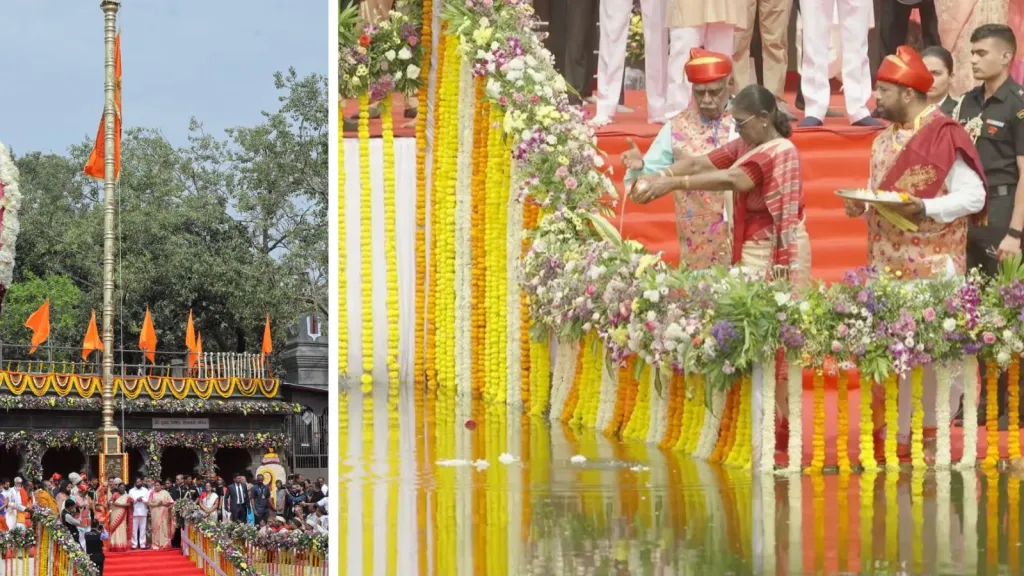
President Droupadi Murmu formally inaugurated preparations for the 2027 Nashik-Trimbakeshwar Simhastha Kumbh Mela by hoisting the sacred religious flag, known as Dharmadhwaja, at Ramtirtha in Nashik on Saturday. The ceremony took place on the banks of the Godavari River in the presence of saints, religious leaders, political representatives and thousands of devotees.
The flag-hoisting ceremony marked the beginning of the preparations for one of India’s major religious gatherings, which is scheduled to continue until July 2028. The event was accompanied by Vedic chants, conch-shell sounds and traditional rituals, reflecting the religious significance of the Godavari and the centuries-old traditions associated with the Kumbh Mela.
President Murmu unfurled the religious flag at 12:02 pm after performing prayers and participating in sacred rituals. A separate flag-hoisting ceremony was held at Trimbakeshwar, around 30 kilometres from Nashik, where Maharashtra Chief Minister Devendra Fadnavis performed the ceremony at Kushavarta Teerth.
President Murmu Performs Religious Rituals at Ramtirtha
The ceremony at Ramtirtha began with President Droupadi Murmu offering oblations into the sacrificial fire at the Yagnakund. She subsequently worshipped the Godavari River and paid respects to the Dharmadhwaja before hoisting the religious flag amid the chanting of priests.
As the flag was raised, conch shells were blown and devotees gathered along the riverbank to witness the occasion. The religious proceedings were conducted under the leadership of priest Satish Shukla and Chandrashekhar Panchakshari, president of the Purohit Sangh.
Speaking after the ceremony, Shukla described the religious flag as more than a symbol of religious identity. He said it represented a connection between thousands of years of cultural memory and the present generation.
The ceremony brought together religious traditions and the formal beginning of preparations for the next Simhastha Kumbh Mela. The presence of the President added national significance to the event, which is expected to draw pilgrims, saints and spiritual organisations from across India and abroad.
Devendra Fadnavis Hoists Flag at Trimbakeshwar
Another major ceremony took place at Trimbakeshwar, approximately 30 kilometres from Nashik. Maharashtra Chief Minister Devendra Fadnavis hoisted the religious flag at Kushavarta Teerth and the Godavari River in the presence of Jagadguru Shankaracharya Vidhushekhara Bharati of Sringeri Peeth.
Priests performed traditional rituals and praised the Godavari through the chanting of sacred mantras. The ceremony included the Sankalpa, or resolution, ritual, during which prayers were offered for the happiness, peace, prosperity and well-being of all living beings.
Trimbakeshwar holds particular religious importance in the Simhastha Kumbh tradition. The town is home to the Trimbakeshwar Jyotirlinga temple and is closely associated with the origin and religious significance of the Godavari River.
The ceremonies at Nashik and Trimbakeshwar together marked the beginning of the wider preparations for the 2027 Simhastha Kumbh Mela. Religious leaders and state authorities are expected to coordinate activities as the festival approaches.
Why the Simhastha Kumbh Mela Is Associated With Jupiter’s Entry Into Leo
The Simhastha Kumbh Mela is associated with a particular planetary alignment in Hindu astrological tradition. Jupiter’s entry into the zodiac sign Leo, also known as Simha, is considered an important factor in determining the timing of the festival.
The term Simhastha is linked to this astrological association. The movement of Jupiter into Leo is traditionally regarded as an auspicious period for the religious observances connected with the Kumbh Mela.
Against this religious and astrological background, the hoisting of the Dharmadhwaja carries symbolic importance. It serves as a ceremonial invitation to devotees and marks the beginning of preparations for the gathering.
The festival is expected to bring together pilgrims, sadhus, saints and members of different Akharas. Devotees traditionally visit Nashik and Trimbakeshwar to offer prayers, participate in religious ceremonies, meet spiritual leaders and take a holy dip in the Godavari River.
Meaning of the Shri Ganga-Godavari Dharma Dhwaj
The religious flag hoisted for the Simhastha Kumbh Mela is known as the Shri Ganga-Godavari Dharma Dhwaj. Its symbols carry religious and cultural meanings associated with Hindu traditions, spiritual beliefs and the importance of the Godavari.
One of its central symbols is the Amrit Kumbh, or nectar pot. It represents immortality, liberation and divine power. The pot also connects with the broader religious symbolism of the Kumbh, which is associated with the sacred nectar of immortality.
The flag also carries the Omkar symbol, which represents positivity, the universe and the idea of divine presence throughout creation. The letter ‘Shri’ is included as a symbol of auspiciousness and victory.
Twelve silk tassels on the flag represent social unity and collective strength. A large bell and three smaller bells symbolise sound and the primordial cosmic sound, referred to in the supplied description as Brahmanda or Brahmanad.
Other symbols appear on the opposite side of the flag. These include a crocodile, regarded in the religious tradition as the vehicle of Goddess Godavari, along with representations of the sun and moon.
Together, these symbols give the Dharmadhwaja a religious significance beyond its ceremonial role. Its presence on the banks of the Godavari is intended to announce the approaching festival and invite devotees to participate in the Simhastha Kumbh Mela.
Infrastructure and Security Preparations Begin for the 2027 Kumbh Mela
With the religious ceremonies marking the formal beginning of preparations, Nashik and Trimbakeshwar are expected to receive large numbers of devotees from different parts of India and abroad. Managing the movement and accommodation of pilgrims will require coordination between government departments, local authorities and civic agencies.
Preparations are being planned across several areas, including infrastructure development, sanitation, traffic management, security and essential public services. These arrangements will be important for handling large crowds and ensuring that pilgrims can participate in religious activities safely.
The scale of the gathering means that authorities will need to plan for transportation, crowd movement, medical assistance, drinking water, public toilets, waste management and emergency response facilities. Coordination between the administration and religious organisations will also be important during major ceremonies.
Maharashtra’s Guardian Minister for Nashik, Girish Mahajan, said the effort was to combine modern management practices with respect for the sanctity of ancient religious traditions.
Mahajan said the administrative machinery was working to ensure that devotees arriving to visit the Godavari, take a holy dip and experience the company of saints could have a safe, smooth and memorable journey.
The preparations will be particularly important at major religious locations, including Ramtirtha in Nashik and Kushavarta Teerth in Trimbakeshwar. Both places are expected to play an important role in the festival’s religious activities.
Nashik-Trimbakeshwar Simhastha Kumbh Mela to Continue Until July 2028
The Nashik-Trimbakeshwar Simhastha Kumbh Mela is scheduled to continue from the flag-hoisting ceremonies in 2026 until July 2028. According to the published calendar mentioned in the supplied information, the closing ceremony at Trimbakeshwar is scheduled for July 24, 2028, while the closing ceremony at Nashik is listed for July 29, 2028.
The religious flags at both locations will be lowered during the respective closing ceremonies, marking the conclusion of the festival period. The overall Simhastha period will therefore extend for approximately 21 months.
The extended schedule means that preparations will involve more than arrangements for a few major bathing days. Authorities will need to manage religious events, pilgrim movement and civic services over a prolonged period.
For devotees, the festival offers opportunities to participate in religious observances, visit sacred sites, take a dip in the Godavari and seek the guidance of saints and spiritual leaders. For Nashik and Trimbakeshwar, it also represents a major organisational undertaking requiring long-term planning.
Religious Leaders and Political Representatives Attend the Ceremony
The flag-hoisting ceremonies were attended by senior political representatives, Mahants, spiritual masters and sadhus and saints from different Akharas. Their participation reflected the importance of religious institutions in organising and preserving the traditions associated with the Kumbh Mela.
The presence of President Murmu at Ramtirtha and Chief Minister Fadnavis at Trimbakeshwar gave the ceremonies prominence at both locations. Religious leaders conducted the rituals, while state representatives highlighted the preparations required to accommodate devotees.
The Dharmadhwaja hoisting is traditionally regarded as an important ceremonial milestone ahead of the Simhastha Kumbh Mela. Its message is both religious and organisational: it signals the approaching gathering and begins the period of preparation for the millions of people expected to visit the region over the festival period.
With the flags now raised at Nashik and Trimbakeshwar, attention will turn to the practical arrangements needed for the 2027 Simhastha Kumbh Mela. Infrastructure, sanitation, transport, security and public facilities will remain central to the preparations as Maharashtra gets ready to host devotees until the closing ceremonies in July 2028.
For breaking news and live news updates, like us on Facebook or follow us on Twitter and Instagram. Read more on Latest India on thefoxdaily.com.






COMMENTS 0