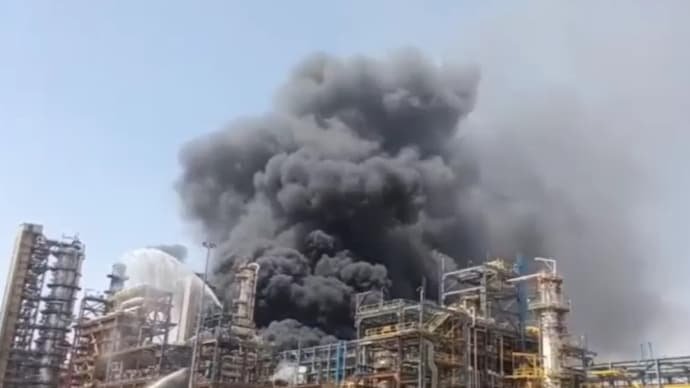
- What Happened at the Rajasthan Oil Refinery?
- Why the Rajasthan Oil Refinery Matters
- Three Key Angles of Investigation
- The Role of Security: Was the Refinery Protected Enough?
- A Global Pattern? Why This Fire Is Raising Eyebrows
- The Hidden Risk: Alarm System Failure
- Economic and Political Impact
- What Competitors Are Missing: The Cyber-Physical Convergence Risk
- Comparison: How This Incident Stacks Up Globally
- What Happens Next?
- Conclusion: More Than Just a Fire
A Fire That Raises More Questions Than Answers
On April 20, a major fire erupted at the HPCL Rajasthan Refinery in Barmer, Rajasthan just a day before it was scheduled to be inaugurated by Prime Minister Narendra Modi. What should have been a landmark moment for India’s energy sector quickly turned into a high-alert investigation involving multiple national agencies.
The central question remains unresolved: was this an industrial accident, a safety lapse, or something more deliberate?
The incident has triggered a multi-layered probe examining technical systems, human actions, and even the possibility of cyber interference. With the refinery representing a crucial piece of India’s energy Infrastructure, the stakes go far beyond a single fire incident.
This article explores the full picture what happened, why it matters, and what it reveals about the evolving risks facing critical infrastructure in India and globally.
What Happened at the Rajasthan Oil Refinery?
The fire broke out in the Crude Distillation Unit (CDU), one of the most critical components of any oil refinery. The CDU is essentially the starting point of refining operations, where crude oil is heated and separated into usable fractions like gasoline, diesel, and kerosene.
Preliminary findings suggest that a hydrocarbon leak in the heat exchanger circuit may have triggered the blaze. In industrial environments dealing with volatile substances, even a minor leak can escalate rapidly if ignition conditions are present.
However, what has alarmed investigators is not just the fire but the sequence of events leading up to it. Reports indicate a delay in alarm activation, raising serious concerns about whether safety systems functioned as intended.
Quick Timeline of Events
| Date | Event |
|---|---|
| April 20 | Fire breaks out in CDU unit at Barmer refinery |
| April 20 (later) | Emergency response activated; fire brought under control |
| April 21 | Prime Minister’s scheduled inauguration postponed |
| Following days | National agencies, including NIA, begin investigation |
Why the Rajasthan Oil Refinery Matters
The Barmer refinery is not just another industrial facility it is one of India’s key energy projects aimed at boosting domestic refining capacity and reducing dependence on imported fuels.
Strategically located in Rajasthan, the refinery is designed to process locally sourced crude oil, supporting regional economic growth and strengthening national Energy Security.
Any disruption at such a facility has ripple effects across multiple sectors:
- Fuel supply chains
- Industrial production
- Regional employment
- Investor confidence in infrastructure projects
That’s why this incident has drawn attention not just from safety regulators, but also from intelligence and Cybersecurity agencies.
Three Key Angles of Investigation
1. Technical Failure: When Systems Go Wrong
Industrial facilities like refineries operate under extreme conditions high temperatures, pressure, and flammable materials. Even with advanced engineering, failures can occur.
Investigators are examining whether:
- Equipment malfunctioned under stress
- Maintenance protocols were properly followed
- The heat exchanger system had pre-existing vulnerabilities
In many refinery accidents worldwide, technical faults such as corrosion, fatigue, or design flaws have been the root cause. However, such failures are usually accompanied by warning signs raising the question: were those signs missed?
2. Human Error: The Weakest Link?
Even the most advanced systems depend on human oversight. A single lapse whether in monitoring, maintenance, or response can escalate into a major incident.
Authorities are evaluating:
- Whether safety protocols were strictly followed
- If personnel were adequately trained
- Whether any operational shortcuts were taken
Globally, human error remains one of the leading causes of industrial accidents. From misjudged pressure levels to delayed response times, small mistakes can have massive consequences.
3. Cyber Interference: A Modern Threat
This is where the investigation takes a more complex turn.
The refinery’s SCADA (Supervisory Control and Data Acquisition) system which digitally controls operations is under scrutiny. Investigators are analyzing command logs, network activity, and system behavior for anomalies.
Cyberattacks on industrial infrastructure are no longer theoretical. In recent years, critical facilities worldwide have been targeted through:
- Malware attacks on control systems
- Unauthorized remote access
- Manipulation of operational parameters
If any form of cyber interference is detected, it would significantly escalate the seriousness of the incident from an industrial accident to a National Security concern.
The Role of Security: Was the Refinery Protected Enough?
The refinery operates under a three-tier security system led by the Central Industrial Security Force (CISF). With around 100 personnel deployed in shifts, physical security appears robust on paper.
Access to the facility is tightly controlled, with restrictions on personnel and vehicles entering sensitive zones. Vehicles are required to have spark arrestors devices designed to prevent ignition from exhaust sparks.
But security is only as strong as its weakest link.
Investigators are now asking:
- Were all vehicles compliant with safety norms?
- Were access protocols strictly enforced?
- Could there have been an internal breach?
In high-risk facilities, even minor deviations from protocol can create vulnerabilities.
A Global Pattern? Why This Fire Is Raising Eyebrows
What makes this incident particularly intriguing is its timing.
In recent months, multiple fires and explosions have been reported at energy facilities across different countries including the United States, Australia, and parts of Asia and Latin America.
While each incident may have its own cause, the clustering of such events has sparked debate among analysts about whether there is a broader pattern at play.
There are three possible explanations:
- Coincidence: Industrial accidents are not uncommon in energy sectors
- Systemic issues: Aging infrastructure and increasing operational pressure
- Coordinated threats: Though unproven, this possibility cannot be entirely dismissed
At this stage, there is no confirmed link between these incidents. However, the mere possibility is enough to warrant deeper scrutiny.
The Hidden Risk: Alarm System Failure
One of the most concerning aspects of the Rajasthan refinery fire is the reported delay in alarm activation.
In industrial safety systems, early detection is critical. Alarms are designed to:
- Alert operators immediately
- Trigger automated shutdown mechanisms
- Prevent escalation
If alarms fail or are delayed, the window for containment shrinks dramatically.
This raises several critical questions:
- Was the system malfunctioning?
- Was it manually overridden?
- Or was it compromised?
The answers to these questions could determine whether this was a routine failure or something far more serious.
Economic and Political Impact
The immediate impact of the fire was the postponement of the refinery’s inauguration a significant political and economic event.
But the broader implications go deeper:
1. Investor Confidence
Large-scale infrastructure projects depend heavily on trust. Any safety-related incident can raise concerns among investors and stakeholders.
2. Energy Security
India’s growing energy needs make projects like the Barmer refinery crucial. Delays or disruptions can affect long-term planning.
3. Policy Implications
The incident may prompt stricter safety regulations, increased audits, and stronger cybersecurity frameworks across the energy sector.
What Competitors Are Missing: The Cyber-Physical Convergence Risk
Most news coverage focuses on whether the fire was an accident or negligence. But a deeper issue often goes unnoticed the convergence of physical and digital risks.
Modern refineries are no longer just mechanical systems; they are cyber-physical ecosystems where software controls hardware.
This creates a new category of risk:
- A digital breach can cause physical damage
- A physical incident can expose digital vulnerabilities
This dual-risk Environment requires a new approach to safety one that integrates cybersecurity with traditional engineering safeguards.
In simple terms: a refinery today needs both fire extinguishers and firewalls.
Comparison: How This Incident Stacks Up Globally
| Factor | Typical Refinery Fires | Rajasthan Refinery Fire |
|---|---|---|
| Cause | Usually technical or human error | Under investigation (includes cyber angle) |
| Security Involvement | Limited | Multi-agency including intelligence |
| Timing | Random | Just before major inauguration |
| Global Context | Isolated incidents | Occurs amid multiple global energy fires |
What Happens Next?
The investigation is still ongoing, and authorities have not reached a final conclusion. However, several outcomes are possible:
- If technical failure is confirmed, focus will shift to engineering fixes and audits
- If human error is identified, accountability measures will follow
- If cyber interference is detected, it could trigger nationwide security upgrades
In any case, the findings will likely influence how India approaches industrial safety in the future.
Conclusion: More Than Just a Fire
The Rajasthan oil refinery fire is not just an isolated industrial incident it is a wake-up call.
It highlights the fragile balance between Technology, human oversight, and security in modern infrastructure. Whether the cause turns out to be accidental or intentional, the lessons will be significant.
As India continues to expand its energy capabilities, ensuring the safety and resilience of such projects will be critical.
The real story here isn’t just what caused the fire it’s what the investigation will reveal about the future of industrial safety in an increasingly complex and interconnected world.
One thing is certain: in today’s environment, the line between accident and attack is thinner than ever and understanding that difference could define the next generation of infrastructure security.
For breaking news and live news updates, like us on Facebook or follow us on Twitter and Instagram. Read more on Latest India on thefoxdaily.com.






COMMENTS 0