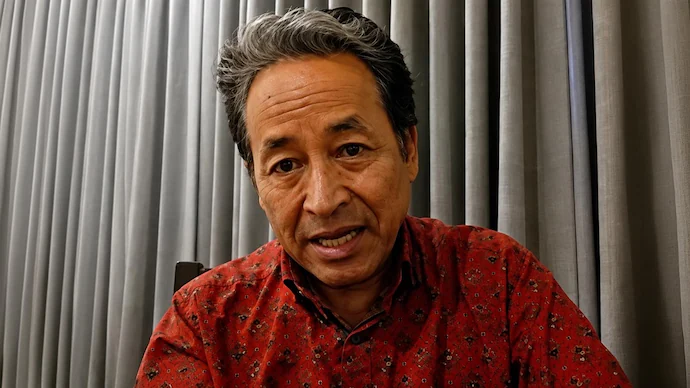
Climate activist and educationist Sonam Wangchuk has defended peaceful street protests as an essential part of democratic governance, warning that governments risk worsening public discontent when they restrict peaceful expressions of dissent. Speaking at the IPF Festival in Mumbai on Saturday, Wangchuk said protests provide feedback to those in power and can help governments address public concerns before they escalate.
Wangchuk referred to unrest in Sri Lanka, Bangladesh and Nepal to argue that people must have opportunities to express their grievances peacefully. He also criticised the deployment of paramilitary forces against protesters, questioned restrictions on demonstrations and called for greater democratic participation by the people of Ladakh in decisions affecting their region.
His remarks come amid criticism of the Centre’s response to planned demonstrations, including a protest called by the Cockroach Janta Party (CJP) at Jantar Mantar in Delhi. The party had demanded the resignation of Chief Election Commissioner Gyanesh Kumar over alleged irregularities in the Special Intensive Revision (SIR) of electoral rolls.
Sonam Wangchuk Says Peaceful Protests Help Governments Perform Better
Wangchuk described peaceful protests as a mechanism through which citizens can communicate their concerns directly to those in power. He argued that demonstrations should be treated as an important source of public feedback rather than as an automatic challenge to the authority of the government.
Referring to countries such as the United Kingdom, Norway and Sweden, Wangchuk said protests are permitted outside parliamentary buildings in several democracies. He contrasted those arrangements with the restrictions and distance he said protesters face in India.
“In India, it was far from Parliament Even when it was just Jantar Mantar in New Delhi, it was too far,” he said.
He added that protests could act as a pressure valve, allowing governments to understand dissatisfaction and respond before public anger grows.
“So, protests are a great mechanism, a feedback, a pressure valve for governments to perform better if they see that,” Wangchuk said.
His argument was that allowing peaceful demonstrations can strengthen governance by giving citizens a visible way to communicate grievances. From this perspective, restrictions on protests risk limiting the information available to decision-makers about public dissatisfaction.
Wangchuk also argued that peaceful protests on the streets are a constitutional right. Speaking to reporters, according to the supplied PTI report, he said permission should not be treated as a prerequisite for people to express themselves peacefully. He suggested that administrative permissions should instead help authorities monitor activities taking place across a city, including festivals.
Warning Against Restrictions on Public Dissent
Wangchuk pointed to unrest in Sri Lanka, Bangladesh and Nepal while explaining why governments should allow peaceful public expression. He argued that when citizens cannot express their concerns through peaceful channels, frustration may develop into more serious unrest.
“Look what happens when protests are not allowed. That is the example of Sri Lanka, Bangladesh, Nepal, when peaceful venting of energy is not allowed,” he said.
The comparison formed a central part of his warning to the Centre. Wangchuk’s remarks presented peaceful protest as a means of managing public dissatisfaction rather than merely as a political activity carried out by opposition groups or activists.
He also criticised the arrest of protesters, including CJP leaders, and urged authorities to consider the concerns being raised instead of focusing only on those delivering the message.
“You don’t kill the messenger. Take the message,” Wangchuk said.
The statement captured his broader argument that governments should assess the substance of public grievances and respond to them through dialogue and appropriate action. His remarks did not establish the merits of the specific allegations raised by CJP over electoral roll revision, but they emphasised the importance of allowing citizens to raise such concerns peacefully.
Background to the CJP Protest and Electoral Roll Dispute
The immediate political context includes a planned CJP protest at Jantar Mantar demanding the resignation of Chief Election Commissioner Gyanesh Kumar over alleged irregularities in the Special Intensive Revision of electoral rolls.
The Opposition has criticised the Union government over restrictions on peaceful demonstrations. Wangchuk’s comments added to that criticism by raising wider questions about the space available for public dissent and the government’s response to protesters.
The allegations concerning the electoral roll revision remain distinct from Wangchuk’s broader argument about the right to protest. The supplied account does not provide independent findings establishing the alleged irregularities, nor does it detail the full administrative or legal grounds for the restrictions on the planned demonstration.
Wangchuk’s position was that authorities should listen to the message being conveyed by protesters, even when they disagree with the demands being made. He suggested that governments would benefit from treating peaceful dissent as an opportunity to understand public concerns rather than responding primarily through arrests or force.
Wangchuk Recalls His Hunger Strike Over NEET Controversy
Wangchuk also referred to his earlier 26-day hunger strike in support of the CJP’s demand for the resignation of then Union Education Minister Dharmendra Pradhan over alleged irregularities in the National Eligibility-cum-Entrance Test (NEET).
He used the episode to reinforce his argument that governments should address concerns that lead people to protest. Wangchuk said decisions that are unnecessary or poorly judged could generate opposition and ultimately harm the government itself.
“If you do things that need not be done, then people will go against you. This will only hurt the government. Do what is right,” he said.
His remarks linked the handling of public protests to the broader responsibility of governments to respond to criticism and correct perceived shortcomings. The reference to NEET also placed his latest comments within a continuing debate over allegations of irregularities in public examinations and the demands made by groups seeking accountability.
The supplied material does not provide further details about the outcome of the earlier hunger strike or the status of the allegations it concerned. Wangchuk invoked it primarily to explain why he believes governments should listen to grievances rather than dismiss those raising them.
Criticism of Paramilitary Deployment Against Protesters
One of Wangchuk’s strongest criticisms concerned the deployment of paramilitary forces in response to protests. He questioned the use of security personnel against citizens, particularly young people, and argued that such forces should be focused on protecting India’s borders.
“But they are behind their own people, the ones like me, our youth,” he said, referring to the deployment of paramilitary personnel against protesters. He noted that these forces come under the Ministry of Home Affairs.
The Centre had faced criticism over the deployment of paramilitary units after CJP called for a protest earlier this month. Wangchuk argued that using such forces for internal security operations against protesters raised questions about how national security resources were being prioritised.
He said the government should give top priority to protecting the country from external threats. In his view, border security should remain the central responsibility of forces tasked with guarding the country’s frontiers, rather than having personnel frequently deployed for domestic situations involving citizens.
“We have started using paramilitary forces frequently for internal security, but our borders must be safe. Paramilitary forces should be the ones protecting the borders,” Wangchuk said.
He called on the Ministry of Home Affairs to focus on border protection and argued that paramilitary forces should be placed under the Ministry of Defence. He framed the proposal as a way to distinguish the management of internal protests from the responsibility of safeguarding national territory.
“If the MHA wants to target civilians, then borders should be handed over to the Ministry of Defence,” he said.
These comments represent Wangchuk’s policy position on the deployment and administrative control of security forces. The supplied account does not indicate that the Centre has accepted his proposal or that any decision has been announced to change the existing arrangement.
Wangchuk Raises Concerns Over China’s Activities Along the Ladakh Border
Wangchuk connected his criticism of domestic security deployments to his concerns about developments along the India-China border in Ladakh. He claimed that China was gradually moving into areas along the border when attention and personnel were diverted elsewhere, particularly during winter.
He warned that delays in responding to developments in border areas could make it more difficult to restore the previous situation.
“By the time they return, China has already entered and then it becomes difficult to push them back,” Wangchuk said.
The claim was part of his argument that border protection should receive greater priority from the government. The supplied material does not provide independent evidence to verify the specific movements he described, so his remarks should be understood as his assessment of the security situation rather than an independently established account of events along the border.
Wangchuk’s comments nevertheless highlighted the connection he sees between national security, the deployment of personnel and the government’s handling of protests. He argued that forces needed for border protection should not be diverted frequently to manage domestic demonstrations.
Land Allotment Dispute Involving the Himalayan Institute of Alternatives, Ladakh
Wangchuk’s comments came after the Ladakh administration defended its decision to cancel the land allotment to the Himalayan Institute of Alternatives, Ladakh (HIAL).
According to the supplied account, the administration cited Wangchuk’s alleged “disregard for the law” and said the allotment had automatically lapsed because dues had not been paid and the lease deed had not been executed.
The issue adds another dimension to the wider dispute between Wangchuk and the authorities over governance and the future of Ladakh. The administration’s explanation focused on compliance with the conditions governing the allotment, while Wangchuk’s remarks at the Mumbai event centred on democratic participation, peaceful dissent and the management of the region.
The supplied material does not include a detailed response from Wangchuk to the administration’s specific claims about outstanding dues or the lease deed. Those claims therefore remain attributable to the administration in this account.
Why Wangchuk Wants Ladakh to Have a Greater Say in Its Governance
A major theme of Wangchuk’s address was the right of people living in a region to influence decisions that shape their lives. He argued that residents are best placed to understand the local consequences of policy decisions because they directly experience the results of development choices, administrative priorities and environmental management.
“And going by that principle, I say Ladakh should have a say in how Ladakh is managed. That is all we are saying, basically,” he said.
Wangchuk called for a democratic system in which local people or their representatives could participate meaningfully in decision-making. He said decisions should account for the long-term future of children and communities living in the region, rather than being determined without sufficient local involvement.
His argument was based on the idea that residents possess knowledge of their own environment and circumstances that outside administrators may not fully understand. He maintained that those who live in Ladakh should have a meaningful role in deciding how the region is managed.
The demand reflects wider concerns about political representation and local decision-making following the reorganisation of the former state of Jammu and Kashmir in 2019. Ladakh became a separate Union Territory after the bifurcation, changing its administrative status.
Wangchuk Compares Ladakh’s Administration to Colonial Rule
Wangchuk criticised the system of administration in Ladakh following the 2019 bifurcation, comparing the region’s governance to that of a former colony managed by a viceroy from New Delhi rather than London.
He argued that administrators from other parts of India might have good intentions but would not necessarily possess the same understanding of Ladakh’s distinctive ecology and local needs as people who live there.
“Just as I would be the most unfit person to become the leader or chief minister of Maharashtra, similarly, somebody from Delhi will not be the fittest and best caretaking person for Ladakh,” he said.
The comparison was intended to underline his demand for greater local participation rather than to suggest that every administrator from outside the region lacks competence. His stated concern was that governance should take account of local knowledge, environmental conditions and the long-term interests of residents.
For Wangchuk, the question of who makes decisions is closely connected to the question of who bears their consequences. He argued that Ladakh’s residents should have a stronger voice in determining policies that affect the region’s environment, development and future generations.
Wangchuk’s Preventive Detention and the Wider Ladakh Dispute
Wangchuk’s latest remarks also come against the background of his preventive detention in September 2025 following violent protests in Ladakh. He was held under the National Security Act until his release in March 2026.
The detention forms part of the broader context surrounding disagreements over governance and the political future of Ladakh. Wangchuk’s current comments focused on peaceful protest and democratic participation, while the earlier episode involved violent protests, according to the supplied account.
These issues should be distinguished: Wangchuk’s defence of peaceful demonstrations does not establish the circumstances of every protest or determine the responsibility for specific incidents. His argument is that peaceful avenues for dissent should remain available so that grievances can be raised without escalating tensions.
His demand for greater local decision-making is similarly connected to his broader view that residents should have a meaningful role in determining policies affecting their region. He has argued that local knowledge is particularly important in Ladakh because of its distinct ecological conditions.
What Wangchuk’s Message Means for the Centre
Wangchuk’s address in Mumbai brought together several issues: the right to peaceful protest, the treatment of demonstrators, the deployment of paramilitary forces, border security and democratic representation in Ladakh.
His central message was that governments should respond to public grievances by examining their substance rather than concentrating solely on those who raise them. He argued that peaceful demonstrations can provide useful feedback, while restrictions risk leaving citizens with fewer ways to communicate dissatisfaction.
He also called for a reassessment of security priorities, contending that forces responsible for border protection should not be diverted frequently to manage domestic protests. His comments about China and Ladakh were presented as part of that argument, although the specific border claims were not independently substantiated in the supplied material.
On Ladakh’s governance, Wangchuk reiterated that residents should have a say in decisions affecting their future. He linked local participation to environmental understanding, accountability and the ability of communities to shape long-term development priorities.
The Centre and the Ladakh administration have not, in the supplied account, announced any change in response to his latest remarks. The immediate political debate therefore remains centred on the handling of protests and the competing positions over Ladakh’s governance.
For Wangchuk, the principle connecting these issues is that authorities should listen to people who raise concerns, protect the space for peaceful dissent and ensure that decisions reflect the needs of those most affected by them. His warning to the Centre was clear: responding to a messenger without addressing the message risks deepening the very dissatisfaction that peaceful protest is intended to express.
For breaking news and live news updates, like us on Facebook or follow us on Twitter and Instagram. Read more on Latest India on thefoxdaily.com.





COMMENTS 0