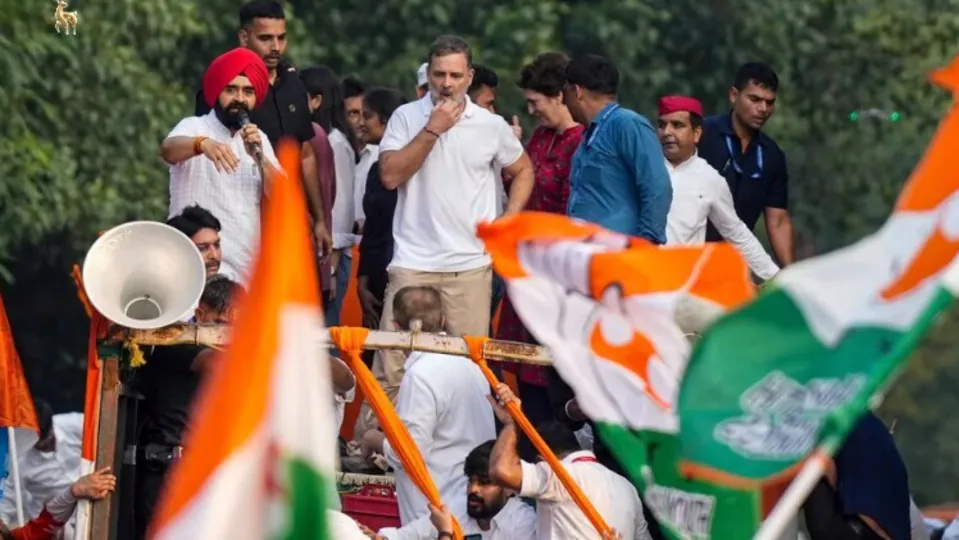
The Supreme Court on Tuesday sought explanations from Congress president Mallikarjun Kharge and Lok Sabha MP Rahul Gandhi over their alleged roles in organising and leading an Opposition march towards the country’s highest court on October 12. The demonstration, held against Chief Election Commissioner (CEC) Gyanesh Kumar, brought thousands of people into central Delhi and raised questions about security, public access and the regulation of political gatherings near sensitive judicial institutions.
A bench headed by Chief Justice of India Surya Kant also sought a response from the Centre on a petition filed by a group of lawyers led by Digant Mishra. The petition seeks guidelines governing processions, protests, demonstrations and public assemblies in the vicinity of the Supreme Court.
The court scheduled the next hearing for November 23. The proceedings also brought allegations concerning the treatment of journalists covering the march into focus, including a claim that a three-month-pregnant woman journalist was pushed and subsequently required hospitalisation.
Congress leaders Rahul Gandhi and Mallikarjun Kharge have been named in the proceedings, along with Samajwadi Party chief Akhilesh Yadav, the Delhi Police Commissioner, the Centre, the Supreme Court Registry and the Congress party.
Why the Supreme Court Has Sought Rahul Gandhi and Kharge’s Responses
The petition raises concerns about the conduct and consequences of the October 12 Opposition demonstration near the Supreme Court. According to the lawyers who approached the court, the march attracted a large gathering of political supporters and lawyers into an area where security arrangements and access to judicial premises require particular attention.
Senior advocate Gaurav Bhatia, appearing for the petitioners, argued that the Opposition demonstration led by Rahul Gandhi created a security scare by bringing a substantial crowd into the court precincts.
The petitioners are seeking a framework that would regulate how political parties, organisations and individuals conduct demonstrations near the Supreme Court. Their argument focuses on preventing public gatherings from disrupting the functioning, security and accessibility of the judicial institution.
The court’s decision to seek responses does not amount to a finding that Rahul Gandhi, Mallikarjun Kharge or any other respondent has committed an offence. It means the court wants the concerned parties to present their positions before considering the issues raised in the petition.
This distinction is important because the allegations made during the hearing remain claims that must be examined through the judicial process.
What Happened During the October 12 Opposition March?
The October 12 demonstration was organised by Opposition leaders to protest against Chief Election Commissioner Gyanesh Kumar. Thousands of people gathered in central Delhi, turning the march into a major political mobilisation.
Rahul Gandhi led the procession from the Constitution Club towards Bhagwan Das Road. The gathering reportedly continued for around three hours, drawing political supporters and members of the legal community into the area surrounding the Supreme Court.
The demonstration followed two days of police action against protesters, adding to the political tensions surrounding the campaign against the CEC.
During the march, Gandhi also walked into the Supreme Court to submit a petition seeking an independent and time-bound investigation into decisions allegedly taken unilaterally by Gyanesh Kumar.
The petition also called for the suspension of the ongoing Special Intensive Revision (SIR) exercise until the proposed investigation was completed.
The demonstration therefore had two connected objectives: publicly protesting against the Chief Election Commissioner and seeking judicial intervention over decisions concerning the functioning of the Election Commission.
Why Was the Protest Directed Against Chief Election Commissioner Gyanesh Kumar?
The Opposition’s demonstration was directed at Gyanesh Kumar, with protesters questioning decisions that they alleged had been taken unilaterally by him.
The demand for an independent investigation reflected the Opposition’s attempt to bring its concerns before the judiciary rather than relying exclusively on political protests.
The demand to suspend the Special Intensive Revision was another important part of the protest. SIR is an electoral roll revision exercise, and the Opposition’s demand linked the dispute to questions concerning the electoral process.
However, the petition filed by the lawyers in the present Supreme Court proceedings focuses on a separate issue: the regulation of demonstrations around the court itself.
This distinction separates the original political dispute from the legal questions now before the Supreme Court. The Opposition’s concerns about the CEC and the SIR exercise are not the same as the petitioners’ concerns about crowd management, security and public demonstrations near judicial premises.
Pregnant Journalist Injury Allegation Becomes a Key Issue
One of the most serious allegations raised during Tuesday’s hearing concerned a woman journalist who was reportedly three months pregnant at the time of the October 12 demonstration.
Gaurav Bhatia alleged that Rahul Gandhi pushed the journalist during the march, causing her to require hospitalisation. He also moved an application seeking the registration of a First Information Report against the Congress leader.
The allegation adds a separate dimension to the petition because it raises questions about the safety of journalists covering politically sensitive demonstrations.
Journalists covering large political gatherings often work in crowded and rapidly changing environments. When demonstrations move through restricted or sensitive areas, maintaining safe access for media personnel becomes particularly important.
However, the allegation against Gandhi has not been established as a judicial finding in the proceedings described. The court has sought responses from the respondents, and the claim must be considered in that context.
The issue also connects with another petition concerning alleged sexual harassment of women journalists while covering protests in the national capital.
Abhishek Manu Singhvi Says Rahul Gandhi and Kharge Will File Responses
Senior advocate Abhishek Manu Singhvi appeared before the Supreme Court on behalf of Rahul Gandhi and Mallikarjun Kharge.
Responding to the court proceedings, Singhvi informed the bench that the leaders would file their responses soon. He also requested that irresponsible statements should not be made before the court had an opportunity to consider the matter.
His statement indicated that the Congress leaders intended to formally present their position in response to the allegations and the issues raised by the petitioners.
The filing of their responses will allow the court to consider the competing arguments, including the petitioners’ concerns about the protest and the respondents’ explanation of their involvement.
The next hearing is expected to provide an opportunity for the court to examine the positions of the parties after receiving the required replies.
Centre Also Asked to Respond to the Petition
The Supreme Court has also sought the Centre’s response to the petition. Solicitor General Tushar Mehta, appearing for the government, told the bench that he would file a reply before the next hearing.
Mehta also requested that the matter be heard alongside a separate petition filed by women journalists under the banner of Network of Women in Media, India.
That petition concerns alleged instances of sexual harassment faced by women journalists while reporting on protests in the national capital.
The request to hear the matters together is significant because both proceedings involve concerns about the conditions under which protests take place and the safety of people working in or around demonstration sites.
Although the petitions raise different allegations, they share an important underlying issue: how public demonstrations can take place without compromising the safety and rights of journalists and other individuals.
Why the Supreme Court’s Location Matters in the Case
The petitioners have argued that the Supreme Court should not be treated as an ordinary public building where unrestricted political demonstrations can take place without considering their institutional significance.
In their submission, the court represents the constitutional promise that disputes, including politically contentious ones, will be decided independently, impartially and according to law.
This argument forms the central basis of their demand for guidelines governing protests near the judicial complex.
The issue involves balancing two important considerations. On one side is the ability of citizens and political parties to express disagreement through peaceful demonstrations. On the other is the need to protect access to judicial institutions and ensure that their operations are not disrupted by large gatherings.
The petitioners’ position is that the Supreme Court’s surroundings require specific safeguards because the institution performs a constitutional function that should remain protected from disruptions.
Balancing the Right to Protest With Judicial Security
Political demonstrations are an important part of democratic participation. They allow citizens and political organisations to express dissatisfaction, demand accountability and draw attention to issues that they believe require public or institutional intervention.
However, the location of a demonstration can influence the practical consequences of exercising that right.
A gathering near a major transport route may create traffic challenges, while a large procession near a judicial complex can raise additional concerns involving security, access and the functioning of the institution.
The legal question is therefore not limited to whether protests should be allowed. It also concerns how authorities can regulate their location, movement and organisation without unnecessarily restricting legitimate public expression.
Any guidelines considered by the Supreme Court could have implications for political parties, civil society groups, lawyers, journalists and law enforcement agencies responsible for managing demonstrations.
Could the Case Lead to New Guidelines for Protests Near the Supreme Court?
The petition specifically seeks guidelines regulating processions, demonstrations, assemblies and protests in the vicinity of the Supreme Court.
If the court considers such guidelines necessary, the resulting framework could clarify the conditions under which public gatherings may take place near the judicial complex.
Possible areas requiring consideration include crowd management, access to court premises, security arrangements and the responsibilities of organisers. These are potential issues arising from the petition’s broader demand, not measures that the court has already ordered.
The court’s eventual approach will also need to consider the relationship between public protest and constitutional freedoms.
A framework that is too restrictive could create concerns about limiting peaceful political expression. On the other hand, an absence of clear arrangements could make it difficult to manage large demonstrations around sensitive public institutions.
The challenge will be to establish safeguards that protect the court’s functioning while preserving the ability of citizens to raise political and constitutional concerns.
What Happens Next in the Supreme Court Case?
The Supreme Court has scheduled the next hearing for November 23 and asked the concerned respondents to submit their replies before the matter is taken up again.
The immediate developments to watch include:
- Rahul Gandhi and Mallikarjun Kharge’s replies: The Congress leaders are expected to formally respond to the allegations and issues raised in the petition.
- Centre’s response: Solicitor General Tushar Mehta has indicated that the government will file its reply before the next hearing.
- Journalist safety petition: The court may consider the Centre’s request to hear the matter alongside the petition filed by Network of Women in Media, India.
- Protest regulations: The court will have to examine whether specific guidelines are necessary for demonstrations and processions near its premises.
The court has not yet announced any final restrictions on political demonstrations near the Supreme Court through the proceedings described.
The November 23 hearing could help clarify the legal issues and determine how the petition will proceed after the respondents submit their positions.
Why This Case Matters Beyond the Congress and BJP Political Dispute
Although the controversy originated from an Opposition march against the Chief Election Commissioner, the Supreme Court proceedings raise questions that extend beyond the immediate political confrontation.
The case brings together three important democratic concerns: the right to protest, the independence and security of judicial institutions, and the safety of journalists reporting on public demonstrations.
For political parties, the proceedings could clarify the responsibilities involved in organising large demonstrations near sensitive institutional premises.
For journalists, the separate petition concerning alleged harassment highlights the importance of ensuring safe working conditions while covering protests.
For the judiciary, the case presents an opportunity to examine how access to the Supreme Court can be protected without unnecessarily restricting peaceful public expression.
The central issue is not simply whether a political march should have taken place on October 12. It is how democratic protest can coexist with the security, accessibility and independence of constitutional institutions.
By seeking responses from Rahul Gandhi, Mallikarjun Kharge and the Centre, the Supreme Court has moved the dispute into a formal judicial process. The next hearing will be important in determining how the court addresses the demand for protest regulations and the allegations arising from the October 12 demonstration.
For breaking news and live news updates, like us on Facebook or follow us on Twitter and Instagram. Read more on Latest India on thefoxdaily.com.





COMMENTS 0