- Understanding the Ranking: It’s Not Just Growth It’s Conversion
- The Two Core Reasons Behind India’s Drop
- How Close Are the Top Economies? The Real Competition Zone
- Why This Drop Isn’t as Alarming as It Sounds
- A Timeline of India’s Economic Rise and Recalibration
- The Bigger Insight: Nominal GDP vs Real Economic Strength
- Real-World Impact: What This Means for India
- Comparison Insight: India vs Japan vs UK
- Prediction: Why India Is Likely to Bounce Back Quickly
- The Unique Angle: This Is a Currency Story, Not a Growth Story
- Conclusion: A Short-Term Dip in a Long-Term Rise
India’s fall to the 6th largest economy in the world in 2026 has sparked widespread debate, confusion, and even concern. Just a few years ago, India was being celebrated as the fastest-rising major economy, expected to leapfrog global giants like japan and Germany. So what changed and how serious is this setback?
To understand this shift, we need to look beyond headlines and rankings. The reality involves a mix of GDP revisions, currency depreciation, global economic shifts, and statistical methodology. More importantly, this isn’t just about numbers it’s about how India is positioned in a rapidly evolving Global Economy.
This article breaks down the full picture: what happened, why it happened, what it means for India’s future, and whether the country can reclaim its growth trajectory.
Understanding the Ranking: It’s Not Just Growth It’s Conversion
One of the most misunderstood aspects of global economic rankings is how they are calculated. When international organizations rank economies, they typically use GDP measured in US dollars. That sounds simple but it introduces two critical variables:
- The size of a country’s GDP in its local currency
- The exchange rate between that currency and the US dollar
This means a country can grow strongly in real terms but still fall in rankings if its currency weakens significantly.
In India’s case, both factors worked against it in 2026.
The Two Core Reasons Behind India’s Drop
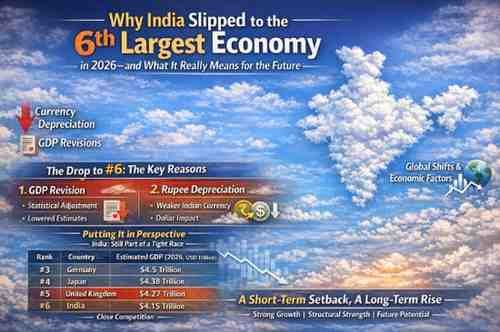
1. GDP Revision: A Statistical Reset
India updated its GDP calculation methodology, introducing a new base year. While such revisions are standard practice globally, they can lead to significant recalibrations.
The updated data revealed that earlier estimates had overstated the size of the economy. As a result, India’s GDP figures were adjusted downward.
This wasn’t an economic collapse it was a statistical correction. But in global rankings, perception matters just as much as reality.
2. Rupee Depreciation: The Silent Game-Changer
The second, and arguably more impactful factor, was the weakening of the Indian Rupee against the US dollar.
Even if India’s economy grows in rupee terms, a weaker currency reduces its dollar-denominated GDP. This creates a paradox where growth exists domestically but appears diminished globally.
What made this situation more unusual was that the dollar itself weakened against other major currencies like the pound and yen yet the rupee still lost ground. This widened the gap between India and countries like the UK and Japan.
How Close Are the Top Economies? The Real Competition Zone
While headlines focus on rankings, the actual numbers tell a more nuanced story.
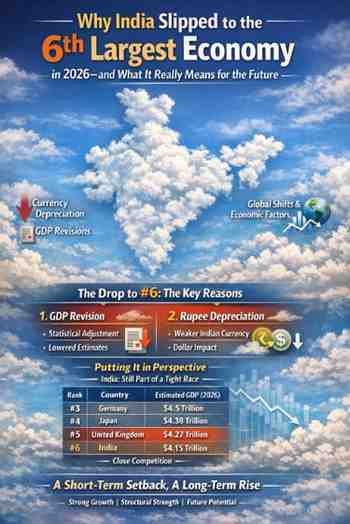
| Country | Estimated GDP (2026, USD Trillion) | Trend |
|---|---|---|
| United States | 32.38 | Strong Growth |
| China | 20.85 | Stable Expansion |
| Germany | ~4.5 | Moderate |
| Japan | 4.38 | Slight Decline |
| United Kingdom | 4.27 | Recovery Phase |
| India | 4.15 | Revised + Currency Impact |
The takeaway? After the US and china, the next four economies are extremely close. The difference between rank 3 and rank 6 is relatively small, meaning minor fluctuations can cause major ranking changes.
In other words, India hasn’t “fallen behind dramatically” it’s part of a tightly packed economic cluster.
Why This Drop Isn’t as Alarming as It Sounds
At first glance, slipping from 4th to 6th may seem like a setback. But a deeper analysis suggests otherwise.
1. India’s Growth Story Remains Intact
India continues to be one of the fastest-growing large economies in the world. Its domestic consumption, digital economy, and Infrastructure investments remain strong growth drivers.
2. Rankings Are Sensitive to External Factors
Exchange rates can shift quickly due to global capital flows, interest rates, and geopolitical factors. These are often outside a country’s direct control.
3. Structural Momentum Is Still Positive
India’s long-term fundamentals young population, expanding middle class, and ongoing reforms remain unchanged.
So while rankings fluctuate, the underlying trajectory matters more.
A Timeline of India’s Economic Rise and Recalibration
- 2022: India overtakes the UK to become the 5th largest economy
- 2023–2024: Strong growth fuels expectations of overtaking Japan and Germany
- 2025: Optimism peaks; projections place India among top 3 by 2030
- 2026: GDP revision + currency depreciation push India to 6th position
- 2027 (Projected): India likely to regain 4th position
- 2031 (Projected): Potential rise to 3rd largest economy
This timeline highlights a key insight: the current dip is part of a larger upward trend, not a reversal.
The Bigger Insight: Nominal GDP vs Real Economic Strength
Here’s a perspective often missing from mainstream discussions:
Nominal GDP rankings do not fully reflect economic strength.
They are influenced by currency values, which can fluctuate due to global financial conditions. In contrast, metrics like Purchasing Power Parity (PPP) provide a more stable comparison of real economic output.
In PPP terms, India remains among the top three economies globally, highlighting its true domestic economic scale.
Real-World Impact: What This Means for India
1. Investor Sentiment
Short-term perception may be affected, but long-term investors focus on growth potential, not rankings.
2. Policy Direction
The government may prioritize currency stability, export competitiveness, and fiscal discipline to strengthen global positioning.
3. Global Influence
India’s geopolitical and economic influence continues to rise, driven by its market size and strategic importance not just GDP rank.
Comparison Insight: India vs Japan vs UK
A critical insight often overlooked is that India’s economy is growing faster than both Japan and the UK.
- Japan is facing demographic decline and economic stagnation
- The UK is navigating post-Brexit adjustments
- India, in contrast, has strong demographic and consumption advantages
This means India’s lower rank today does not reflect its future potential.
Prediction: Why India Is Likely to Bounce Back Quickly
Based on current trends, India is well-positioned to regain lost ground. Here’s why:
- High growth rate: Consistently outpacing developed economies
- Digital transformation: Rapid expansion in fintech, e-commerce, and services
- Infrastructure push: Massive investments improving productivity
- Global supply chain shift: Increasing role as a manufacturing hub
If currency stability improves even slightly, India could quickly move back into the top 4 and potentially top 3.
The Unique Angle: This Is a Currency Story, Not a Growth Story
The most important takeaway and one many competitors miss is this:
India’s drop in ranking is less about economic weakness and more about currency dynamics and statistical adjustments.
This distinction is crucial. It means the fundamentals remain strong, and the setback is likely temporary.
Conclusion: A Short-Term Dip in a Long-Term Rise
India’s shift to the 6th largest economy in 2026 may appear dramatic, but it is best understood as a short-term recalibration rather than a structural decline.
The combination of GDP revision and currency depreciation created a perfect storm that impacted rankings but not the core growth story.
Looking ahead, India is still on track to:
- Reclaim the 4th position in the near term
- Compete for the 3rd position within the next decade
- Strengthen its role as a global economic powerhouse
In the grand scheme, this moment is less a setback and more a reminder: economic rankings are snapshots, but growth trajectories tell the real story.
For breaking news and live news updates, like us on Facebook or follow us on Twitter and Instagram. Read more on Latest India on thefoxdaily.com.






COMMENTS 0