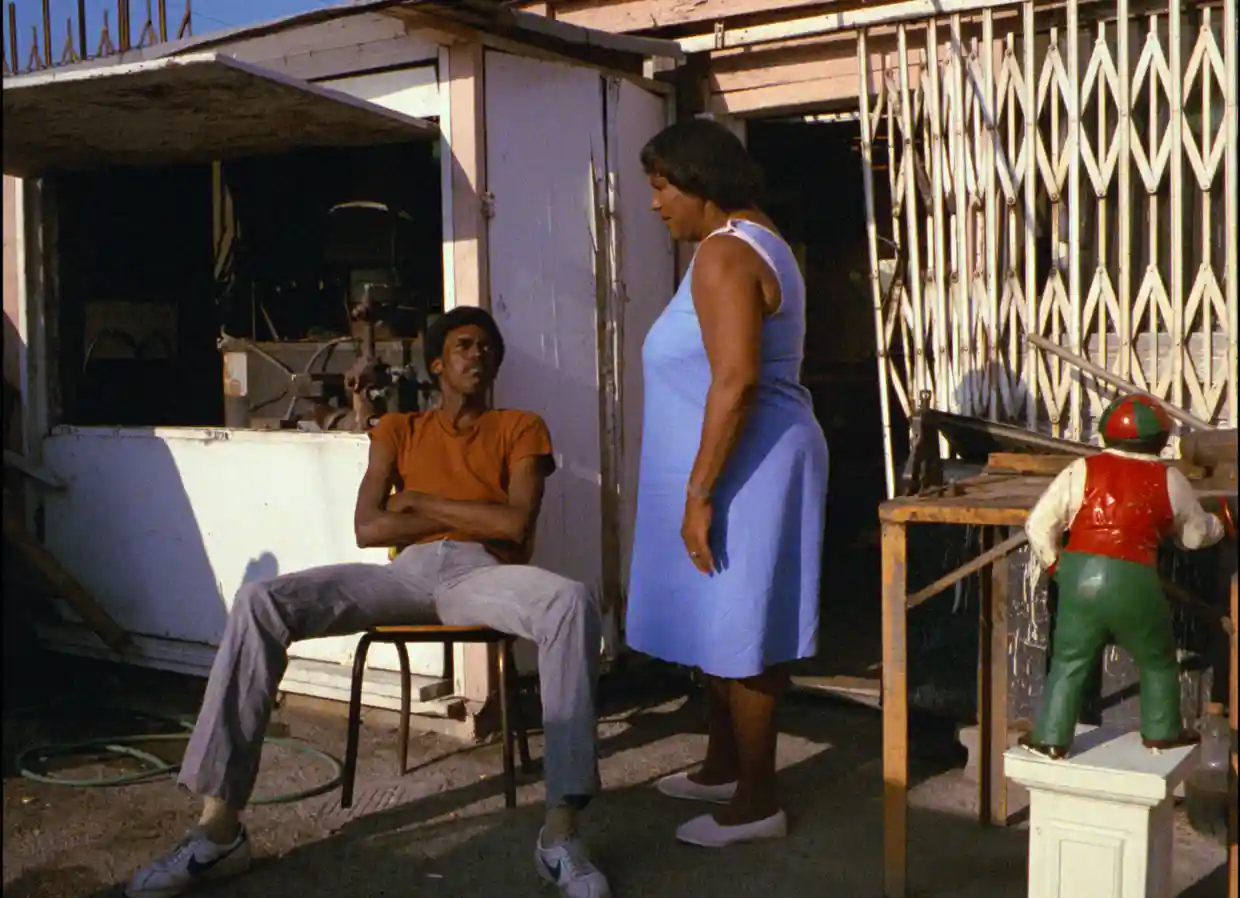
Filmmaker Charles Burnett is receiving renewed recognition as his restored 1983 film My Brother’s Wedding reaches a new generation of viewers. Through its portrayal of Black working-class life in South Central Los Angeles, the film explores class divisions, personal responsibility and everyday human contradictions. Burnett’s reflections on the production also reveal how independent filmmakers preserve stories that mainstream cinema has often overlooked.
Some films become important because of their commercial success, while others earn their place in cinema history through their honesty, distinctive perspective and influence on future generations. Charles Burnett’s My Brother’s Wedding belongs to the latter category. Made in 1983, the tragicomic drama captures the complexities of ordinary life in a Black working-class community in Los Angeles, focusing on relationships, class differences and the difficult choices people face.
For decades, the film remained difficult for audiences to access in the form its director originally intended. Production challenges, disagreements over the final edit and limited distribution prevented it from receiving the attention it might otherwise have attracted. A recent restoration has changed that situation, bringing the film back to theatres and streaming audiences while renewing interest in Burnett’s contribution to independent American cinema.
At 82, Burnett is experiencing a resurgence of appreciation for a career devoted to telling stories about people whose lives have frequently been marginalised or misrepresented on screen. The renewed attention surrounding My Brother’s Wedding also highlights a broader question: how many important films and performances have been overlooked because the industry failed to provide their creators with the resources, distribution or recognition they deserved?
Charles Burnett’s Personal Experience Inspired My Brother’s Wedding
At the heart of My Brother’s Wedding is a dilemma that Burnett himself experienced. He had agreed to attend the wedding of a co-worker, only to discover that it was scheduled for the same day and time as the funeral of a childhood friend.
Initially, Burnett decided to attend the funeral. However, when he tried to explain his decision to his co-worker, her disappointment made it difficult for him to withdraw from the wedding. He even attempted to persuade the bride to change the date, an idea he later acknowledged was unrealistic.
Unable to resolve the conflict, Burnett decided he would try to attend both events. When the day arrived, however, he became caught up in the wedding and ultimately missed the funeral.
That experience became the foundation for the central conflict in My Brother’s Wedding. The film follows Pierce Mundy, a young Black man facing a similar predicament after committing to attend a wedding before learning that a childhood friend has died.
Like Burnett, Pierce feels responsible for being present at both events. He struggles to reconcile competing obligations and even tries, unsuccessfully, to have the wedding rescheduled.
The parallel between the director’s experience and his protagonist’s predicament gives the story an intimate quality. Rather than constructing a dramatic dilemma from an extraordinary event, Burnett draws on a situation rooted in everyday life, where good intentions do not necessarily lead to good decisions.
The Meaning of Being Your Brother’s Keeper
For Burnett, the dilemma is about more than choosing between a wedding and a funeral. It raises questions about responsibility, maturity and the difference between wanting to do the right thing and actually making a responsible decision.
Reflecting on the film’s central idea, he explained:
“The idea was the fact that if you want to be someone’s brother’s keeper, you have to have principles and you have to be mature enough to make decisions and say, yes or no.”
He added that good intentions and decent character are not enough on their own. Being responsible for others requires the maturity to make appropriate decisions, even when those decisions disappoint someone.
This idea gives Pierce’s predicament its emotional complexity. He is not presented as a deliberately cruel or indifferent person. Instead, he is someone who wants to satisfy competing expectations but struggles to recognise that avoiding a difficult choice can itself have consequences.
Burnett’s approach allows the audience to consider Pierce’s limitations without reducing him to a simple moral lesson. His dilemma is recognisable precisely because it emerges from ordinary human behaviour: people can care about others and still fail to act decisively when their obligations conflict.
The film’s central question remains relevant beyond its specific setting. Personal responsibility often requires people to choose between competing demands, acknowledge the limits of what they can do and accept the consequences of their decisions.
Why My Brother’s Wedding Was Difficult to Complete
Despite the clarity of its central idea, My Brother’s Wedding encountered serious difficulties during production and post-production. These problems affected the film’s completion and contributed to its limited release.
One major challenge involved the lead actor, who disappeared from the set after demanding additional pay. Burnett later tracked him down and discovered that the actor had reinvented himself as a pastor.
The incident illustrates the practical challenges facing independent filmmakers, particularly productions working without the financial resources and organisational support available to larger studios. When a key performer becomes unavailable, the consequences can extend beyond an individual scene, affecting schedules, continuity and the ability to finish a project.
For a filmmaker working with limited resources, such disruptions can be particularly difficult to absorb. Independent productions often have less flexibility to replace personnel, extend shooting schedules or undertake expensive reshoots.
An Unfinished Cut Became the Film’s Final Version
The problems continued after filming ended. During post-production, a German broadcaster requested a completed version of the film. Burnett rushed to assemble a rough cut, expecting it to serve as an interim version rather than the definitive edit.
However, the production company accepted that rushed version as the final cut, against the director’s wishes.
The longer, unfinished version was subsequently shown at New York City’s New Directors/New Films festival in 1983, where it received mixed reviews. After that screening, the film became extremely difficult to see for many years.
For Burnett, the experience represented a painful compromise. The material existed, but the version audiences encountered did not reflect the finished work he had wanted to present.
Looking back, he acknowledged that starting over might have been preferable, but by then the opportunity had passed. He explained that filmmaking often requires creators to work through a succession of unexpected problems, making the best of the material and circumstances available to them.
His reflection captures an essential tension in independent filmmaking. Artistic ambition may be clear, but the final work is also shaped by financing, production schedules, personnel and decisions made by people beyond the director’s control.
Burnett’s experience also demonstrates why the preservation of a film involves more than retaining its footage. The form in which a film is edited, presented and distributed can significantly influence how audiences understand its artistic intentions.
“Sometimes It’s Not Perfect, but It Works”: Burnett on Independent Filmmaking
The phrase “Sometimes it’s not perfect, but it works” offers a useful way to understand Burnett’s approach to the realities of filmmaking. His experience with My Brother’s Wedding involved a series of compromises that prevented the film from reaching audiences in the form he had intended.
Yet the work survived. Its characters, observations and depiction of a specific community remained available for rediscovery, even when the film itself was difficult to access.
Burnett’s comments do not suggest that artistic compromises are unimportant. Rather, they reflect the practical reality that filmmaking frequently involves working through problems that cannot be completely resolved.
For independent directors, completing a film can require balancing creative goals against limited budgets, unpredictable production circumstances and external demands. The result may not be ideal, but it can still contain moments of considerable artistic value.
The restoration of My Brother’s Wedding makes that distinction especially significant. A film that spent decades circulating in a compromised form can now be presented more closely to its director’s original intentions, allowing audiences to evaluate the work with a clearer understanding of what Burnett wanted to achieve.
Restoring My Brother’s Wedding for a New Generation
Renewed interest in Charles Burnett’s work has accompanied efforts to preserve and restore his films. In 2025, his 1978 debut, Killer of Sheep, received a restoration that introduced the film to newer audiences. The work is widely regarded as a landmark of independent American cinema.
In 2026, My Brother’s Wedding, Burnett’s second feature, received a digital restoration and remastering. The project brought together Milestone Films, the UCLA Film & Television Archive, the Berkeley Art Museum & Pacific Film Archive, and Kino Lorber.
Burnett supervised the restoration in consultation with Maya S Cade, president of Milestone Films, and Jillian Borders, head of preservation at the UCLA Film & Television Archive.
The restored film has enjoyed sold-out screenings at New York’s Film Forum and has been shown at theatres across the United States. It is also available to stream on the Criterion Channel, with screenings planned across the United Kingdom and Europe later in the year.
These developments represent more than a renewed distribution opportunity. They give audiences the chance to encounter a film whose history was shaped by an unfinished edit and decades of limited accessibility.
Why Film Restoration Matters
Film restoration helps preserve works that might otherwise deteriorate or remain inaccessible. Depending on the surviving materials and the condition of the original elements, restoration can involve carefully recovering visual and sound information, addressing damage and preparing a version suitable for contemporary screening.
In Burnett’s case, restoration also carries a particular artistic significance. Because the original release was affected by post-production difficulties, presenting the film anew creates an opportunity for viewers to engage with the director’s work under improved conditions.
Maya S Cade described the restoration of Killer of Sheep and My Brother’s Wedding as experiences that “feel like resurrections”. She explained that the aim was to use available tools to ensure Burnett’s vision would endure for generations.
Her comparison captures the relationship between preservation and rediscovery. Restoration cannot reverse the circumstances that affected a film’s original release, but it can give the work a renewed public life.
It can also change how film history is understood. When an overlooked work becomes accessible again, viewers and scholars can reconsider its themes, style and influence without relying solely on incomplete memories or limited screenings.
Previously Unseen Photographs Preserve the People Behind the Film
The restoration effort has also brought attention to material beyond the film itself. While organising Burnett’s archive, Cade discovered previously unseen photographs taken during the production of My Brother’s Wedding.
The images offer an intimate look at the people who helped make the film. They document a production shaped not only by its director and principal performers but also by the wider community whose participation gave the work its distinctive texture.
According to Cade, the photographs reveal the number of people required to make a film and represent a form of archival repair in their own right.
Such images are valuable because film history is often told through the careers of directors, actors and other prominent figures. Behind every production, however, are people whose contributions may never receive comparable recognition.
For Burnett, the photographs have a deeply personal dimension. They allow him to remember friends and collaborators, many of whom have since died.
He has spoken about the emotional experience of seeing them again and expressed gratitude that the restored film allows audiences to appreciate their work. He also acknowledged feeling guilty that he had been unable to pay many of the non-professional actors who participated in his independent films.
The restoration gives those performers another opportunity to be seen. Their presence is preserved not as an abstract element of film history, but as part of the story of a community and the people who helped represent it on screen.
This is one of the less visible benefits of archival work: it can recover the contributions of people who might otherwise disappear from the historical record.
How South Central Los Angeles Shaped Burnett’s Storytelling
Burnett wrote, directed and produced My Brother’s Wedding on location in South Central Los Angeles, the area where he grew up. His familiarity with the community informed the film’s attention to everyday routines, neighbourhood relationships and the social pressures affecting working-class families.
The film does not treat its setting merely as a backdrop for a conventional plot. Its characters belong to a recognisable social world, shaped by employment, family expectations, economic limitations and competing ideas about success.
Burnett’s use of non-professional actors strengthens this sense of place. Their connection to the environments and experiences represented in the film contributes to its naturalistic quality.
Rather than presenting Black life through exaggerated stereotypes or extraordinary dramatic situations, the film focuses on people navigating ordinary problems. Its characters have ambitions, frustrations and disagreements, but they are not divided neatly into heroes and villains.
This approach was central to Burnett’s wider artistic vision. In his original treatment for the film, he wrote that its story communicated to all people, reflecting his belief that a deeply specific account of a community could speak to audiences beyond that community.
Class Divisions and the Meaning of Success in My Brother’s Wedding
One of the film’s most revealing themes is the difference between working-class life and middle-class respectability. Through Pierce’s family relationships, Burnett examines how economic status can shape people’s ambitions, judgments and relationships with one another.
Pierce’s brother, Wendell, is engaged to Sonia, a woman from an upper-middle-class family. Pierce distrusts Sonia’s apparent sweetness, viewing it as artificial rather than sincere.
The tension becomes especially visible during a dinner shared by the two families. Sonia’s family’s wealth is apparent in details such as fine wine and a maid serving the meal. Pierce interprets these displays as signs of social status and describes them as a form of showing off.
For Pierce, the dinner becomes an opportunity to challenge the assumptions that accompany wealth and conventional success. He lists the various jobs he has held, including driving a cement truck, working as a railroad brakeman and transporting explosives and other dangerous materials.
His mother, meanwhile, wishes her sons had become a doctor and a lawyer, like Sonia’s parents’ children. The exchange exposes a conflict between different ideas of achievement and the social value attached to particular occupations.
The scene ultimately develops into a heated argument involving Pierce, Wendell and Sonia. Beneath the confrontation lies a broader question: how much of a person’s worth is determined by their economic position, and how do class differences influence the way families judge one another?
Burnett’s Own Observations of Class and Opportunity
Burnett has explained that class differences were visible in Los Angeles while he was growing up. He also described the romantic ideas that people in his community sometimes held about poverty and the working class.
The film complicates those ideas. Pierce is not presented as an uncomplicated champion of working-class life. His attachment to the people and circumstances he knows does not automatically make his judgments fair or his decisions wise.
Similarly, the wealthier characters are not simply devices for demonstrating the superiority of one social group over another. The conflict emerges through competing attitudes, family expectations and personal misunderstandings.
This complexity gives the film a realism that extends beyond its specific setting. Class is not represented only through money or possessions; it also shapes how people define respectability, imagine their futures and evaluate the lives of others.
By grounding these tensions in a family gathering, Burnett turns a social issue into a recognisable human encounter. The characters disagree about success, but their arguments also reveal their fears, ambitions and desire for recognition.
The Influence of Southern Storytelling on Burnett’s Films
Although Burnett grew up in Los Angeles, his understanding of community was also shaped by stories passed down from older relatives and neighbours who had migrated from the American South.
Born in Vicksburg, Mississippi, Burnett recalled a neighbourhood culture in which people spent time talking on porches and sharing accounts of their experiences. Many of his neighbours had come to California from Mississippi, Louisiana, Texas and Arkansas.
His mother, grandmother and other relatives spoke about their lives in Mississippi, particularly their connections to Natchez and Vicksburg. Through these conversations, the South acquired a distinctive place in his imagination, shaped by memory, family relationships and the way people told stories about the past.
Burnett has described those recollections as having an almost mystical quality. The South existed in the stories not merely as a geographical location but as a place transformed by memory and personal experience.
That culture of storytelling helped inform his approach to cinema. His films often find significance in seemingly ordinary conversations, domestic routines and small interactions that reveal how people understand themselves and their communities.
Rather than forcing every scene towards a dramatic turning point, Burnett allows everyday life to retain its own rhythm. Humour can emerge from an awkward exchange, a family argument or a character’s imperfect response to a situation.
This emphasis on the mundane is not an absence of storytelling. It is a different understanding of what stories can contain. A person’s life may be meaningful without being extraordinary, and a film can reveal that meaning by paying close attention to the details that more conventional narratives might overlook.
Charles Burnett and the LA Rebellion Film Movement
Charles Burnett was a central figure in the LA Rebellion, a movement of Black filmmakers who challenged established Hollywood conventions and developed alternative approaches to telling stories about Black life.
Among the filmmakers associated with the movement were Julie Dash and Haile Gerima. Their work placed greater emphasis on Black experiences, community histories and visual approaches that differed from the dominant patterns of mainstream American cinema.
Burnett described the movement’s purpose as telling stories about the Black experience. Its filmmakers were responding to the harmful images that had shaped American cinema, including those found in D. W. Griffith’s 1915 film The Birth of a Nation.
The film, notorious for its racist portrayal of Black people and its glorification of the Ku Klux Klan, helped reinforce white supremacist narratives and is associated with the revival of the organisation. For filmmakers such as Burnett, challenging such representations meant more than simply replacing negative characters with positive ones.
It required developing stories in which Black people could appear as complex human beings rather than stereotypes created to serve someone else’s worldview.
My Brother’s Wedding reflects that commitment through its portrayal of Pierce. He is neither an idealised hero nor a one-dimensional figure. His strengths and shortcomings emerge from the same ordinary circumstances that shape the lives of the people around him.
By focusing on family disagreements, social aspirations, work and neighbourhood life, Burnett challenges the assumption that Black stories must conform to familiar Hollywood genres or dramatic formulas to be meaningful.
How Burnett’s Work Influenced Future Generations of Filmmakers
Burnett’s influence extends beyond the films he directed. His approach to independent filmmaking and his commitment to representing Black working-class life have inspired subsequent generations of artists.
His debut film, Killer of Sheep, has influenced filmmakers including Ava DuVernay, Sean Baker, Yasiin Bey and Barry Jenkins. Its renewed availability has helped audiences and emerging directors revisit a work that demonstrates how cinema can find power in ordinary lives and modest settings.
My Brother’s Wedding also has connections to filmmakers who later developed influential careers. Arthur Jafa and Julie Dash met while working as assistants on the production. Jafa served as first assistant camera on his first film set, while Dash worked as first assistant director.
These connections show how a film can contribute to cinema history in ways that are not immediately visible in its reception. A production may be difficult to distribute or receive mixed reviews, yet still provide an important creative environment for people who later shape the medium.
Burnett has also reflected on the talented Black actors he encountered while casting for professional productions. He recalled asking older performers where they had been, only to recognise that the question was misguided because the answer was already apparent: many had simply not been given the opportunities to demonstrate their abilities.
His observation points to a structural problem within the entertainment industry. Talent alone does not guarantee access to meaningful roles, financial support or sustained professional opportunities.
For Burnett, the loss is not merely personal to the actors. When talented performers are excluded, cinema loses stories, perspectives and performances that might have enriched its cultural record.
Why Archiving Black Cinema Matters
The renewed attention surrounding My Brother’s Wedding demonstrates the importance of preserving films and the records associated with their production.
Film archives can protect original materials, preserve photographs and documents, and help ensure that works remain available for future audiences. They can also recover evidence of the creative labour that surrounded a production, including the contributions of people whose names may not appear prominently in conventional accounts of film history.
Cade, who runs the Black Film Archive, an online database documenting Black films made between 1898 and 1999, has worked with Burnett’s archive for more than a year and a half.
Her discovery of the previously unseen production photographs adds another dimension to the restoration. The images preserve moments from the film’s creation and help reconnect the finished work with the community that participated in it.
This archival process matters because cultural history is shaped not only by the works that remain popular but also by the works that are preserved, studied and made accessible. If films disappear or remain difficult to see, their contributions can become less visible to scholars, artists and the public.
Restoration cannot by itself correct every historical inequality in film distribution or recognition. However, it can help bring overlooked work back into circulation and create opportunities for a more complete understanding of cinema.
In Burnett’s case, preserving the films also preserves the lives and experiences they depict. The characters in My Brother’s Wedding are fictional, but the world around them is rooted in real communities, personal memories and the everyday experiences of people whose stories have often received limited attention on screen.
Conclusion: Charles Burnett’s Enduring Vision of Ordinary Life
The restoration of My Brother’s Wedding offers audiences a chance to rediscover a film that combines humour, social observation and an unsentimental understanding of human behaviour. Its central dilemma, inspired by Charles Burnett’s own experience, becomes a meditation on responsibility and the difficulty of making decisions when obligations conflict.
The film’s production history is equally revealing. A disappearing actor, an unwanted final cut and years of limited accessibility prevented it from reaching its audience in the form Burnett intended. Yet the work survived, and restoration has given it a renewed life.
That revival also brings greater attention to the communities and collaborators who helped shape the film. From the non-professional actors who brought their experiences to the screen to the crew members whose careers later developed in significant directions, My Brother’s Wedding represents a collective creative effort.
Burnett’s larger contribution lies in his determination to portray Black working-class life without reducing it to stereotypes or forcing it into conventional Hollywood narratives. His characters make mistakes, argue with family members, pursue ambitions and struggle with everyday decisions. Their lives are meaningful because they are human, not because they fit a predetermined dramatic formula.
As the restored film reaches new audiences, its significance extends beyond a single production. It reinforces the importance of independent filmmaking, archival preservation and the opportunity for underrepresented artists to tell their own stories. Burnett’s career demonstrates that even a film shaped by imperfect circumstances can endure when its observations are honest and its vision remains worth rediscovering.
SEO keywords: Charles Burnett, My Brother’s Wedding restoration, Charles Burnett films, Black independent cinema, LA Rebellion film movement, Killer of Sheep, Black working-class life, film restoration, Milestone Films, UCLA Film & Television Archive
For breaking news and live news updates, like us on Facebook or follow us on Twitter and Instagram. Read more on Latest Lifestyle on thefoxdaily.com.

COMMENTS 0