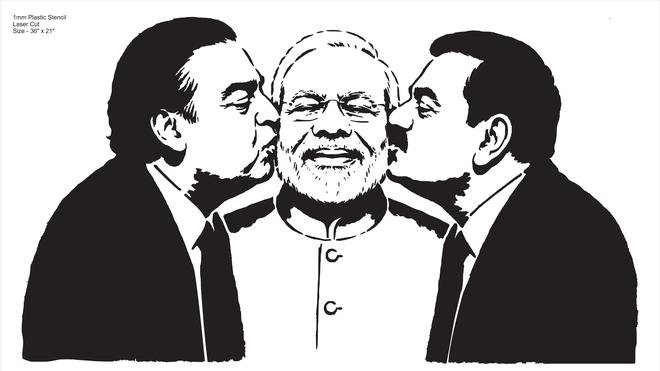
In an age where protest movements are shaped as much by visuals as by slogans, street artist Tyler’s stencil has emerged as a defining image in the ongoing protests against the NEET examination paper leak in India. What began as an artistic expression in Mumbai has rapidly transformed into a nationwide protest symbol, prominently seen at demonstrations in places like Jantar Mantar in New Delhi.
This moment highlights the growing intersection of street art, youth activism, and political expression—especially among Gen Z, who are increasingly using visual culture to articulate dissent.
Who: Mumbai-based street artist Tyler and student protesters
What: A stencil artwork becoming a protest symbol
When: During the 2026 NEET protest movement
Where: Across India, especially Jantar Mantar, New Delhi
Why: To visually express frustration over examination irregularities
How: Through widespread sharing, replication, and adaptation of the artwork
—
The Context: NEET Protests and Youth Anger
The National Eligibility cum Entrance Test (NEET), one of India’s most competitive medical entrance exams, has faced intense scrutiny following allegations of a paper leak. The controversy triggered protests across multiple cities, with students demanding accountability, transparency, and systemic reform.
What makes this movement distinct is its visual language. Unlike traditional protests dominated by speeches and placards, this wave has been marked by memes, posters, and street art—tools that resonate deeply with a digitally native generation.
In this landscape, Tyler’s stencil found fertile ground.
—
The Artwork: Symbolism and Interpretation
The stencil in question depicts Prime Minister Narendra Modi flanked by prominent industrialists—a composition that invites interpretation and critique. While the artist’s intent may be layered, protesters have embraced the image as a shorthand for broader concerns about governance, accountability, and institutional integrity.
Street art thrives on ambiguity, and this piece is no exception. Its power lies in:
- Visual immediacy – easily recognisable and shareable
- Symbolic layering – open to interpretation
- Reproducibility – simple enough to recreate across mediums
These qualities have enabled the artwork to transcend its original context and become a collective symbol.
—
From Street to Protest: How the Image Spread
The journey of Tyler’s stencil from a local artwork to a national protest icon illustrates how modern movements operate.
| Stage | Medium | Impact |
|---|---|---|
| Creation | Street walls in Mumbai | Initial visibility |
| Digital Sharing | Social media platforms | Rapid amplification |
| Adoption | Printed posters, placards | Mass participation |
| Symbolisation | Protests across India | Cultural and political significance |
Once the image entered the digital ecosystem, it was reshaped, remixed, and redistributed—turning it into a viral visual language.
—
Art as Protest: A Historical Perspective
Tyler’s stencil is part of a long tradition of art being used as a tool of resistance.
- 1960s protest posters during civil rights movements
- Graffiti and murals in political revolutions worldwide
- Digital memes in modern social movements
What has changed is the speed and scale. Today, an artwork can move from a street corner to a national stage within hours.
—
Why This Matters: Beyond the Artwork
The rise of Tyler’s stencil as a protest symbol reveals deeper shifts in how dissent is expressed in India.
1. Visual Communication is Dominant
Images are faster to consume and easier to share than text-heavy arguments.
2. Decentralised Movements
No single leader controls the narrative; symbols like this unify diverse voices.
3. Youth-Led Expression
Gen Z protesters are leveraging creativity to engage and mobilise peers.
—
The Role of Social Media in Amplification
Without social media, the stencil might have remained a local phenomenon. Instead, platforms enabled:
- Instant visibility
- User-generated variations
- Cross-city adoption
This demonstrates how online and offline activism are now deeply interconnected.
—
A Unique Insight: The Rise of “Open-Source Protest Art”
One of the most interesting aspects of this movement is how the artwork functions almost like open-source content.
Anyone can:
- Download it
- Modify it
- Print or paint it
- Use it in their own context
This removes barriers to participation and allows the symbol to evolve organically.
In effect, the protest owns the art—not the artist alone.
—
Potential Risks and Controversies
As with any politically charged artwork, Tyler’s stencil is not without controversy.
- Different interpretations may lead to polarisation
- Legal scrutiny around public displays
- Attribution challenges as the image spreads
These factors highlight the complex relationship between art, politics, and public space.
—
What This Means for Future Movements
The success of this visual symbol suggests a broader trend:
- Protests will increasingly rely on strong visual identities
- Artists may play a more central role in activism
- Movements will adopt shareable, adaptable content
This could redefine how public discourse is shaped in the years to come.
—
Conclusion: When Art Becomes a Voice
Tyler’s stencil is more than just a piece of street art—it is a reflection of a generation finding its voice through creativity.
Its journey from Mumbai to Jantar Mantar underscores the power of imagery in uniting people, conveying complex ideas, and sustaining momentum in protest movements.
In a world saturated with information, it is often a single image—not a thousand words—that captures the moment.
And in this case, that image has become a symbol of dissent, dialogue, and the evolving language of protest in India.
For breaking news and live news updates, like us on Facebook or follow us on Twitter and Instagram. Read more on Latest Lifestyle on thefoxdaily.com.

COMMENTS 0