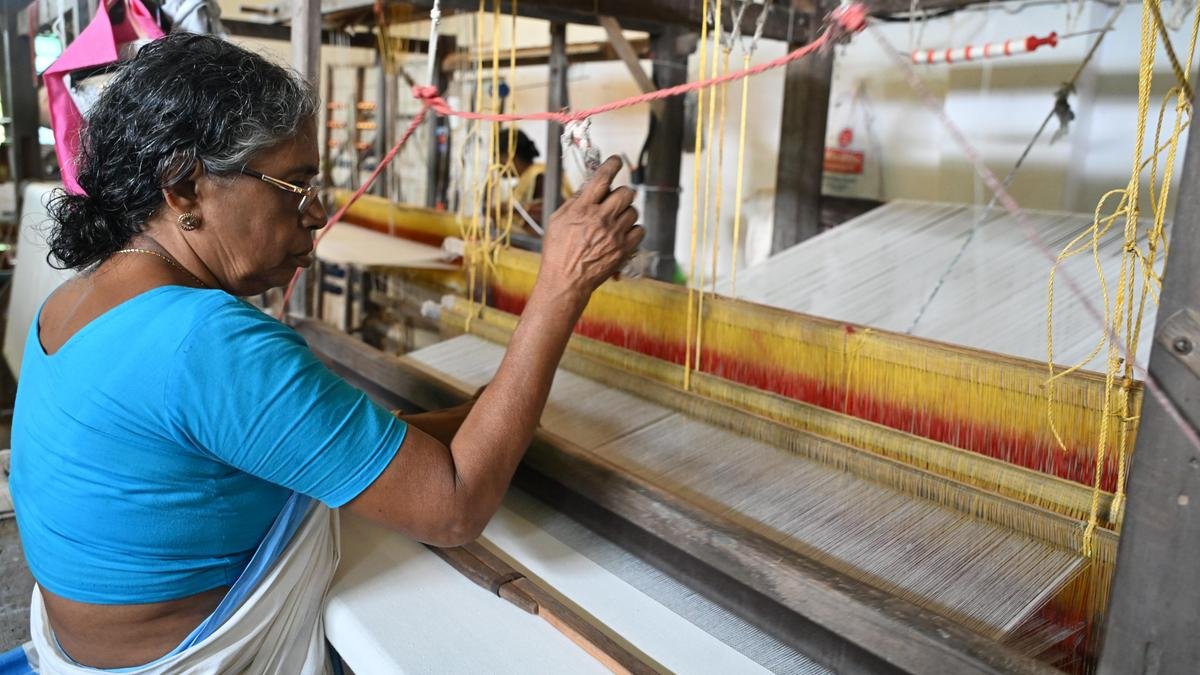
Kannur handloom industry crisis: Kannur’s reputation as the “Manchester of Kerala” was built not through nostalgia but through generations of skilled weaving, cooperative production and a textile economy that connected local households with markets far beyond the district. Yet the industry that once provided dependable livelihoods to thousands of workers is now facing a difficult question: can traditional handloom remain a viable occupation in an economy increasingly dominated by mechanised production?
The warning signs are becoming difficult to ignore. Kerala, which once had roughly 25,000 to 30,000 handloom workers, now has about 18,000, according to industry representatives cited in the source material. The number of handloom cooperative societies has also declined from approximately 600 to around 450. At the same time, delayed wages, financial losses and shrinking worker participation are putting pressure on societies that were originally designed to protect the interests of weavers.
The crisis is therefore bigger than falling production. It is about whether an occupation rooted in Kannur’s social and economic history can still provide a sustainable income in the twenty-first century.
Why Kannur became known as the ‘Manchester of Kerala’
Kannur’s association with handloom is the result of a long-established textile ecosystem in which weaving was not simply a factory occupation but a community-based livelihood. Skills were passed between generations, cooperative societies organised production and workers developed specialised knowledge that gave the district’s textiles a distinctive identity.
The comparison with Manchester is revealing. Manchester became internationally associated with textile manufacturing because its economy was transformed by the textile industry. Kannur developed a very different model, one deeply connected with Kerala’s cooperative traditions and household-level skills.
That distinction matters today. A heritage industry cannot survive simply because consumers admire its history. It needs functioning institutions, skilled workers, reliable income, viable markets and a production model capable of competing with alternatives.
Kannur’s current predicament shows what happens when the cultural value of an industry grows faster than its economic sustainability.
National Handloom Day highlights an uncomfortable contradiction
National Handloom Day is intended to recognise India’s weaving communities and the cultural and economic importance of handloom. For Kannur, however, the occasion also exposes a contradiction.
The district can celebrate its handloom heritage while many weaving units struggle to provide workers with timely income.
That contradiction deserves more attention than ceremonial recognition alone. A handloom product may be promoted as traditional, sustainable and artisanal, but the person who actually produces it needs a predictable livelihood. Without that economic foundation, heritage becomes increasingly disconnected from the people who created it.
The most important question on National Handloom Day is therefore not simply how to preserve handloom designs. It is how to ensure that weaving remains an occupation people can realistically choose.
The worker shortage is also a livelihood crisis
The decline from roughly 25,000–30,000 handloom workers in Kerala to about 18,000 is more than a statistic. It represents a gradual erosion of the human infrastructure required to keep the sector alive.
Handloom is inherently skill-intensive. A machine can be purchased or upgraded relatively quickly, but experienced weaving knowledge takes years to develop. When older workers leave and younger generations decide not to enter the profession, the industry loses accumulated knowledge that cannot be replaced simply by increasing financial investment.
The reasons for leaving are also understandable. Workers need income at predictable intervals. If wages are delayed for extended periods, a job that carries significant physical demands becomes difficult to justify when alternative employment offers quicker or more reliable earnings.
This creates a cycle that can accelerate decline.
- Fewer workers reduce production capacity.
- Lower production can weaken the financial position of societies.
- Financial difficulties can contribute to delayed wages.
- Delayed wages encourage more workers to leave.
- Fewer skilled workers make it harder to revive production.
Breaking that cycle requires more than asking workers to remain committed to tradition.
Delayed wages are the clearest warning signal
Among all the challenges facing Kannur’s handloom sector, delayed wages may be the most immediate threat because they directly affect household survival.
A worker cannot pay rent, buy food or manage everyday expenses with promises of future payment. Unlike a business owner who may be able to absorb a temporary cash-flow problem, a wage-dependent worker has limited room to wait.
This explains why some workers have reportedly left the profession. Their decision should not automatically be interpreted as a loss of interest in handloom. In many cases, it is an economic decision.
This distinction is crucial. If policymakers interpret the decline merely as younger workers becoming uninterested in traditional occupations, the response may focus on skill promotion or awareness campaigns. But if delayed wages and unstable livelihoods are major reasons for attrition, financial restructuring becomes much more important.
Why cooperative societies matter to Kannur’s handloom economy
The decline in handloom cooperative societies from around 600 to approximately 450 is another significant indicator of structural stress.
Cooperatives have historically played an important role in organising handloom production. They can provide a framework through which workers collectively manage production, procurement, sales and other aspects of the business rather than negotiating entirely as individuals.
When cooperative societies weaken, the consequences can extend beyond administrative efficiency. Workers may lose an institutional mechanism through which they access employment, materials and markets.
The decline therefore raises a larger question: are the existing cooperative structures designed for the market conditions of today?
A cooperative model does not automatically guarantee commercial success. Societies need working capital, professional management, reliable buyers, contemporary product development and strong marketing channels. Without these, even an institution created to protect workers can become financially fragile.
The power loom problem is really a question of market economics
The advance of power looms has intensified the pressure on traditional handloom production.
Power looms can produce fabric at much greater speed and scale. For markets where price, volume and delivery speed dominate purchasing decisions, mechanised production has an obvious advantage.
Kannur itself demonstrates this transition. The district continues to have a strong position in Kerala’s home textile export economy through power loom-based production, even as traditional handloom struggles.
This creates a striking industrial paradox: the region remains associated with textiles, but the economic success of mechanised textile production does not automatically translate into prosperity for traditional handloom workers.
Handloom cannot realistically win a volume competition against power looms by attempting to produce identical products more cheaply. Its survival strategy has to be different.
Handloom’s future cannot depend on competing on price
This may be the most important economic lesson from Kannur’s crisis.
If a handloom cooperative attempts to sell a product that looks and performs like a mass-produced power-loom product while charging significantly more, convincing consumers to choose the handloom version becomes difficult.
Instead, the industry needs to emphasise attributes that mechanised mass production cannot reproduce in the same way: craftsmanship, design individuality, provenance, cultural identity and the human skill embedded in production.
But these qualities must be translated into commercial value.
Consumers may admire a handwoven fabric, but admiration alone does not guarantee a sale. The product must also have contemporary design, consistent quality, convenient availability, attractive presentation and a price that consumers understand.
In other words, Kannur handloom needs to move from simply selling “traditional fabric” to selling a compelling product story backed by quality and design.
The missing link: connecting heritage with contemporary demand
One danger facing heritage industries is the assumption that preserving the past means reproducing the same products indefinitely.
That approach can gradually shrink the customer base. Younger consumers may appreciate traditional craftsmanship but prefer modern silhouettes, home interiors, colours and functional products.
Kannur’s handloom sector could therefore benefit from treating traditional weaving as a production capability rather than a fixed catalogue.
The same skills can potentially support contemporary home textiles, fashion accessories, apparel fabrics and other products if designers and weavers work together effectively.
This is not about abandoning tradition. It is about translating traditional skill into products that fit contemporary lifestyles.
Design could become as important as production
One of the biggest opportunities for the handloom sector lies in design innovation.
Weavers possess technical knowledge about yarn, texture, patterns and construction. Designers understand changing consumer preferences. When those two capabilities are brought together, traditional weaving can produce products that feel contemporary without losing their handcrafted character.
Such collaboration could also help distinguish Kannur’s products from generic handloom merchandise sold across different regions.
A strong regional identity can become a commercial advantage when it is supported by consistent design and quality. “Made in Kannur” could mean more than geographical origin; it could become an identifiable design proposition.
Young workers will not return because of nostalgia
The industry’s demographic challenge requires a realistic response.
Young people are unlikely to enter handloom simply because they are told that their grandparents worked on looms. Cultural pride is important, but employment decisions are usually shaped by income, working conditions, career prospects and social mobility.
If handloom is to attract a new generation, it needs to offer a credible career proposition.
That could involve better wage predictability, skill certification, opportunities to move into design and production management, exposure to digital commerce and clearer pathways for entrepreneurship.
The future handloom worker may not necessarily look like the traditional image of a weaver. A young person trained in textile design, digital marketing or e-commerce could become part of the same ecosystem while remaining connected to the weaving process.
This broader definition of the sector could help prevent handloom from becoming isolated from the skills and technologies required by modern markets.
Technology should support handloom rather than replace it
The debate is often framed as handloom versus technology, but that is too simplistic.
Digital tools can potentially help traditional producers with inventory management, customer communication, product catalogues, payments, marketing and direct sales. Technology can also help document designs and maintain records of production and demand.
The critical distinction is between using technology to strengthen the handloom ecosystem and replacing the skilled human production that gives handloom its identity.
Digital commerce is particularly relevant because it can reduce dependence on a limited local customer base. A cooperative society with a strong online catalogue can potentially reach consumers interested in handcrafted textiles beyond Kannur.
However, online visibility alone is not enough. Digital sales require reliable fulfilment, quality control, packaging, customer service and consistent supply.
The sector needs to rethink what success means
For years, the success of handloom may have been measured largely in terms of production and the number of workers employed. Those indicators remain important, but they do not capture the entire problem.
A more useful framework would consider whether a weaving unit can provide predictable wages, maintain skilled employment, generate sufficient margins, develop new products and attract younger workers.
This shifts the conversation from preserving units at any cost to building economically viable institutions.
That does not mean abandoning struggling societies. It means identifying why they are struggling and directing support towards the problems that actually prevent sustainability.
Government support needs to reach the production floor
Government schemes and institutional assistance can play an important role in protecting traditional industries, but their effectiveness ultimately depends on whether benefits reach workers and functioning production systems.
For Kannur, the immediate priority should include mechanisms that reduce wage delays and address working-capital problems. Beyond that, support should encourage product development, market access, design partnerships and training for younger workers.
Subsidies that merely keep an unsustainable production model alive cannot solve the underlying problem indefinitely. The stronger approach is to combine social protection with commercial restructuring.
Handloom is both an economic sector and a cultural asset. Policy therefore has to recognise both dimensions without allowing either one to obscure the other.
Kannur’s textile identity is not necessarily disappearing — it is changing
It would be too simplistic to describe Kannur’s textile story as a straightforward collapse. The district continues to have a significant textile economy, particularly through power loom production and home textiles.
The more precise description is a transition.
The industrial base that once gave traditional handloom a central role is changing. The challenge is determining whether handloom can find a new position within that evolving textile economy.
That position does not have to be the largest one. A smaller but financially healthy handloom sector with skilled workers, strong products and distinctive markets could be more sustainable than a much larger system surviving through chronic financial stress.
A possible roadmap for reviving Kannur handloom
A sustainable revival would require several interventions working together rather than a single rescue measure.
- Ensure timely wages: Workers cannot be expected to remain in an occupation where income is unpredictable.
- Strengthen cooperative finances: Societies need adequate working capital and commercially capable management.
- Invest in contemporary design: Traditional weaving skills need products that match present-day consumer preferences.
- Build stronger branding: Kannur’s textile identity should become a recognisable commercial advantage.
- Expand digital sales: Cooperatives should reach customers beyond conventional local and institutional markets.
- Create opportunities for young workers: Training should include weaving as well as design, technology, marketing and entrepreneurship.
- Differentiate handloom from power loom: Competing primarily on price is unlikely to be a sustainable strategy.
The common thread is simple: preservation must be linked to viability.
What happens if the decline continues?
The consequences would extend beyond the loss of an industry.
Every generation of workers leaving handloom reduces the pool of people capable of passing traditional techniques to the next generation. Once a specialised skill disappears, restoring it can be extremely difficult.
There is also a social cost. Cooperative societies are not merely production centres; they form part of the institutional history of communities that have depended on collective economic activity.
And there is a cultural cost. Kannur’s reputation as a textile centre was created by people who turned skill into livelihood. If the industry survives only as a museum story, the region may retain the memory of handloom without retaining the economic ecosystem that made that memory possible.
Conclusion: Kannur handloom needs a future, not just a celebration
Kannur’s handloom crisis is not simply a story about old looms struggling against modern machines. It is a story about whether traditional skill can remain economically meaningful in a rapidly changing market.
The decline in workers and cooperative societies, combined with delayed wages and financial pressure, shows that nostalgia alone cannot sustain the industry. The people who weave the fabric need reliable livelihoods, and cooperatives need commercially viable models.
The way forward is not necessarily to make handloom compete directly with power looms. It is to make handloom valuable for reasons that mass production cannot easily replicate — craftsmanship, design, identity, quality and authenticity — while using modern tools to improve the way those qualities reach consumers.
Kannur does not have to choose between heritage and modernity. Its real challenge is to connect the two.
The future of the “Manchester of Kerala” will ultimately depend not on how loudly its handloom legacy is celebrated, but on whether the next generation can see weaving as a viable livelihood rather than a fading memory.
For breaking news and live news updates, like us on Facebook or follow us on Twitter and Instagram. Read more on Latest Lifestyle on thefoxdaily.com.

COMMENTS 0