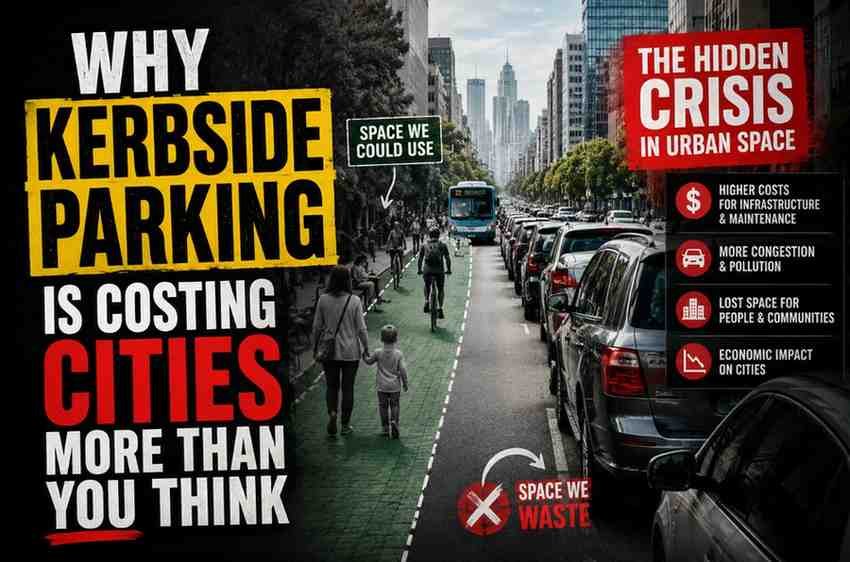
There is a peculiar social contract embedded in every street in every city in the world. A strip of public land typically about 2.4 metres wide and eight metres long per space is handed over, free of charge or for a nominal fee, to a privately owned machine. That machine sits there for an average of 23 hours a day, doing absolutely nothing, occupying space that could be a tree, a bench, a protected cycle lane, a rain garden, a wider pavement, or a business terrace. The machine’s owner drives away for an hour, parks somewhere else, and the cycle continues. Nobody questions it because it has always been this way. And yet, as cities from Oslo to Ottawa to Minneapolis have been discovering in recent years, kerbside parking is one of the most expensive, dangerous, and economically inefficient things a city can offer its residents and it overwhelmingly benefits one group at the expense of everyone else.
The question is no longer whether kerbside parking reform makes sense. The evidence has settled that debate comprehensively. The question is whether the political will exists to act on it and, increasingly, why it is taking so long.
The most important thing to understand about kerbside parking is that it is not free. It has never been free. It is simply free for the person parking. Everyone else pays.
Public rights-of-way are among the most valuable assets a city owns. Kerb space in a dense urban area can be worth hundreds of thousands of pounds per year in commercial value if used for anything other than car storage. Research from Urban Planning academics consistently finds that cities dramatically undervalue and therefore underprice public parking drivers receive more than their proportional share of these assets compared to bus riders, cyclists, and pedestrians, all of whom pay taxes that fund the same street infrastructure without receiving equivalent space allocation in return.
The land cost alone is staggering when aggregated. Urban planning professor Adam Millard-Ball at UCLA has estimated that in some city-centre areas, parking takes up a quarter or more of all available land and studies consistently show that more than a third of those spaces sit empty at any given moment. This is not efficient allocation of scarce urban real estate. It is a publicly subsidised welfare programme for car owners, paid for by everyone.
Off-street parking, when it is built into new housing developments, carries an additional hidden tax. Research cited by the US Department of Transportation found that removing parking minimums in transit-oriented areas of Colorado could lead to 71 per cent more homes being built in those areas, and 41 per cent more homes overall in urban zones. Every parking space built into a residential development adds cost to every unit whether or not the occupant owns a car. Cities like Minneapolis, which removed off-street parking minimums in 2017, subsequently saw housing construction rates run at three times the rest of Minnesota, while rents rose by just one per cent compared to 14 per cent statewide. The asphalt connection to housing affordability is direct and documented.
The Safety Problem: Parked Cars Kill
There is a visual pollution argument against kerbside parking that urbanists make constantly the deadening effect of a street wall of steel on walkability, neighbourhood character, and local economy. That argument, however compelling, is almost beside the point when you consider the physical danger that rows of parked cars represent to non-drivers.
Kerbside parking degrades pedestrian sightlines in ways that are directly lethal. A pedestrian particularly a child stepping from between two parked cars is invisible to an approaching driver until the last fraction of a second. The cars that protect the driver who parks them become a visual wall that endangers everyone trying to cross the road nearby. Analysis of UK road safety data shows that 88 per cent of pedestrian deaths in road traffic accidents occur on urban roads the very roads where kerbside parking is most dense.
The danger geometry extends beyond pedestrian crossings. Kerbside parking forces cyclists into the door zone the arc of danger created when a parked car’s door is opened without warning. It narrows effective road width, compresses bus routes, and forces buses to stop further from the kerb, creating the gap between bus and pavement that causes falls and injuries disproportionately among elderly and disabled passengers. And when emergency vehicles need rapid access to residential streets, it is the density of parked cars not the distance from the fire station that most often determines whether they arrive in time.
None of this is unknown to transport engineers. It has simply been politically easier to accept it as the background radiation of urban life than to challenge the cultural assumption that a car has an inherent right to rest on a public street indefinitely.
The Myth That Retailers Depend on It
The most tenacious political argument for kerbside parking is the one made by local businesses: take away the parking and you take away the customers. It is repeated by high street associations, local councillors, and chambers of commerce with such conviction that it has become received wisdom. The research says otherwise consistently, across multiple cities, over multiple decades.
A study on Boundary Street in Brisbane, Australia, directly tested the business dependency assumption when kerbside parking was reassigned to cycling infrastructure. The data showed that most visitors arrived on foot, that parking spaces were generally available anyway (contrary to local belief), and that pedestrians accounted for 34 per cent of all commercial spending in the area far exceeding the contribution of drivers. This pattern has been replicated in study after study across Europe and North America.
The Oslo example is perhaps the most dramatic real-world test. Between 2016 and 2018, the Norwegian capital removed 800 on-street parking spaces from its city centre as part of its Car-free Liveability Programme. Businesses predicted disaster. What happened instead was a measurable increase in city-centre business turnover between 2017 and 2018, higher footfall than in comparable reference areas, and an increase in the number of businesses choosing to establish themselves in the city centre. Car traffic within the area fell by 11 per cent by 2018 and by a further 19 per cent by 2019. Not a single apocalyptic prediction made by parking’s defenders came true.
The explanation, once examined, is not surprising. Pedestrians, cyclists, and transit users visit local businesses more frequently than drivers, who tend to make larger, less frequent trips. A street where people are walking because the pavements are wider, the environment is more pleasant, and there is somewhere to sit is a street where people spend money. A street lined with parked cars is a through-route, not a destination.
What the Space Could Be Instead
The really energising part of the kerbside parking debate is not the argument against cars. It is the argument for everything else. The question “what do we do with the space?” has generated some of the most creative urban thinking of the past decade and some of its most convincing evidence.
| Alternative Use | Key Benefit | Real-World Example |
|---|---|---|
| Widened pavements | Pedestrian safety, accessibility, footfall | Oslo city centre footfall increased 10% |
| Protected cycle lanes | Road safety, reduced car trips, health | Copenhagen 300km+ of routes post-reform |
| Parklets / green space | Urban heat reduction, biodiversity, wellbeing | Paris greening of surplus parking spaces underway |
| Rain gardens | Stormwater management, flood reduction | New Orleans, Indianapolis 9climate adaptation pilots |
| Street furniture and seating | Dwell time, social cohesion, elderly access | Rotterdam systematic space reallocation programme |
| Loading zones and delivery bays | Last-mile logistics, reduced congestion | Multiple cities globally zero-emission delivery zones |
| Outdoor dining terraces | Business revenue, street vibrancy | Barcelona parking revenue funds public bike system |
| Social housing footprint | Affordability, density, urban infill | Ottawa eliminated parking mandates January 2026 |
Research published in npj Urban Sustainability modelled what would happen if kerbside parking spaces in a typical city were converted to rain gardens and green space. Even under conservative assumptions moving parking off-street rather than eliminating it the conversions would deliver substantial biodiversity gains, measurable reductions in urban heat island effects, and improved stormwater interception that reduces flood risk downstream. These are not marginal lifestyle improvements. In a climate of increasingly intense urban heat events and flash flooding, they are infrastructure investments with direct public health implications.
The Political Economy of Kerb Space
If the evidence is this strong, why do most streets still look the way they did in 1975? The answer is political rather than technical and understanding it is essential to understanding how change actually happens.
Car owners vote. They vote in high proportions, they are geographically spread across constituencies, and they have a sharp, immediate, tangible interest in parking that motivates political engagement. The benefits of removing kerbside parking safer streets, greener space, lower housing costs, better air quality are diffuse, long-term, and distributed across the whole population rather than concentrated in an identifiable advocacy group. This creates a structural asymmetry that politicians navigate carefully: the person who will lose their parking space is angry today, and the child who would have grown up with cleaner air and safer streets cannot vote.
This is why the most successful parking reforms have tended to happen either through state or national legislation which can override local political inertia or in cities with strong mayoral leadership willing to absorb short-term political cost for long-term urban benefit. In the United States, Montana and Washington passed state laws in 2025 preventing cities from requiring off-street parking for most new multifamily housing. Baltimore eliminated citywide parking minimums in late 2025. Ottawa voted unanimously in January 2026 to abolish parking mandates across all urban and suburban areas the culmination of a decade-long reform campaign. Boston was actively debating the same step in June 2026.
The momentum is real, and it is accelerating. The question is no longer whether this reform movement will reshape urban space it is how quickly and how equitably it does so.
The Equity Dimension: Who Is Parking Reform Actually For?
The most important critique of aggressive kerbside parking reform is an equity one, and it deserves honest engagement rather than dismissal. Not everyone who drives to a high street or parks outside their home has a comfortable alternative. Disabled people for whom walking distance to a car-free zone is impossible. Shift workers who return home at 2am when no bus runs. Rural residents whose nearest amenity is fifteen miles away. Carers transporting equipment or dependent family members who cannot manage public transport.
The answer is not to preserve the status quo in deference to these legitimate needs. It is to design parking reform that accommodates them explicitly maintaining accessible parking near key destinations, building adequate disabled bays as a non-negotiable element of any reallocation, and sequencing car removal in parallel with genuine public transport improvement rather than in advance of it. Cities that have done this well Copenhagen, Zurich, Stockholm have demonstrated that the two are compatible. Cities that have removed parking without improving alternatives have created genuine hardship and deserved the backlash they received.
The equity argument cuts both ways, however. Kerbside parking as currently structured is itself deeply inequitable. It disproportionately benefits car owners who tend to be wealthier, more mobile, and better served by existing transport infrastructure at the cost of public space and air quality that affects everyone. In London, parking revenues from short-stay visitors and enforcement income cross-subsidise resident permit costs, meaning that non-car-owning residents effectively subsidise their neighbours’ parking through the general rate base. That is a redistribution in the wrong direction.
The Path Forward: What Good Reform Looks Like
The cities making the most progress share a common approach that is neither wholesale abolition nor status quo preservation. It involves three interlocking elements: price it, repurpose it, replace it.
Pricing kerbside parking to reflect its true market value rather than setting it at a fraction of the cost reduces cruising-for-parking traffic (which studies suggest accounts for up to 30 per cent of urban traffic in congested areas), generates revenue for public transport, and signals to drivers that kerb space is a shared resource rather than an entitlement. Barcelona’s parking reforms generated sufficient revenue to fund the city’s entire public bike system. London boroughs use parking charge revenues to provide free public transport for elderly and disabled residents.
Repurposing specific spaces starting with the most redundant, the most dangerous, and the most valuable into parklets, cycle infrastructure, or loading zones demonstrates the alternative in physical form before the political argument is fully won. People understand a tree and a bench in a way they do not understand an urban planning white paper.
And replacing the trips that currently require parking through genuinely competitive public transport, safe cycling infrastructure, and walkable neighbourhood design means that the demand for kerbside space erodes naturally over time, rather than being taken away by force.
Conclusion: The Most Valuable Public Space We Give Away for Free
Kerbside parking is a subsidy masquerading as infrastructure. It is a safety hazard marketed as convenience. It is a housing affordability crisis embedded in a zoning code. And it is, overwhelmingly, a gift from the public at large to a minority of car owners who have come to regard a space on a public street as a private right.
The evidence accumulated from Oslo to Ottawa, from Brisbane to Barcelona, from Minneapolis to Paris, points in one direction with unusual consistency: cities that have reclaimed kerb space from cars have not regressed. They have become more walkable, more economically vibrant, safer, greener, and better adapted to the climate pressures that are rewriting the agenda for urban design. The businesses that feared the worst have mostly seen the opposite. The footfall went up. The cyclists arrived. The tree grew.
The kerbside is not an inert strip of tarmac. It is the front line of the fight for what cities are for. The question is whether the people who make decisions about it are prepared to treat it that way or whether, for another decade, they will leave it to the cars.
For breaking news and live news updates, like us on Facebook or follow us on Twitter and Instagram. Read more on Latest Lifestyle on thefoxdaily.com.




COMMENTS 0