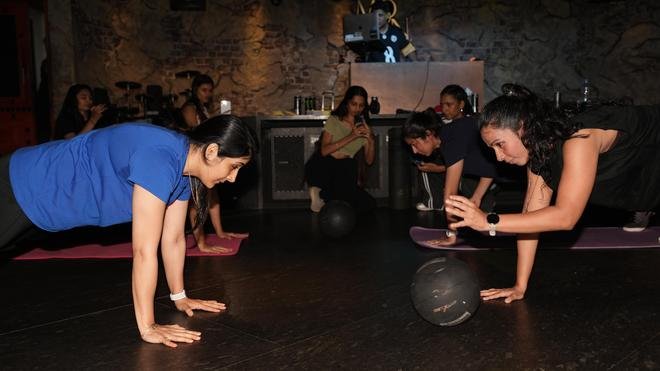
Women in Visakhapatnam are finding a more energetic and social way to approach fitness, with kickboxing, cardio and strength-focused workouts moving beyond conventional gym routines. At a recent Club Cardio session organised by The Social Wave at Moon Bar, around 70 women transformed a club setting into a temporary fitness floor, punching, kicking, squatting and performing burpees through an hour of high-energy movement.
There were no opponents, no competitive bouts and no expectation that participants needed to be trained fighters. Four trainers guided the group through controlled kickboxing combinations while a DJ supplied the soundtrack. The result was part workout, part social gathering and part demonstration of how the idea of women’s fitness is changing.
The significance of the event goes beyond one workout in Visakhapatnam. Increasingly, exercise is being framed around strength, stamina, confidence, skill and community rather than only weight loss or appearance. For women who find traditional gym routines repetitive, intimidating or difficult to sustain, a group-based experience can provide an entirely different reason to keep moving.
Why Kickboxing Is Becoming an Attractive Fitness Workout
Kickboxing may sound like a combat sport, but a fitness kickboxing class does not require participants to fight. Instead, instructors use controlled punches, kicks, footwork and combinations to create a dynamic workout.
That distinction makes the format accessible to a much wider audience. Participants can experience movements inspired by combat sports without entering a ring or taking physical blows from another person.
A typical fitness session can involve several physical qualities at once. Punching combinations require coordination and repeated upper-body movement, while kicks and footwork challenge the lower body. Squats, burpees and other conditioning exercises can add further cardiovascular and muscular demands.
The variety is part of the attraction. Instead of spending an entire session repeating one movement on a treadmill or stationary bicycle, participants continually respond to new instructions and combinations.
What Made the Visakhapatnam Session Different?
The venue itself was an important part of the experience.
Moon Bar, normally associated with leisure and nightlife, became a temporary workout space. The DJ dropped the beat, four trainers took participants through the exercises and approximately 70 women moved together across the floor.
That environment changes the psychology of a workout.
Instead of entering a conventional gym with rows of machines and individual training stations, participants became part of a collective experience. Everyone was following the same instructor, moving to the same rhythm and sharing the energy of the room.
It is a subtle but important shift: fitness becomes something people participate in together rather than something they simply complete alone.
Why Group Fitness Can Help Turn Exercise Into a Habit
Starting a fitness routine is often easier than maintaining one.
Motivation can be high during the first few weeks of a new gym membership, workout plan or fitness challenge. The difficulty comes later, when exercise becomes another item on an already crowded schedule.
Group workouts introduce a social element that can make regular participation easier.
There is a scheduled time, an instructor, other participants and a shared experience. The anticipation of seeing friends or familiar faces can become an additional reason to attend.
Music and choreography can add another layer. When participants are learning combinations and moving together, attention is directed toward the activity rather than constantly focused on how long remains in the workout.
This does not mean group exercise automatically guarantees consistency. But it can remove some of the loneliness and monotony that make individual workouts difficult to maintain.
Women’s Fitness Is Moving Beyond the Weight-Loss Conversation
For decades, commercial fitness messaging aimed at women has frequently centred on calorie burning, weight reduction and body shape.
Those goals may remain important to some individuals, but they are no longer the only ways women are defining fitness.
Strength has become a more meaningful part of the conversation. Women are increasingly interested in becoming stronger, improving physical capability, learning new skills and feeling more confident in their bodies.
This matters because strength is a performance outcome rather than simply an appearance-based one.
Being able to perform a controlled squat, complete another set, move with better balance or learn a new kickboxing combination represents progress even if there is no immediate change on a weighing scale.
That broader definition of success can make exercise more rewarding.
Kickboxing vs Traditional Cardio: What Is Different?
| Feature | Kickboxing-based fitness | Traditional cardio |
|---|---|---|
| Movement | Combines punches, kicks, footwork and varied combinations | Often uses repetitive movements such as walking, running or cycling |
| Muscle involvement | Can involve the upper body, legs, hips and core | Varies according to the activity and equipment |
| Skill component | Requires learning combinations, timing and coordination | Often involves simpler, repetitive movement patterns |
| Group potential | Works particularly well in instructor-led classes | Can be performed individually or in groups |
| Variety | Combinations and drills can change throughout a session | Can become repetitive depending on the workout |
Neither approach is universally superior. A brisk walk, run or cycling session can be highly effective, just as a kickboxing class can be demanding and enjoyable. The most useful form of exercise is one that matches a person’s goals, abilities and preferences and can be performed consistently.
The Often-Overlooked Benefit: Movement Confidence
Fitness is not only about physiological changes. There is also a learning component.
Someone unfamiliar with exercise may feel uncertain about how to use weights, machines or even basic movements in a gym. That uncertainty can become a barrier to participation.
Trainer-led kickboxing offers a straightforward learning pathway. Participants can begin with individual movements and gradually combine them into sequences.
Over time, movements that initially seem complicated can become familiar.
This is where the concept of movement confidence becomes important. The ability to understand how one’s body moves can make other forms of physical activity feel less intimidating.
Learning a new physical skill also gives people a measurable form of progress that has little to do with appearance.
Music Is Part of the Workout, Not Just Background Noise
The DJ at the Visakhapatnam session was not merely providing entertainment.
Music can help establish rhythm and contribute to the atmosphere of a group exercise session. When movements are performed in repeated combinations, a steady beat can make the activity feel more coordinated and engaging.
It also changes the emotional character of exercise.
A conventional workout may feel like a task to complete. A music-led session can feel more like an event. That distinction may be particularly useful for people who associate exercise with boredom or obligation.
In the Visakhapatnam setting, music helped create a bridge between fitness and social life. Participants were exercising, but they were also sharing an experience in a familiar social environment.
Why the Social Side of Fitness Matters
Access to exercise is not simply a question of whether a gym exists.
People also need environments where they feel comfortable participating.
A group workout can provide that environment by creating a shared sense of purpose. Women who might hesitate to attend an unfamiliar fitness class alone may find the experience more approachable when the session is explicitly designed as a community event.
The social component can extend beyond the workout itself. Participants may meet new people, exchange fitness tips, encourage one another or decide to attend another session together.
In that sense, community can become part of the infrastructure supporting a fitness habit.
High-Intensity Does Not Mean Everyone Should Work at Maximum Intensity
The energetic atmosphere of a kickboxing class should not be confused with the need to exercise as hard as possible.
A well-organised session should allow participants to modify movements according to their fitness level. Beginners may need simpler combinations, lower-impact alternatives or additional recovery periods.
Technique should also come before speed. Throwing punches or kicks rapidly without learning appropriate movement patterns can increase the risk of strain or injury.
A suitable warm-up is important before demanding activity, while recovery after exercise should also be taken seriously.
People returning to exercise after a long break, or those with an existing injury or medical concern, should seek appropriate professional guidance before beginning a high-intensity workout.
Strength Training and Cardio Can Work Together
Another useful development in modern fitness is the recognition that cardiovascular exercise and strength training do not have to compete for attention.
A balanced fitness routine can include both.
Strength training can help develop muscular strength and physical capacity, while aerobic activity challenges the cardiovascular system. Depending on how it is structured, a kickboxing-inspired workout can incorporate elements of both conditioning and muscular endurance.
However, one class should not be expected to provide everything.
A well-rounded routine can include resistance training, aerobic activity, mobility work and recovery. The right combination depends on the person’s age, fitness level, goals and circumstances.
The Bigger Shift: From “Exercise to Lose Weight” to “Exercise to Feel Strong”
The most interesting part of Visakhapatnam’s fitness trend may not actually be kickboxing.
It is the changing question behind the workout.
Instead of asking only, “How many calories did I burn?”, people can ask broader questions: Am I stronger? Do I have better stamina? Can I move more confidently? Did I enjoy the session? Am I likely to come back?
Those questions can create a healthier relationship with exercise.
Weight loss can be a legitimate objective, but it is not the only measure of physical progress. Improved endurance, coordination, strength and everyday energy can be meaningful outcomes in their own right.
This is particularly important because body weight naturally fluctuates. If it is the only measurement used to judge progress, normal fluctuations can make an otherwise successful fitness routine feel unsuccessful.
How Social Fitness Could Change Visakhapatnam’s Workout Culture
The Moon Bar session points toward an interesting possibility for the city’s fitness culture: exercise does not necessarily have to happen inside a traditional gym.
Clubs, community spaces, outdoor venues and other suitable locations can potentially host structured fitness experiences when they have adequate space, qualified instructors and appropriate safety arrangements.
This approach brings fitness closer to people’s existing social lives.
Rather than asking someone to completely reorganise their routine around a gym membership, organisers can create workouts that feel like social occasions while retaining the fundamentals of effective exercise.
That could help fitness reach people who have never felt particularly comfortable with conventional gym culture.
What Women Should Look for in a Kickboxing Fitness Class
- Qualified trainers: Instructors should demonstrate movements clearly and provide modifications for different fitness levels.
- A proper warm-up: Participants should gradually prepare their bodies before high-intensity movements.
- Beginner-friendly modifications: New participants should not be expected to match an advanced participant’s pace immediately.
- Adequate space: Participants should have enough room to punch, kick and move without colliding with others.
- Controlled technique: Fitness kickboxing should emphasise movement quality rather than simply throwing punches and kicks as hard or fast as possible.
- Hydration and recovery: Participants should be encouraged to take appropriate breaks and drink water.
- Progressive training: Difficulty should increase gradually rather than suddenly overwhelming beginners.
Prediction: Fitness Businesses May Start Selling Experiences, Not Just Workouts
If social fitness continues to attract participants, fitness providers may increasingly compete on the overall experience.
That could mean more women-focused strength sessions, music-led workouts, outdoor fitness events, themed classes and collaborations between trainers and lifestyle communities.
The opportunity is significant because the experience itself can become a retention tool. People may return not simply because they believe they should exercise, but because they genuinely enjoy the environment.
There is, however, an important caveat.
A fashionable venue, loud music and an energetic atmosphere cannot replace good coaching. The most successful social fitness concepts will ultimately need to combine entertainment with proper programming, safe technique and sensible recovery.
The Real Opportunity Is Making Strength Feel Welcoming
There is a particularly valuable lesson in the growing popularity of women-focused, strength-oriented workouts.
Strength training can sometimes be presented as something reserved for experienced gym-goers or serious athletes. Social formats can challenge that perception.
When strength-related movements are introduced through accessible classes, music and community, the entry point can feel less intimidating.
The goal is not to turn every participant into an athlete. It is to help more people discover that strength is something they can develop gradually.
That mindset can be more empowering than a fitness culture focused primarily on shrinking the body.
Conclusion: Visakhapatnam Is Showing That Fitness Can Be a Social Experience
The sight of around 70 women throwing punches and performing high-energy exercises at a Visakhapatnam club may seem like an unusual fitness experiment. But it reflects a much larger evolution in the way exercise is being presented.
Kickboxing, strength training, music and community are coming together to make fitness more engaging, approachable and socially rewarding.
The most important takeaway is not that every woman needs to take up kickboxing. It is that exercise does not have to follow one traditional formula.
For some people, the ideal workout will remain a quiet run or a session with weights. For others, it may be an energetic group class where music is playing, trainers are calling out combinations and friends are exercising alongside them.
What matters is finding a form of movement that is safe, enjoyable and sustainable.
And if Visakhapatnam’s emerging social fitness scene is any indication, the future of women’s exercise may be less about simply finding a place to work out and more about creating a community that makes people want to keep showing up.
For breaking news and live news updates, like us on Facebook or follow us on Twitter and Instagram. Read more on Latest Lifestyle on thefoxdaily.com.


COMMENTS 0