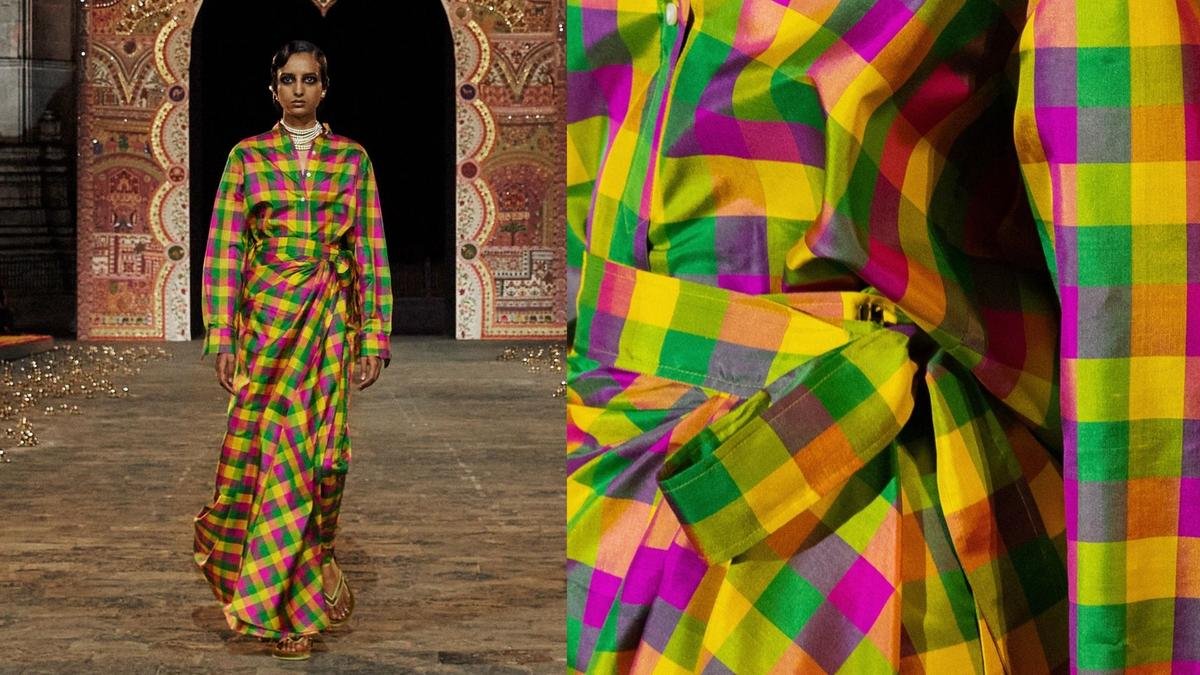
Madras Checks history: Few textiles have travelled as far from their original social identity as Madras checks. Born from the weaving traditions of the Coromandel coast and closely associated with Chennai, the lightweight cotton fabric was once so ordinary in parts of South India that it could be worn without any sense of fashion-consciousness. Yet the same colourful checks eventually crossed oceans, entered American wardrobes, became associated with Ivy League style and found their way into the collections of major international fashion houses.
The story of Madras checks is therefore much more than a fashion success story. It is a story about trade, colonial-era commerce, cultural translation, branding, changing class identities and the extraordinary ability of a textile to acquire a completely different meaning in another market.
Today, designers are rediscovering the fabric for its lightness, irregularity and unmistakable visual character. But there is an uncomfortable irony behind that renewed attention. The global recognition of Madras checks has not necessarily translated into security for the handloom communities that have traditionally produced such textiles.
The history of Madras checks ultimately raises a larger question for Indian fashion: when a regional textile becomes a global luxury reference, who benefits from the value created by that journey?
What are Madras checks?
Madras checks are lightweight cotton textiles characterised by colourful checked patterns and a distinctive woven appearance. Their identity is closely connected with the textile traditions of the Madras region, the historic name for present-day Chennai.
The fabric’s appeal comes partly from its simplicity. Unlike heavily embellished textiles, Madras checks derive their character from yarn, colour, weave and pattern. They can be visually vibrant without being physically heavy, making them particularly suitable for warm climates.
That practicality helps explain why the textile could occupy such different worlds. In South India, lightweight checked cloth was perfectly suited to everyday life. In international fashion, the same qualities could be reframed as relaxed sophistication.
The fabric did not become globally desirable because it suddenly changed. The meaning attached to it changed.
From the Coromandel coast to international markets
The story of Madras textiles cannot be separated from the long history of textile trade along India’s eastern coast.
The Coromandel coast was an important centre of cotton textile production and commerce, connecting Indian weaving communities with merchants and markets far beyond the region. Indian cotton textiles had an established reputation for craftsmanship and variety long before modern global fashion existed.
Madras, as a port city, became part of these commercial networks. Textiles produced in and around the region could travel through maritime trade routes, where their value was determined not only by their physical qualities but also by changing consumer tastes.
This history is important because it challenges the idea that Indian textiles became globally relevant only after modern designers discovered them. The international movement of Indian cloth began centuries earlier through trade.
What changed over time was the audience and the language used to describe the fabric.
The cloth that looked ordinary at home
One of the most fascinating aspects of Madras checks is the gap between local perception and international perception.
In parts of South India, checked cotton cloth could be associated with everyday working-class clothing. It was practical, affordable and familiar. Precisely because it was so ordinary, there was little reason to treat it as an aspirational fashion object.
That explains the reaction to someone imagining the cloth as a fashionable shirt. The suggestion could sound almost comical when viewed through the social context in which the textile was commonly worn.
This is a recurring pattern in fashion history. Objects that are considered ordinary in one culture can become desirable in another because consumers encounter them without the social associations attached to their original context.
Fashion does not simply sell materials. It sells meanings.
How Madras checks became an American fashion story
The transformation of Madras checks accelerated as the textile entered international consumer markets, particularly in the United States.
There, the fabric acquired associations very different from those attached to it in its place of origin. Its bright colours and casual appearance suited a particular interpretation of relaxed summer dressing.
Madras checks became associated with American collegiate and preppy culture, including the world surrounding Ivy League campuses. The textile moved from being an everyday Indian cloth to becoming part of a carefully constructed American style vocabulary.
This was a remarkable cultural translation.
The same visual qualities that made Madras checks practical in a tropical environment — lightness, breathability and vivid colour — could be repackaged as symbols of leisure and sophistication in another market.
That transition demonstrates how global fashion works. A textile can leave its original social environment and acquire a new identity without losing its physical characteristics.
The power of the Madras check was its imperfection
Modern luxury often places enormous value on precision. Madras checks offer something different.
The fabric’s charm can lie in its irregularities, colour relationships and tactile qualities. Handwoven textiles may carry subtle variations that distinguish them from perfectly uniform industrial production.
For contemporary designers, those variations can become an asset rather than a defect.
This is particularly relevant at a time when consumers increasingly express interest in craftsmanship and authenticity. A textile that visibly communicates human production can feel more meaningful in a fashion market saturated with identical mass-produced goods.
But there is an important distinction between appreciating handmade irregularity and romanticising the difficult economic circumstances of the people who produce it.
Why luxury fashion is rediscovering Madras checks
International fashion has increasingly drawn inspiration from regional textiles, craft traditions and historical garments. Madras checks fit neatly into this movement because they offer a combination of heritage and contemporary versatility.
The textile can be interpreted in shirts, jackets, dresses, skirts and accessories without requiring heavy ornamentation. Its strong colour combinations also give designers an immediately recognisable visual language.
That versatility helps explain why major fashion houses can revisit the fabric decades after its first international moment.
The appearance of Madras checks in the fashion vocabulary associated with Dior is particularly significant because it demonstrates how a textile once regarded as ordinary can enter one of the world’s most prestigious luxury contexts.
When a luxury house uses a regional textile tradition, it can give that material a new audience. But it can also raise questions about attribution, ownership and who receives economic value from the craft.
Dior’s interest shows how far the textile has travelled
The use of Madras checks in Dior’s Fall 2023 collection illustrates the extraordinary distance travelled by the textile.
The journey is not simply geographical. It is social and symbolic.
A fabric that could be associated with everyday clothing in Chennai can appear in a global luxury collection where craftsmanship, history and exclusivity are part of the product’s value proposition.
That transformation demonstrates the power of fashion to recontextualise materials. But it also forces us to ask whether the global fashion system adequately recognises the source communities whose skills and traditions make such reinterpretation possible.
Recognition is valuable. Economic participation is more important.
Madras checks and the problem of cultural distance
Global fashion frequently works through cultural distance.
A consumer in Paris, New York or London may see a colourful checked textile as an expression of relaxed luxury without knowing that similar cloth has long been embedded in everyday life in South India.
That distance can create fascinating creative possibilities. Designers can see a material without being constrained by its original social hierarchy.
But it can also erase context.
When a textile becomes fashionable internationally, its story may be simplified into a generic narrative about “Indian craftsmanship”. The specific weaving communities, regional histories and labour involved in producing it can disappear behind the prestige of the global brand.
For a textile such as Madras checks, that would be a particularly unfortunate outcome because its identity is inseparable from the people and places that produced it.
The handloom community is the missing part of the luxury story
The renewed interest in Madras checks arrives at a difficult moment for traditional weaving communities.
Handloom sectors across India face familiar structural pressures: competition from mechanised production, rising input costs, changing consumer demand, ageing workers, shrinking production networks and difficulties in ensuring reliable incomes.
The problem is especially striking in regions where textiles have enormous cultural value but relatively weak bargaining power for producers.
A designer may be able to sell a handwoven textile at a premium, yet the weaver who produces it may not receive a proportionate increase in income. The value chain between loom and luxury showroom can be long and complicated.
This is why the global success of a textile should not be measured only by how many designers use it.
A more meaningful question is whether the communities producing it can build sustainable livelihoods from that demand.
Why handloom cannot simply compete with cheaper cloth
Madras checks face the same fundamental challenge as many traditional textiles: industrial production can manufacture cloth more quickly and cheaply.
A handloom producer therefore cannot realistically win a price war by trying to imitate mass-produced fabric.
The stronger strategy is differentiation.
Handloom needs to communicate why its products are worth paying more for: the skill involved, the time required, the uniqueness of the weave, the cultural history and the quality of the finished fabric.
But storytelling has to be backed by genuine economic value. If consumers pay more for authenticity while producers continue to receive inadequate compensation, the system is not truly sustainable.
Madras checks could become a case study in craft-led luxury
The global journey of Madras checks offers an important opportunity for Indian fashion.
Instead of treating handloom merely as a heritage category, designers and businesses could position regional textiles as high-value design resources.
That would require stronger links between weavers, designers, brands and consumers.
Designers can help develop contemporary applications. Brands can provide consistent demand. Retailers can communicate provenance. Consumers can reward authenticity through purchasing decisions. And producers need stronger bargaining power within the chain.
The objective should not be to turn every traditional textile into a luxury product. It should be to create viable markets in which craftsmanship receives appropriate economic recognition.
What makes Madras checks particularly suited to modern fashion?
Several characteristics give Madras checks an advantage in contemporary fashion.
- Lightweight construction: The fabric is naturally suited to warm-weather dressing.
- Strong colour identity: Its checks can create an immediate visual impact without elaborate embellishment.
- Versatility: The textile can move between casual clothing, contemporary fashion and more experimental design.
- Handcrafted character: Subtle variations can communicate artisanal production.
- Historical depth: Its association with Chennai and the wider Coromandel textile tradition gives designers a strong cultural narrative.
These qualities explain why the textile can simultaneously feel traditional and contemporary.
The fashion industry’s fascination with ‘rediscovery’ deserves scrutiny
There is a recurring phrase in global fashion coverage: designers “discover” or “rediscover” a traditional craft.
The language can be misleading.
A designer may discover a textile, but the community producing it never stopped knowing how to make it. What appears new to the fashion establishment may have been continuous knowledge for generations of craftspeople.
This distinction matters because words shape economic relationships.
Calling a textile “rediscovered” can unintentionally position the global fashion system as the source of its renewed relevance, rather than recognising the communities that maintained it during periods when international attention was absent.
Madras checks therefore offer a useful reminder: fashion trends are often cyclical, but craft knowledge is cumulative.
Could Madras checks become a stronger global Indian fashion identity?
There is an opportunity for Indian designers to use Madras checks as part of a broader strategy of craft-led international fashion.
India has no shortage of textiles with regional identities, but the challenge has always been converting that abundance into recognisable contemporary design languages.
Madras checks have already demonstrated that such a transition is possible.
Their journey from Chennai to international fashion proves that a textile does not have to lose its identity to become globally relevant. In fact, its regional identity can be the very thing that makes it interesting.
The next step is ensuring that global recognition strengthens rather than weakens the communities behind the material.
What the future could look like for Madras checks
The future of Madras checks is likely to involve both traditional and contemporary applications.
Designers may experiment with oversized checks, unusual colour combinations, modern tailoring and unexpected fabric pairings. At the same time, the original lightweight character of the textile will remain valuable for warm-climate clothing.
There is also potential in home interiors, accessories and limited-edition collaborations, provided such expansion does not compromise the integrity of the weaving tradition.
Digital commerce could further widen the market by allowing small weaving communities and specialist brands to reach consumers who actively seek traditional textiles.
But technology alone cannot solve the underlying livelihood problem. Producers need reliable demand, fair compensation, access to raw materials and the ability to participate more meaningfully in determining how their products are priced and marketed.
The real luxury is the survival of the skill
There is an uncomfortable contradiction at the heart of the Madras checks story.
The world may celebrate the fabric precisely when the economic conditions surrounding its production remain fragile.
Luxury fashion can make a textile expensive. It cannot, by itself, make weaving economically sustainable.
That requires a functioning ecosystem in which the craftsperson is not treated as the final invisible link in a long chain but as an essential creator of value.
If Madras checks are to have another century of relevance, their future cannot depend solely on periodic appearances in international fashion collections. The weaving communities need markets that reward their expertise consistently.
Conclusion: From everyday Chennai cloth to global fashion icon
The story of Madras checks is one of fashion’s most revealing journeys. A lightweight checked cotton textile associated with everyday life on the Coromandel coast travelled through international trade, entered American collegiate culture and eventually reached the collections of global luxury houses such as Dior.
Its transformation shows how dramatically the meaning of clothing can change across borders. What looks ordinary in one place can become aspirational somewhere else. What is associated with practicality can become a symbol of style. What was once dismissed as humble can eventually be presented as luxury.
But the most important part of the story is not how far the fabric has travelled. It is whether the people who continue to make it can travel with it economically.
Madras checks do not need to be rescued from obscurity; they have already conquered the fashion world. What needs protecting now is the human knowledge behind the cloth.
The future of this iconic textile should therefore be measured not only by its presence on international runways, but by whether its renewed popularity creates better opportunities for the weavers who gave the fabric its identity in the first place.
For breaking news and live news updates, like us on Facebook or follow us on Twitter and Instagram. Read more on Latest Lifestyle on thefoxdaily.com.

COMMENTS 0