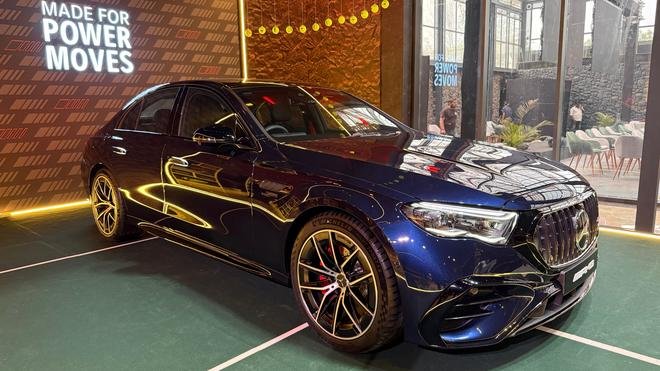
The arrival of the Mercedes-AMG E53 Hybrid in India marks an important change in the way performance luxury cars are being engineered. The idea of combining an AMG performance sedan with a plug-in hybrid system may initially sound like a compromise: less engine, more battery, and a car expected to satisfy both efficiency-minded commuters and traditional performance enthusiasts.
The E53 Hybrid makes a different argument. Instead of using electrification simply to reduce fuel consumption, Mercedes-AMG has integrated the electric motor as a performance tool. The result is a 585 hp system output in its standard configuration, 750 Nm of combined torque and a claimed electric-only range of more than 100 km. The car can also sprint from 0-100 kmph in around four seconds, depending on specification and launch-control configuration.
That combination makes the Mercedes-AMG E53 Hybrid particularly interesting for India. It is not merely an E-Class with a larger battery. It represents a new interpretation of the executive performance sedan, where electric driving can handle everyday journeys while the petrol engine remains available when long-distance travel or stronger performance is required.
Mercedes-AMG E53 Hybrid: the key numbers at a glance
| Specification | Mercedes-AMG E53 Hybrid |
|---|---|
| Powertrain | 3.0-litre turbocharged inline-six petrol engine with electric motor |
| Combined output | 585 hp |
| Combined torque | 750 Nm |
| Battery | 28.6 kWh gross capacity, with approximately 21.2 kWh usable capacity |
| Electric-only range | More than 100 km, depending on specification and test cycle |
| Transmission | AMG SPEEDSHIFT TCT 9G automatic |
| Drive system | AMG 4MATIC+ all-wheel drive |
| 0-100 kmph | About 4 seconds in India-spec standard configuration; quicker figures are possible with performance equipment |
| Top speed | 250 kmph for the standard India-spec configuration |
Why the E53 Hybrid changes the usual AMG formula
AMG has traditionally been associated with powerful petrol engines, aggressive acceleration and an unmistakable mechanical character. The E53 Hybrid belongs to a newer generation in which electric assistance is not simply an efficiency add-on.
The petrol engine is a 3.0-litre turbocharged inline-six producing 449 hp on its own. It works with an electric motor integrated into the transmission, allowing the combined system to produce 585 hp and 750 Nm.
This arrangement has an important engineering advantage. An electric motor can deliver torque extremely quickly, helping compensate for the response characteristics of a turbocharged combustion engine. Instead of waiting for the petrol engine to build boost, electric assistance can provide immediate thrust.
That means the hybrid system is doing something enthusiasts may appreciate: filling gaps in the conventional power delivery rather than simply replacing the engine.
More than 100 km of electric driving is the bigger story
The headline power figure will attract attention, but the E53’s electric range may ultimately be the more significant feature for everyday owners.
Mercedes-AMG has fitted the car with a 28.6 kWh battery, of which around 21.2 kWh is usable for normal operation. The claimed electric-only range exceeds 100 km under the relevant test cycle.
For a plug-in hybrid, that is substantial. It means the E53 is capable of functioning as a genuinely electric-powered commuter for many short daily journeys, provided the owner regularly charges the battery.
This creates a very different ownership proposition from a conventional performance sedan.
Instead of starting every morning with the petrol engine as the default source of propulsion, an owner can potentially complete many routine urban journeys using electric power and reserve the combustion engine for longer trips.
The distinction is important because plug-in hybrids only deliver their full efficiency potential when their batteries are charged regularly. The E53 therefore makes the most sense as a vehicle whose owner can take advantage of its charging capability rather than treating it like a conventional hybrid.
Performance has not been pushed into the background
Despite the emphasis on electric driving, the E53 remains unmistakably performance-focused.
The combined system produces 585 hp and 750 Nm, while the India-spec car can accelerate from 0-100 kmph in approximately four seconds. Its 4MATIC+ all-wheel-drive system is designed to distribute power effectively and maintain traction.
For buyers interested in outright performance, Mercedes-AMG also offers a higher-output configuration internationally with the AMG Dynamic Plus package. With Race Start, system output can reach 612 hp, while additional performance equipment can raise the top-speed limit beyond the standard configuration.
However, it is important not to confuse the maximum global specification with the standard India-spec car. The headline 585 hp figure is the relevant combined output for the version introduced in India, while the more powerful figure is associated with specific performance equipment and operating conditions.
The real engineering trick is how the two power sources work together
The E53 Hybrid is interesting because the petrol engine and electric motor have different strengths.
The inline-six is suited to sustained high-speed driving and longer journeys, where its energy source can be replenished quickly through conventional refuelling. The electric motor, meanwhile, provides immediate torque and enables quiet, zero-tailpipe-emission driving when the battery has sufficient charge.
Rather than forcing the driver to choose one personality, the plug-in hybrid architecture allows the car to switch between them.
In electric mode, the E53 can behave like a refined premium EV for everyday travel. In hybrid and performance-oriented modes, the combustion engine becomes an important part of the experience. This dual personality is arguably the strongest reason for the car’s existence.
Why this matters more in India than it may appear
India’s luxury-car market has a particular contradiction. Buyers increasingly have access to electric vehicles, but long-distance travel, charging infrastructure and personal preferences still make combustion engines attractive to many customers.
A high-performance plug-in hybrid sits directly in that gap.
An owner living in a major city with home charging could use electric power for regular commuting while retaining the freedom of a petrol engine for highway journeys. For someone who values performance but does not want every trip to involve planning around charging infrastructure, the hybrid architecture provides an alternative.
This does not make the E53 a replacement for a full battery-electric vehicle. Instead, it occupies a middle ground.
That middle ground may become increasingly important as luxury manufacturers transition their portfolios toward electrification without abandoning customers who still value long-distance flexibility and the character of combustion engines.
E53 Hybrid versus a conventional AMG: what has changed?
| Traditional performance-sedan approach | E53 Hybrid approach |
|---|---|
| Combustion engine provides the primary propulsion | Combustion engine and electric motor share propulsion duties |
| Performance comes mainly from engine output | Electric torque supplements petrol-engine performance |
| Fuel is required for normal driving | Short everyday journeys can potentially be completed electrically |
| Engine response defines acceleration character | Electric assistance can provide immediate torque |
| Long-distance flexibility is a major strength | Long-distance flexibility is retained while adding electric capability |
The E53 is also an argument against the idea that hybrid means slow
For years, the word “hybrid” was associated with efficiency rather than excitement. Performance hybrids have steadily challenged that assumption.
The E53 takes the concept further by making the electric motor part of the performance architecture. Its 585 hp combined output puts it firmly in the high-performance category rather than the conventional economy-hybrid class.
There is an important lesson here for the wider automotive industry: electrification does not automatically mean reducing performance. In some applications, electric assistance can actually make a high-performance vehicle faster and more responsive.
The more difficult question is whether that extra performance comes with acceptable complexity, weight and cost.
The compromise enthusiasts may notice: complexity
There is no such thing as a free performance upgrade.
A plug-in hybrid needs a combustion engine, electric motor, high-voltage battery, power electronics and the associated cooling and control systems. Compared with a conventional petrol performance sedan, the architecture is substantially more complicated.
That complexity is the price paid for having two different propulsion systems in one vehicle.
For the buyer, the benefit is versatility. For the engineer, it means balancing thermal management, battery performance, electric output, transmission behaviour, regenerative braking and conventional engine operation.
This is why the E53 should not be evaluated simply by asking whether it is “better” than a pure-petrol AMG. It is designed around a different objective: combining performance with a degree of electric usability that a conventional performance sedan cannot offer.
Charging becomes part of the ownership experience
The E53’s plug-in hybrid character also changes the driver’s relationship with charging.
A conventional petrol car can be refuelled in a few minutes and then driven for hundreds of kilometres. A plug-in hybrid is different because its electric range is most valuable when the battery is regularly replenished.
The E53 supports AC charging, with an 11 kW onboard charging capability. A DC charging option is also available in markets where that equipment is offered.
For an owner with reliable home charging, this could be one of the car’s biggest strengths. The vehicle can effectively begin each day with a fresh supply of electric energy.
Without regular charging, however, much of the plug-in hybrid advantage becomes less relevant. In that situation, the car increasingly behaves like a heavy performance vehicle carrying a battery that is not being used to its full potential.
The overlooked benefit: electric driving can improve everyday refinement
Performance is not the only reason to appreciate the electric motor.
Luxury cars are expected to be quiet and smooth, particularly during urban driving. Electric propulsion naturally suits this environment because it can deliver power with very little mechanical noise.
For a car that spends part of its life crawling through city traffic, an electric mode can make the driving experience calmer and more effortless.
Then, when the road opens up, the petrol engine and electric motor can provide the performance expected from an AMG.
This contrast may actually be more relevant to luxury-car buyers than the headline acceleration figure. A car that is comfortable during a weekday commute and exciting on an open road has a broader range of usable personalities.
Price and positioning in India
Mercedes-Benz India introduced the AMG E53 Hybrid in two versions: the Performance Edition at Rs 1.45 crore and the Racing Edition at Rs 1.48 crore, both ex-showroom.
That positioning puts the E53 firmly into India’s high-end performance-luxury segment. It also means buyers are not simply paying for horsepower. They are paying for the combination of executive-car comfort, AMG engineering, all-wheel drive and plug-in hybrid capability.
The car does not have a perfectly direct equivalent in India’s market because its combination of performance, body style and plug-in hybrid technology is unusual.
That may be one of its strongest selling points. Instead of competing only on the traditional question of which performance sedan is fastest, Mercedes-AMG can offer a different ownership proposition altogether.
What the E53 says about the future of AMG
The E53 Hybrid is part of a larger transformation in performance-car engineering.
Manufacturers are increasingly using electrification to meet efficiency and emissions requirements while preserving, and sometimes enhancing, performance. The important shift is that batteries are no longer being treated only as energy-storage devices for EVs. In performance applications, they are also tools for torque delivery and response.
That changes the definition of a modern performance car.
In the past, more power usually meant a larger engine, more boost or a more aggressive combustion setup. Now, engineers can combine combustion power with electric torque and sophisticated software to create performance that would be difficult to achieve through an engine alone.
The E53 is therefore less a compromise between petrol and electric driving and more an example of how the two technologies can be deliberately combined.
Who is the Mercedes-AMG E53 Hybrid really for?
The E53 makes the most sense for a buyer who wants several cars’ worth of capability in one package.
- For the daily commuter: The electric-only range can make routine urban journeys possible without using the petrol engine when the battery is sufficiently charged.
- For the performance enthusiast: The 585 hp output, 750 Nm torque and AMG chassis hardware deliver serious acceleration and performance.
- For the long-distance traveller: The petrol engine retains the flexibility associated with conventional refuelling.
- For the luxury buyer: The E-Class foundation brings executive-car comfort and technology alongside AMG-specific performance engineering.
The verdict: is the plug-in AMG a compromise?
The easiest way to misunderstand the Mercedes-AMG E53 Hybrid is to judge it by an old definition of what an AMG should be.
If AMG performance is defined only by a large petrol engine and maximum mechanical simplicity, the E53 represents a significant departure. But if performance is defined by response, acceleration, flexibility and driver engagement, electrification becomes much harder to dismiss.
The E53’s strongest argument is that it does not force its owner to choose between electric commuting and long-distance performance. It attempts to deliver both.
That makes its more than 100 km claimed electric range particularly important. The battery is not there merely to improve a specification sheet. It can fundamentally change how the car is used during everyday driving.
Conclusion: the AMG E53 Hybrid is a preview of performance’s next chapter
The Mercedes-AMG E53 Hybrid arrives in India at a time when the definition of a performance car is changing rapidly. With 585 hp, 750 Nm, a 3.0-litre turbocharged inline-six, electric assistance, AMG 4MATIC+ all-wheel drive and more than 100 km of claimed electric-only range, it offers a combination that would have seemed contradictory a decade ago.
Yet the logic behind it is increasingly clear. The petrol engine provides long-distance freedom and sustained performance, while the electric motor adds immediate response and everyday electric usability.
The biggest question is no longer whether an AMG can be a hybrid. It is whether performance enthusiasts will accept electrification when it is used to make the car more versatile rather than simply more efficient.
The E53’s answer is confident: electrification does not have to be the end of AMG performance. Used intelligently, it can become another way of delivering it.
For breaking news and live news updates, like us on Facebook or follow us on Twitter and Instagram. Read more on Latest Lifestyle on thefoxdaily.com.


COMMENTS 0