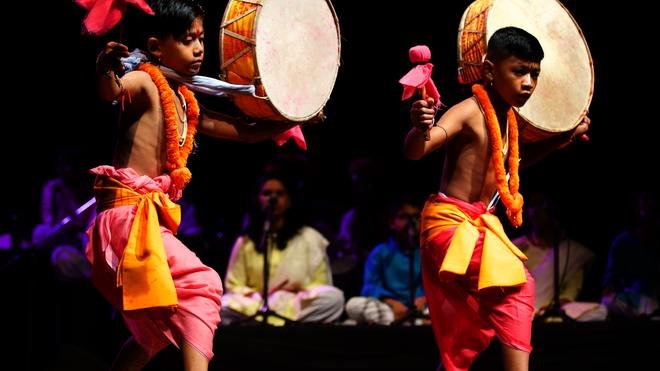
What makes the Jackfruit Festival in Bengaluru significant is not simply the presence of a celebrated artist such as Shubha Mudgal, but the scale of its focus on young musicians. The eighth edition of the festival brings together 194 young performers from across India for three days of performances, workshops and outreach programmes. Organised by Bhoomija Trust, the festival places emerging musicians at the centre of a cultural experience designed around learning, performance and interaction.
In an Indian music landscape where established names often dominate festival publicity, an event built around young performers offers a different proposition. It creates a space where musicians can perform before new audiences, learn from experienced practitioners and encounter musical traditions beyond their immediate surroundings. With Shubha Mudgal leading the festival, the programme also brings together the worlds of artistic experience and youthful experimentation.
The result is more than a three-day sequence of concerts. The Jackfruit Festival can be viewed as an ecosystem for musical exchange—one in which performance, education and outreach are deliberately connected.
What is the Jackfruit Festival in Bengaluru?
The Jackfruit Festival is a music-focused cultural initiative presented by Bhoomija Trust. Its eighth edition brings 194 young musicians from different parts of India together in Bengaluru for three days of activities.
The festival combines three important elements: performances, workshops and outreach programmes. That combination matters because young musicians need more than opportunities to appear on stage. Exposure, mentorship, peer interaction and the ability to understand audiences can be equally important in developing a sustainable artistic practice.
The festival therefore operates on two levels. For audiences, it offers an opportunity to discover young performers. For participants, it provides a platform where music can become a shared learning experience rather than a solitary pursuit.
Why Shubha Mudgal’s presence adds weight to the festival
Shubha Mudgal is an established name in Indian music, with a career spanning classical performance and wider musical collaborations. Her association with a festival centred on young musicians creates an important bridge between generations of performers.
That generational connection is one of the strongest aspects of the Jackfruit Festival. Young musicians often enter a field where artistic growth takes years of practice, performance and exposure. Having an experienced artist associated with a programme can help place that journey within a broader musical context.
But the value of such an association should not be reduced to celebrity appeal. A festival becomes meaningful when established artists and emerging performers are part of the same cultural conversation. In that sense, Mudgal’s role helps draw attention to the larger question the festival raises: how can India’s enormous pool of young musical talent receive meaningful platforms for growth?
194 young musicians: why the number matters
The participation of 194 young performers is one of the defining features of this edition. The number signals a deliberate emphasis on breadth rather than building a programme around a small selection of headline acts.
India’s musical traditions are exceptionally diverse. Young musicians may train in classical forms, regional traditions or other contemporary practices, often within very different cultural environments. Bringing performers together in one festival creates the possibility of encounters that may not happen within conventional training structures.
There is also a practical benefit to putting young performers on a shared platform. A musician’s development is shaped not only by formal instruction but also by listening to other musicians, observing different performance styles and understanding how artists communicate with audiences.
For the audience, the large participant pool changes the experience as well. Instead of presenting youth as a single category, a festival of this scale can reveal the variety within India’s emerging musical community.
Three days of music, learning and outreach
The three-day format is particularly important because it allows the festival to move beyond the traditional concert model. A single performance can create visibility, but a multi-day programme can create continuity between performing, learning and community engagement.
Performances provide the public-facing component. They give young musicians the opportunity to present their work and develop stage experience. Workshops introduce another layer, creating space for learning and interaction. Outreach programmes extend the festival’s purpose beyond the main performance environment.
This structure reflects a broader understanding of what a cultural festival can achieve. A successful music festival does not necessarily have to be measured only by the number of concerts it stages. Its longer-term value can also lie in the relationships and learning opportunities it creates.
Why workshops may be as important as performances
Concerts are visible. Workshops are quieter, but they can have a deeper educational effect.
For young musicians, workshops can offer opportunities to examine aspects of music that are difficult to capture in a formal performance. Listening, interpretation, stage presence, collaboration and exposure to unfamiliar approaches can all influence an artist’s development.
The inclusion of workshops in the Jackfruit Festival suggests that its organisers are looking beyond the immediate excitement of a stage appearance. The objective is not simply to provide young artists with a slot on a programme, but to make the festival a place where they can learn from one another and from experienced musicians.
This distinction is important in the context of arts development. A platform gives an artist visibility; a learning environment can give that visibility a longer-term purpose.
Bengaluru is an important setting for this musical exchange
Bengaluru provides a natural setting for a festival that brings together different generations and musical communities. The city has a strong cultural ecosystem and an audience accustomed to engaging with multiple forms of performance.
More importantly, hosting participants from across India in one city changes the relationship between local and national culture. The festival is not simply bringing an outside audience to Bengaluru. It is bringing young performers from different places into the city’s cultural environment.
That makes the Jackfruit Festival part of a larger conversation about how Indian cities can function as cultural meeting points. Bengaluru’s role here is not merely that of a venue; it becomes a point of connection between performers, traditions and audiences.
From stage opportunity to cultural network
One of the less discussed benefits of youth-focused festivals is the creation of networks.
A young musician who meets another performer at a festival may discover a collaborator, a teacher, a new musical tradition or simply a different way of approaching performance. These connections are difficult to measure immediately, but they can influence artistic careers over time.
The Jackfruit Festival’s scale makes this particularly interesting. With 194 young performers participating, the event creates a sizeable peer network within a short period. The most important outcome may therefore continue after the festival itself ends.
This is where the festival model differs from a conventional concert series. A concert primarily connects performer and audience. A youth festival can connect performer to performer, performer to mentor and performer to community.
The bigger issue: creating sustainable opportunities for young artists
The presence of young talent is not the same as the availability of sustained opportunities.
India has no shortage of musicians who train for years before seeking professional platforms. The challenge is creating enough spaces where emerging performers can move from training to public performance, from public performance to professional networks, and eventually towards sustainable artistic careers.
This is why initiatives such as the Jackfruit Festival have relevance beyond their immediate programme. They help address one part of the cultural pipeline: exposure and experience.
Of course, a single festival cannot solve every structural challenge faced by young musicians. But repeated platforms can contribute to a healthier ecosystem, particularly when they combine performance with education and outreach.
Jackfruit Festival versus a conventional music festival
| Aspect | Conventional concert-focused festival | Jackfruit Festival approach |
|---|---|---|
| Primary focus | Performances and audience experience | Performances combined with learning and outreach |
| Artist profile | Often centred on established performers | Strong emphasis on young musicians |
| Learning | May remain secondary to concerts | Workshops form part of the programme |
| Community dimension | Primarily audience-oriented | Includes outreach programmes |
| Long-term potential | Visibility through performance | Visibility plus peer and learning networks |
The comparison is not meant to suggest that one festival model is automatically better than another. Rather, it highlights what makes the Jackfruit Festival distinctive: its attempt to treat young performers not simply as entertainers but as participants in a broader cultural and educational process.
Why youth-focused music festivals matter now
Music discovery has changed dramatically. Young performers today can reach audiences through digital platforms without necessarily passing through traditional cultural institutions. That has created unprecedented access, but it has also made professional visibility more fragmented.
In this environment, physical festivals still offer something digital platforms cannot fully reproduce: shared space.
Being in the same room with another musician, watching a live performance, participating in a workshop or interacting with an experienced artist creates forms of learning that are difficult to replicate through screens. A festival can therefore complement digital exposure rather than compete with it.
The Jackfruit Festival’s emphasis on physical gathering is particularly relevant because music remains fundamentally social. Even when a performance is consumed online, much of musical culture is built through communities, teachers, peers and live audiences.
A possible long-term impact on India’s musical ecosystem
The strongest potential impact of the festival may not be visible immediately. The real test of a youth-focused cultural initiative is what happens to its participants after the applause ends.
If festivals can consistently provide young artists with performance experience, mentorship, peer networks and access to audiences, they can strengthen the transition from learner to professional performer. Over time, such platforms may also help audiences discover artists before they become widely known.
That creates a useful cycle: emerging performers gain visibility, audiences encounter new talent, cultural institutions build stronger networks and India’s musical diversity becomes easier to experience beyond individual traditions or regions.
The Jackfruit Festival is therefore worth watching not only as an annual cultural event but as a model of how youth participation can be incorporated into arts programming.
What makes the eighth edition especially significant?
The eighth edition represents continuity. A festival that reaches its eighth edition is no longer simply a one-off experiment. Its existence across multiple editions indicates an ongoing commitment to the format.
That continuity matters for young artists because cultural development requires repeated opportunities. One stage appearance can be memorable; a recurring ecosystem can become transformative.
The combination of 194 young performers, three days of programming, workshops, outreach and the leadership of Shubha Mudgal gives this edition a particularly strong identity.
It also suggests a useful direction for future cultural programming: rather than separating entertainment, education and community engagement, festivals can bring all three together.
The future of the Jackfruit Festival
If the festival continues to grow, its biggest opportunity will be to deepen the connections it has already created. Future editions could build on the same philosophy by strengthening pathways for young musicians beyond the festival stage, while retaining the intimate interaction that makes workshops and peer exchange valuable.
The most important measure of success may eventually be simple: how many participating musicians continue to find meaningful opportunities, collaborations and audiences because of connections made through the festival?
That is a more demanding benchmark than attendance or publicity, but it is also a more meaningful one for an initiative focused on young artists.
Conclusion: Bengaluru becomes a stage for India’s next generation of musicians
The Jackfruit Festival in Bengaluru stands out because it puts young musicians at the heart of the programme. With 194 performers from across India, three days of performances, workshops and outreach, and the presence of Shubha Mudgal, the eighth edition brings together performance and learning in a way that goes beyond a conventional concert experience.
Its deeper importance lies in the opportunity to build connections between generations of musicians and between young performers from different parts of the country. In a musical ecosystem where visibility can be difficult to sustain, such spaces can provide valuable experience, community and discovery.
The future significance of the Jackfruit Festival will ultimately depend on what grows from those encounters. If today’s young performers become tomorrow’s collaborators, teachers, innovators and celebrated artists, the festival’s most important work will have happened long after its final performance has ended.
For breaking news and live news updates, like us on Facebook or follow us on Twitter and Instagram. Read more on Latest Lifestyle on thefoxdaily.com.

COMMENTS 0