Primary Keyword: monsoon inspired textiles India
LSI Keywords: Studio Medium Beat Repeat, shibori textiles India, bandhani techniques fashion, arashi dyeing India, contemporary Indian textiles, textile design India, handcrafted fabrics India, sustainable fashion India
Introduction: When Rain Becomes Fabric
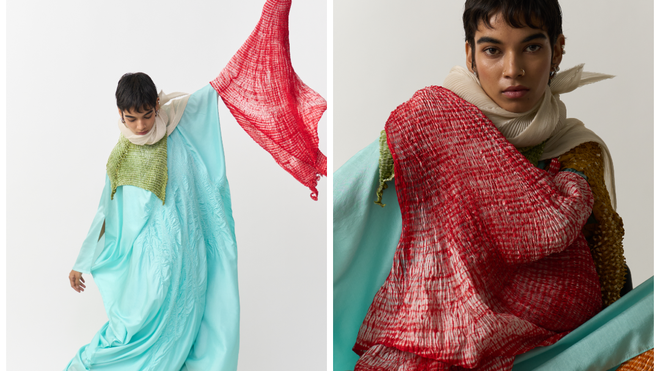
What does the monsoon feel like—beyond the sound of rain or the scent of wet earth? For designers Riddhi Jain and Dhruv Satija, it is something that can be seen, touched, and worn. Their latest collection, Beat, Repeat, transforms the fleeting rhythms of rain into monsoon inspired textiles in India, blending traditional dyeing techniques with contemporary design thinking.
Who: Designers Riddhi Jain and Dhruv Satija of Studio Medium
What: A textile collection inspired by the monsoon
When: Showcased in 2026
Where: Presented in a heritage home setting in Chennai
Why: To reinterpret natural rhythms through textile craft
How: Using techniques like bandhani, arashi, shibori, and mothra
At its core, Beat, Repeat is not just a collection—it is an exploration of how nature’s patterns can be translated into fabric through time-honoured craftsmanship.
Setting the Scene: A Monsoon Within Walls
The presentation of the collection plays a crucial role in its storytelling. Inside a 60-year-old Chennai home, a seven-foot shibori canopy hangs overhead, dyed in deep blues and greens. It diffuses light across white walls, creating shadows that mimic the rhythm of falling rain.
This immersive installation blurs the line between environment and exhibit. The viewer is not just observing textiles—they are stepping into a reimagined monsoon.
Insight: By transforming the display space into an extension of the collection, the designers elevate textiles from objects to experiences.
The Craft Vocabulary: Traditional Techniques, Modern Expression
What sets Beat, Repeat apart is its thoughtful use of traditional textile techniques, each chosen for its ability to express a specific aspect of the monsoon.
1. Shibori: The Rhythm of Rainfall
Shibori, a resist-dyeing technique, creates fluid, organic patterns that resemble cascading rain. The folds and bindings produce unpredictable results—much like the monsoon itself.
2. Bandhani: Droplets and Density
Bandhani’s intricate tie-dye patterns evoke clusters of raindrops, capturing both intensity and delicacy.
3. Arashi: Movement and Wind
Arashi, often associated with diagonal patterns, mirrors the slant of rain driven by wind, adding a sense of motion to the textiles.
4. Mothra: Geometry of Nature
Mothra introduces structured patterns, reflecting the underlying order within natural chaos.
By combining these techniques, the designers create a layered narrative—one that captures not just the look of rain, but its behaviour.
Beyond Aesthetics: The Philosophy of Beat, Repeat
The title itself—Beat, Repeat—suggests rhythm and continuity. It reflects the cyclical nature of the monsoon, where patterns emerge, dissolve, and return.
This philosophy extends into the textiles:
- Repeating motifs echo rainfall patterns
- Layered dyes create depth and movement
- Irregularities celebrate unpredictability
Key Idea: The collection embraces imperfection as a design principle, aligning with the inherent variability of handcrafted processes.
Why Monsoon? A Cultural and Emotional Lens
In India, the monsoon is more than a season—it is an emotional and cultural phenomenon. It influences agriculture, daily life, and even artistic expression.
By choosing the monsoon as their inspiration, the designers tap into a shared sensory memory:
- The sound of rain on rooftops
- The shifting shades of the sky
- The interplay of light and shadow
This makes the collection instantly relatable, even as it remains conceptually sophisticated.
Comparison: Traditional vs Contemporary Textile Interpretation
| Aspect | Traditional Textiles | Beat, Repeat Collection |
|---|---|---|
| Purpose | Functional and decorative | Conceptual and narrative-driven |
| Technique Use | Region-specific | Cross-technique integration |
| Design Approach | Pattern-focused | Experience-focused |
| Audience | Local or cultural | Global, design-conscious |
This comparison highlights how the collection bridges heritage and innovation.
A Unique Insight: Textiles as Environmental Storytelling
One of the most compelling aspects of Beat, Repeat is its role as environmental storytelling.
Rather than depicting the monsoon literally, the designers interpret its essence through process and material.
- Dye becomes rain
- Fabric becomes landscape
- Technique becomes narrative
This approach moves beyond visual representation, engaging the viewer on a sensory and conceptual level.
The Broader Impact: Redefining Indian Textile Design
The significance of monsoon inspired textiles in India extends beyond a single collection.
1. Reviving Craft Traditions
By using techniques like bandhani and shibori, the collection keeps traditional skills relevant in a modern context.
2. Encouraging Experimentation
Designers are increasingly blending multiple techniques, breaking away from rigid regional boundaries.
3. Elevating Textiles as Art
Collections like Beat, Repeat position textiles as conceptual art forms, not just fashion elements.
Challenges in Craft-Based Design
While the approach is innovative, it comes with its own set of challenges:
- Time-intensive processes: Handcrafted techniques require patience
- Consistency issues: Variations are inherent
- Scalability: Difficult to mass-produce
Yet, these challenges are also what make the final pieces unique and valuable.
Future Outlook: Where Do Monsoon Textiles Go From Here?
1. Greater Global Recognition
Indian textile techniques could gain more visibility on international platforms.
2. Sustainable Fashion Integration
Handcrafted methods align with eco-conscious fashion movements.
3. Cross-Disciplinary Collaborations
Textiles may increasingly intersect with architecture, art installations, and design.
Prediction: Concept-driven textile collections like Beat, Repeat will play a key role in positioning India as a leader in narrative-driven fashion design.
Conclusion: When Craft Captures Climate
Studio Medium’s Beat, Repeat is more than a textile collection—it is a meditation on nature, rhythm, and craft.
By translating the monsoon into fabric, Riddhi Jain and Dhruv Satija demonstrate how traditional techniques can be reimagined for contemporary storytelling.
In doing so, they remind us that textiles are not just materials—they are mediums of memory, emotion, and meaning.
And sometimes, the most powerful stories are the ones you can wear.
For breaking news and live news updates, like us on Facebook or follow us on Twitter and Instagram. Read more on Latest Lifestyle on thefoxdaily.com.






COMMENTS 0