Twenty years after his first New York Fashion Week appearance, Sabyasachi Mukherjee has returned to the city with denim, Western silhouettes, Indian craftsmanship and a major collaboration with The Metropolitan Museum of Art. The result may look less conventionally Indian at first glance, but that tension is central to what the designer appears to be exploring with his latest collection.
Sabyasachi Returns to New York With a Different Vocabulary
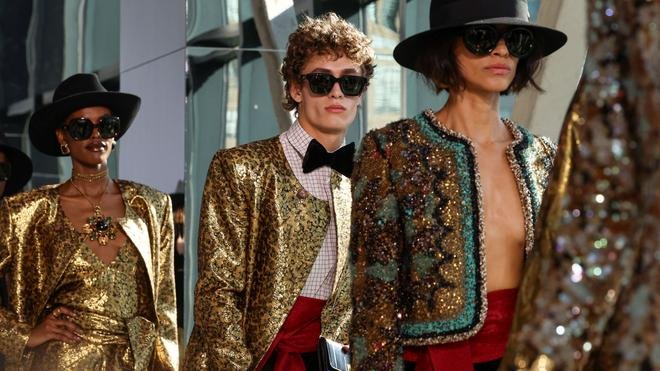
Sabyasachi Mukherjee’s Spring 2027 ready-to-wear show marked his return to New York Fashion Week after his previous appearance in 2009. The collection, titled “Bengal Byzantine Broadway,” opened with supermodel Christy Turlington in a head-to-toe denim look, immediately signalling that this was not going to be a conventional showcase of saris, lehengas or overtly traditional Indian silhouettes.
Instead, the collection brought together indigo jeans, plaid shirts, denim, Western-inspired jackets and relaxed tailoring with embroidery, brocade, hand-painted silk and jewellery. Vogue described the approach as Western clothing viewed through a slightly Indian lens. 0
So, Why Does It Not Look “Indian” Enough?
The question itself reveals how strongly Sabyasachi has shaped the visual idea of Indian luxury. For years, his name has been associated with elaborate bridalwear, rich textiles, antique-inspired jewellery, hand embroidery, dramatic colour and unmistakable references to India’s craft traditions.
His latest New York collection deliberately moves away from using those elements as obvious cultural shorthand. A pair of jeans can be as important to the collection as a brocade jacket. A Western shirt can become the foundation for intricate Indian craftsmanship. The Indian identity is therefore embedded in the making rather than necessarily announced through the silhouette.
That is a significant shift. Instead of asking an international audience to recognise an outfit as “Indian” before appreciating it, Sabyasachi appears to be asking viewers to see Indian craftsmanship as part of a broader global fashion language.
Denim Becomes the Unexpected Starting Point
Denim was among the clearest visual signals of this change. Turlington opened the show in a structured denim jacket and flowing trousers, establishing a relaxed American vocabulary before the collection moved into richer layers of embellishment and craft. 1
Rather than treating denim as something separate from Indian luxury, the collection places it alongside detailed embroidery, jewels and artisanal surfaces. The contrast is what gives the clothes their identity.
It also makes the collection easier to read as contemporary ready-to-wear. These are pieces that can enter an everyday wardrobe rather than existing only within the visual world of weddings and formal Indian occasions.
Indian Craftsmanship Is Still at the Centre
Calling the collection less traditionally Indian does not mean that Indian craftsmanship has disappeared. In fact, much of the collection’s identity comes from the tension between familiar Western garments and painstaking Indian techniques.
According to Vogue’s runway review, the collection included dramatic jackets and boleros decorated with gems, rich embroidery, brocade and hand-painted silk. One cow-print jacket, for example, used embroidered pieces patchworked onto tulle. 2
This approach reflects a broader philosophy associated with the Sabyasachi brand: Indian craft does not necessarily need to remain attached to traditional clothing. It can be incorporated into contemporary silhouettes and international wardrobes.
What Does “Bengal Byzantine Broadway” Mean?
The title itself offers a clue to the collection’s cultural mixture.
- Bengal points towards Sabyasachi’s roots and the cultural and artistic vocabulary that has informed his work.
- Byzantine connects to the historical and decorative influences behind the jewellery collaboration with The Met.
- Broadway evokes New York, spectacle, performance and the city’s particular cultural energy.
Rather than presenting these references as separate worlds, the collection places them together. The result is less about reproducing a single historical Indian aesthetic and more about showing how different cultural influences can coexist within contemporary luxury.
The Met Collaboration Adds Another Layer
The New York return was also tied to a significant multi-year collaboration between Sabyasachi and The Metropolitan Museum of Art. The first chapter focuses on high jewellery inspired by Byzantine and related historical influences, interpreted using Indian goldsmithing and gem-setting techniques. 3
Sabyasachi has said that he is drawn to cultures shaped by exchange and layered histories. In discussing the collaboration, he pointed to the Byzantine world’s connections with India and noted the presence of Jahangir coins from Agra within The Met’s collection. 4
That context helps explain why the designer’s New York collection does not rely solely on familiar Indian motifs. His interest is broader: how Indian craftsmanship can participate in a conversation spanning different cultures and periods.
A Designer No Longer Trying to Explain India
There is perhaps another reason the collection can feel less “Indian” than expected: Sabyasachi no longer appears to need to explain his Indian identity through every garment.
The designer’s own history shows how much his brand has evolved. His first New York Fashion Week collection, “Snail,” was presented as a meditation on slow luxury and combined heritage craft with modern silhouettes. His official brand history describes that New York experience as an important lesson, with the designer later returning to the city when he felt the timing was right. 5
Since then, the label has expanded into international ready-to-wear, jewellery and accessories, while establishing a permanent New York presence. The brand’s West Village flagship opened as part of its effort to change perceptions of Indian luxury from simply “made in India” towards “designed and made in India.” 6
That evolution matters. The Sabyasachi returning to New York in 2026 is not the same designer who first showed there. He arrives with a much larger global business, a recognised jewellery identity and years of experience presenting Indian craft to international consumers.
And Yet, India Is Still Visible
There are plenty of reminders that this is still unmistakably a Sabyasachi collection. The emphasis on handwork, jewellery, rich surfaces and artisanal construction remains central. The Indian influence simply operates differently.
That contrast was also visible among the guests. Rani Mukerji attended the show in a classic black sari, offering a striking counterpoint to the denim-heavy runway. Her look demonstrated that Indian fashion did not need to disappear in order for the show to operate within a New York fashion context. 7
From Indian Fashion to Global Luxury
Sabyasachi’s New York comeback can therefore be read as part of a larger change in how Indian luxury is presented internationally. Earlier global fashion narratives often required Indian designers to foreground visibly Indian garments, motifs and techniques to establish their identity.
The newer proposition is more fluid. Indian craftsmanship can appear on denim. Jewellery inspired by Byzantine history can be made using Indian techniques. Western silhouettes can carry Indian embroidery. A designer from Kolkata can build a collection around the visual language of New York without abandoning his roots.
The official Sabyasachi history describes the brand’s broader ambition as taking the best of India to the world while bringing global influences back to India. 8
The Real Question May Be Different
Perhaps the more interesting question is not whether Sabyasachi’s New York comeback looks Indian enough, but what Indian fashion is allowed to look like on a global stage.
If Indian identity is defined only by a sari, lehenga, embroidery or recognisable traditional motifs, then the New York collection may initially appear surprisingly Western. But if Indian fashion is also defined by its craftsmanship, materials, techniques, cultural references and the designer’s perspective, the picture becomes considerably more complicated.
Sabyasachi’s latest collection seems to argue for that broader definition. It does not abandon India for New York. Instead, it places Indian craft inside a wardrobe that speaks fluently to New York.
Bottom Line
Sabyasachi’s New York comeback looks different precisely because the designer has moved beyond the need to make “Indian” immediately visible. Denim, Western silhouettes and everyday pieces form the surface, while Indian craftsmanship, jewellery and cultural references provide much of the depth.
After nearly two decades away from New York Fashion Week, “Bengal Byzantine Broadway” is less a return to the past than a statement about the next phase of the Sabyasachi brand: Indian in its craftsmanship, global in its vocabulary and increasingly confident about letting the two exist together.
“`9
For breaking news and live news updates, like us on Facebook or follow us on Twitter and Instagram. Read more on Latest Lifestyle on thefoxdaily.com.

COMMENTS 0