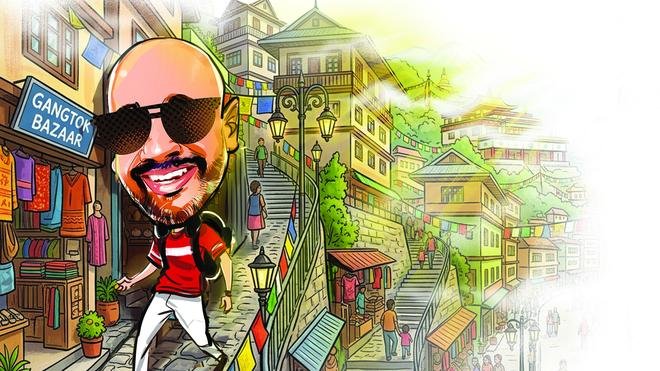
Why is Gangtok considered one of India’s most walkable cities? The answer lies partly in its geography, but geography alone does not explain the relationship residents have with the city. In Gangtok, walking is woven into the ordinary routines of life: going to school, visiting friends, running errands, reaching local shops and moving between neighbourhoods.
For writer Prajwal Parajuly, returning to Gangtok offers an opportunity to reconsider a simple question that many larger Indian cities have forgotten: what happens when a city is designed around people moving through it rather than cars moving past them?
Gangtok is not flat, effortless or conventionally pedestrian-friendly. Its roads climb sharply, the terrain can be demanding and the Himalayan weather is unpredictable. Yet these very characteristics have helped shape a different urban rhythm. Walking is not an activity reserved for exercise or leisure. It is transportation.
That makes Gangtok an intriguing contrast to India’s rapidly motorising metropolitan centres, where short journeys are increasingly made by cars, motorcycles and app-based taxis, often at the expense of sidewalks, public space and everyday human interaction.
Gangtok’s greatest pedestrian advantage: proximity
Walkability is often misunderstood as simply having attractive footpaths.
A city can have beautifully paved sidewalks and still be difficult to navigate without a vehicle if homes, schools, offices, shops and public services are spread far apart.
Gangtok’s more important advantage is proximity.
Many everyday destinations can be reached without a long motorised journey. Neighbourhood shops, educational institutions, markets and social spaces are woven into the urban fabric.
This creates a different relationship between residents and distance.
A journey that might be described as “too far to walk” in a large Indian metropolis can simply be part of an ordinary day in Gangtok.
Growing up in a city where walking is normal
For someone who grows up in a walkable environment, walking does not necessarily register as exercise.
It is simply how one gets somewhere.
School can involve walking. Meeting friends can involve walking. Buying groceries can involve walking. Visiting a neighbour can involve walking.
That distinction is important because cities influence habits long before residents consciously make lifestyle choices.
A child who grows up in a neighbourhood where destinations are accessible on foot naturally accumulates physical activity through ordinary routines. Another child growing up in a car-dependent environment may need a deliberate exercise programme to achieve the same level of movement.
In that sense, walkability is a public-health intervention built into the street itself.
The hills make walking harder—and somehow more natural
Gangtok’s terrain might appear to be an argument against walkability.
After all, the city is built on steep Himalayan slopes rather than a flat plain. Walking uphill requires effort. Stairs can replace roads in places. Distances that look short on a map can feel much longer when elevation changes are involved.
But the terrain has also shaped the city in ways that discourage the assumption that every movement must happen inside a vehicle.
Gangtok’s pedestrian routes include stairways, narrow lanes, footpaths and shortcuts that connect spaces in ways a car cannot always replicate.
A vehicle may have to follow a winding road. A pedestrian can sometimes take a more direct route.
The result is a city where feet can occasionally be more efficient than wheels.
What makes a city truly walkable?
Urban planners generally consider several factors when evaluating walkability. Distance is only one of them.
- Connectivity: Can pedestrians move directly between destinations?
- Density: Are homes, shops and services located close enough to one another?
- Safety: Can people walk without facing excessive traffic danger?
- Comfort: Are walking routes usable in different weather conditions?
- Accessibility: Can older people, children and people with disabilities navigate them?
- Mixed land use: Are residential, commercial and civic activities integrated?
- Public transport: Can walking connect effectively with buses and other transport?
- Public realm: Do streets feel like places for people rather than merely corridors for vehicles?
Gangtok performs strongly on some of these characteristics because of its compact urban form and pedestrian-oriented local movement. But it also has limitations, particularly for people with mobility challenges and on steep terrain.
That nuance matters. Calling Gangtok walkable should not mean pretending that every street is universally accessible.
Walkability is not the same as flatness
This may be the most interesting lesson from Gangtok.
Modern discussions about pedestrian-friendly cities often focus on flat streets, wide pavements and cycling infrastructure. Gangtok demonstrates that walkability can emerge in a very different physical environment.
Its hills require a different pedestrian vocabulary.
Stairs, ramps, switchbacks, retaining walls, shortcuts and small-scale pathways become part of the transport network.
The city’s topography therefore suggests an important principle for Indian planners: walkability should be designed around local geography rather than imposed through a standard template.
Gangtok’s quiet streets offer another advantage: social contact
Walking changes how people experience a city.
Inside a car, the environment moves past a person at speed. On foot, the pedestrian moves through the environment at human pace.
That difference creates opportunities for interaction.
A person walking to the market may stop to talk to a shopkeeper. Neighbours may meet on the street. Children can encounter friends on the way home from school. Small businesses become part of everyday life rather than destinations viewed through a windscreen.
These interactions may appear insignificant individually, but collectively they contribute to a city’s social fabric.
Walkable streets can therefore function as informal social infrastructure.
Why car dependency changes urban life
India’s larger cities have experienced extraordinary growth in private vehicle ownership.
As roads become congested, urban authorities frequently respond by attempting to accommodate more traffic through road widening, flyovers, parking facilities and new corridors.
But this can create a cycle.
More road capacity can encourage more driving. More vehicles then generate congestion, which creates pressure for still more road capacity.
Meanwhile, pedestrian space may become narrower or fragmented.
A city designed primarily around traffic movement can make even a short journey uncomfortable or unsafe without a vehicle.
Gangtok offers a different possibility: design the city so that many everyday trips never need a car in the first place.
Walking can reduce the hidden cost of urban transport
A short motorised journey may seem inexpensive to an individual, but car dependence creates costs that are distributed across society.
These include congestion, fuel consumption, air pollution, noise, road maintenance, parking demand and traffic injuries.
Walking produces none of these direct transport costs.
It also requires no fuel, no parking space and no vehicle ownership.
When thousands of small journeys are shifted from motorised transport to walking, the cumulative effect can be substantial.
That is why walkability is increasingly viewed not only as a lifestyle feature but as part of urban transport policy.
The public-health argument is even stronger
Regular physical activity is strongly associated with better cardiovascular health and lower risks of several chronic diseases.
Yet asking people to exercise every day can be difficult, particularly in cities where long working hours and commuting leave little time for structured physical activity.
Walking built into daily transport solves part of that problem.
A person who walks to school, walks to the market and walks to meet friends accumulates activity without necessarily thinking of themselves as exercising.
That is one reason the design of streets can have public-health consequences.
The healthiest city may not be the one with the most gyms; it may be the one that makes everyday movement unavoidable, safe and convenient.
Gangtok’s walkability has a cultural dimension too
Infrastructure alone cannot explain why walking feels normal in a place.
Culture matters.
When residents expect to walk, neighbourhoods adapt around pedestrians. Shops serve local foot traffic. Informal social interactions develop around streets. Children become accustomed to moving through their surroundings on foot.
Once car use becomes the default, the opposite can happen.
Businesses prioritise parking. Roads are widened. Pedestrian crossings become less convenient. Children are driven to school because streets feel unsafe. Short journeys become motorised.
The built environment then reinforces the behaviour that created it.
Gangtok’s pedestrian culture demonstrates the opposite feedback loop: when walking is normal, the city can remain organised around short-distance human movement.
But Gangtok is not a perfect walkability model
A credible assessment also needs to acknowledge the limitations.
Steep gradients can make walking difficult for older adults, people with disabilities and anyone with mobility limitations. Heavy rain can make slopes and steps more challenging. Seasonal weather can affect pedestrian comfort.
Some streets can also face congestion, parking pressure and vehicle-pedestrian conflicts as Gangtok’s population, tourism and motorisation increase.
This means the city’s walkability is not guaranteed to survive unchanged.
In fact, one of the most important questions for Gangtok may be whether it can preserve its pedestrian character while accommodating rising vehicle ownership and tourism demand.
The danger of copying Gangtok without understanding it
Indian cities should not simply attempt to reproduce Gangtok’s streets.
A flat metropolitan city cannot be transformed into a Himalayan hill city, nor should it try.
The transferable lesson is more basic: make everyday destinations close enough, connected enough and safe enough that people have a genuine alternative to driving.
In Bengaluru, that might mean connecting residential areas to workplaces and transit stations. In Delhi, it could involve better pedestrian connections around metro stations. In Mumbai, it may mean protecting footpaths from parking and street-level obstructions.
The infrastructure would look different in every city.
The principle remains the same.
What Indian cities could learn from Gangtok
| Gangtok lesson | Possible application elsewhere |
|---|---|
| Everyday destinations can be close together | Promote mixed-use neighbourhoods instead of separating homes from shops and services. |
| Pedestrian shortcuts matter | Create direct walking links that are shorter than vehicle routes where possible. |
| Walking can be part of daily life | Design school, market and neighbourhood trips around pedestrians rather than cars. |
| Local geography should shape infrastructure | Use ramps, shaded paths, crossings, stairs and other solutions suited to each city’s terrain. |
| Cars should not automatically receive priority | Protect pedestrian space and manage parking rather than continuously expanding road capacity. |
| Walking and public transport can complement each other | Make the first and last kilometre around transit stations safe and convenient on foot. |
The first-and-last-kilometre problem
Even cities with excellent public transport can remain difficult to navigate if the journey to and from the station is unpleasant.
This is where Gangtok’s pedestrian culture offers another useful insight.
Walking is not necessarily an alternative to public transport. It is often what makes public transport possible.
A person can walk from home to a bus stop, take public transport for the longer portion of a journey and walk again at the destination.
When those pedestrian connections are safe, the need for private vehicles falls.
For India’s major cities, improving these short walking links could potentially produce greater transport benefits than focusing exclusively on large road projects.
What happens if Gangtok becomes more car-dependent?
This is the question that may ultimately determine the city’s future.
As incomes rise and vehicle ownership increases, the convenience of private transport can become difficult to resist. Tourism can further increase traffic pressure in a city whose geography limits road expansion.
If more residents shift from walking to private vehicles, Gangtok could gradually lose one of its most distinctive characteristics.
The transformation would not happen overnight.
It would begin with small changes: more cars parked on pedestrian routes, greater traffic on neighbourhood streets, children being driven for short trips and businesses adapting to vehicle access.
Eventually, walking could become something people do because they have to rather than because the city naturally supports it.
Protecting walkability therefore requires active policy, not nostalgia.
A future where walking becomes an urban advantage
India’s cities do not need to eliminate cars to become more walkable.
The more realistic objective is to ensure that cars are not the only practical option.
A successful city should allow people to choose the appropriate mode for the journey: walking for short trips, cycling where conditions permit, public transport for longer journeys and private vehicles when they are genuinely necessary.
Gangtok’s experience demonstrates what can happen when walking remains embedded in everyday urban life.
The challenge for other Indian cities is to recover that possibility without copying the city’s geography.
Conclusion: Gangtok’s real lesson is about freedom, not footsteps
Why is Gangtok one of India’s most walkable cities? Not because every street is flat, every pavement is perfect or every journey is effortless.
Its strength lies in a different urban relationship: many daily activities remain close enough to be reached on foot, pedestrian routes form part of the city’s structure, and walking remains an ordinary part of life rather than a specialised form of exercise.
For people who grow up in Gangtok, this can make walking feel almost invisible. It is simply how they move through their city.
That may be the most valuable lesson for India’s increasingly congested urban centres.
A walkable city is not one that forces people to walk. It is one that gives people the freedom to walk—safely, conveniently and without feeling that they are sacrificing time or dignity by leaving the car behind.
Gangtok’s uphill rhythms offer a powerful reminder that the future of Indian cities does not necessarily have to be faster.
Sometimes, it may need to slow down enough for people to see the city they are moving through.
For breaking news and live news updates, like us on Facebook or follow us on Twitter and Instagram. Read more on Latest Lifestyle on thefoxdaily.com.



COMMENTS 0