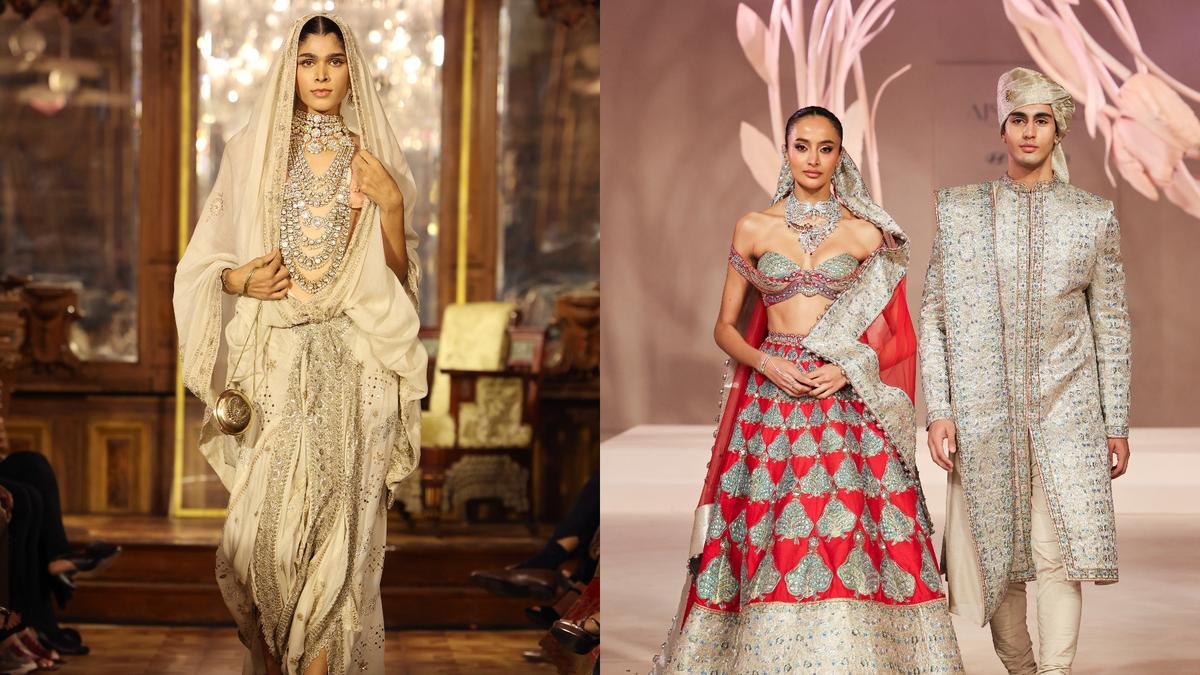
India couture fashion expansion:The geography of Indian luxury is changing. For decades, Delhi and Mumbai have been the country’s most important destinations for couture, celebrity fashion, luxury retail and high-value weddings. But the next phase of growth is increasingly being shaped by cities such as Hyderabad, Bengaluru and Chennai, where a growing affluent population is creating demand for premium fashion closer to home.
The shift was particularly visible at the Hyundai India Couture Week 2026, where Anamika Khanna opened the event with a show at Hyderabad’s Taj Falaknuma Palace, while Rahul Mishra closed the week in Delhi. The contrast between the two locations captured a larger change taking place in Indian luxury: Delhi remains an essential fashion capital, but designers can no longer afford to think of India’s ultra-rich as being concentrated in only two metropolitan markets.
Khanna’s Hyderabad presentation was significant not simply because couture travelled outside the traditional fashion circuit. It demonstrated how designers are increasingly connecting runway storytelling with commercial expansion. Her Hyderabad show followed the opening of a new store in the city in 2025, creating a direct link between fashion-week visibility and local consumer access.
The broader question is no longer whether Indian couture can succeed outside Delhi and Mumbai. It is whether the country’s emerging luxury centres could become essential to the next generation of Indian fashion businesses.
Why Hyderabad matters to Indian couture
Hyderabad represents an especially compelling opportunity because its luxury identity is supported by several different forces. The city has a strong tradition of jewellery, weddings, hospitality and premium consumption, while its expanding high-income population has created new demand for luxury products.
For couture designers, this combination matters.
Couture is rarely an impulse purchase. It is often connected to weddings, celebrations, social occasions and significant personal milestones. A city with a strong wedding culture and affluent clientele can therefore provide a natural customer base for high-value fashion.
Hyderabad also offers something that a runway in Delhi cannot provide on its own: proximity to the consumer.
A couture show can generate publicity, but a physical retail presence allows designers to develop relationships with customers, understand local preferences and provide fittings and consultations. For an industry where personal service is part of the product, that proximity can become commercially important.
Anamika Khanna’s Hyderabad show was more than a location change
Anamika Khanna’s opening presentation at the Taj Falaknuma Palace carried symbolic value because the venue itself helped connect Indian craftsmanship, heritage and luxury.
The collection featured embroidery from Barmer and references to Kalighat painting, bringing regional artistic traditions into a contemporary couture setting. That choice is significant because Indian couture has increasingly moved beyond the idea that luxury must be expressed only through conventional bridal ornamentation.
Regional crafts can provide designers with a deeper design vocabulary while also creating a connection between luxury fashion and India’s diverse cultural traditions.
The Hyderabad setting strengthened that message. A historic palace became the backdrop for a contemporary couture presentation, allowing the designer to place traditional craft within a modern luxury narrative.
But the commercial significance was equally important. Khanna had already established a retail presence in Hyderabad, meaning the city was not merely a spectacular backdrop for a fashion show. It was also a market.
The old Delhi-Mumbai luxury map is becoming insufficient
Delhi and Mumbai remain crucial to India’s fashion economy. They have established luxury consumers, media ecosystems, designers, stylists, celebrities, fashion professionals and high-end retail infrastructure.
But India’s wealth distribution has become more geographically diverse.
As businesses, technology companies, entrepreneurs and new-generation wealth expand beyond the traditional commercial centres, luxury consumption is following them. Affluent consumers increasingly expect premium experiences in the cities where they live rather than travelling to Delhi or Mumbai for every major purchase.
This does not mean the established fashion capitals are losing relevance. Instead, India’s luxury map is becoming multi-centred.
For couture houses, that creates a strategic opportunity. Rather than treating smaller or emerging luxury markets as secondary locations, designers can develop them as independent business territories.
Bengaluru is an obvious next frontier
Bengaluru’s relationship with luxury is different from Hyderabad’s. Its consumer base has been strongly influenced by technology, entrepreneurship and globally exposed professionals.
That creates a customer who may be comfortable with international luxury brands while simultaneously showing interest in Indian design.
For couture houses, Bengaluru presents an opportunity to position Indian craftsmanship within a more contemporary luxury conversation. The potential customer may not necessarily want heavily traditional clothing for every occasion. They may be looking for sophisticated pieces that combine Indian techniques with modern silhouettes.
This could encourage designers to rethink the assumption that couture expansion is primarily about bridal stores.
Bridal wear will remain a major part of the Indian couture economy, but emerging luxury markets can also support occasion wear, bespoke clothing, limited-edition collections and high-value fashion services.
Chennai brings a different kind of luxury opportunity
Chennai’s importance comes from a different cultural and economic foundation. The city has deep connections with classical arts, textiles, jewellery and traditional South Indian wedding culture.
That gives couture designers an opportunity to engage with consumers who already understand craftsmanship and ceremonial dressing.
But Chennai also demonstrates why a single national strategy may not work for luxury fashion. Consumer preferences can vary substantially between regions. Colours, silhouettes, fabrics, embroidery traditions and wedding customs differ across India.
A designer entering Chennai therefore has to do more than reproduce a Delhi collection in another showroom. The stronger strategy is to understand local consumers while retaining the brand’s broader identity.
This balance between consistency and localisation could become one of the defining challenges for Indian couture houses as they expand.
The ultra-rich are becoming more geographically dispersed
The growth opportunity outside India’s traditional luxury capitals is ultimately connected to the changing geography of wealth.
As more high-net-worth individuals and entrepreneurial families emerge in different parts of the country, luxury consumption becomes less dependent on a small group of established metropolitan buyers.
That matters particularly for couture because the customer journey is highly personal.
A customer purchasing a couture outfit may require several consultations, fabric discussions, measurements, alterations and fittings. Geographic distance can therefore become a meaningful barrier.
A brand with a store or client-facing presence in an emerging luxury city can convert interest into actual purchases more effectively than a brand that expects customers to travel to another metropolitan centre.
Couture is selling experience, not just clothing
One reason location matters so much in luxury fashion is that couture is fundamentally experiential.
The garment itself is only one part of the transaction. The customer also buys access to the designer’s world, personalised service, craftsmanship, exclusivity and the emotional significance surrounding the purchase.
That is why luxury fashion cannot be evaluated solely through the number of products sold.
A well-designed boutique can function as a brand embassy. It allows consumers to experience fabrics, understand craftsmanship and interact directly with the label.
Fashion shows in emerging cities can strengthen that relationship further by transforming a retail market into a cultural event.
Hyderabad’s role in the 2026 couture week illustrates this possibility. A city can become both a stage for fashion storytelling and a commercial destination.
Indian craftsmanship is becoming a competitive advantage
The use of Barmer embroidery and Kalighat-inspired artwork in Khanna’s couture presentation points towards another major trend: Indian luxury increasingly draws its competitive strength from craft.
Global luxury fashion has long relied on heritage, craftsmanship and artisanal techniques as part of brand identity. Indian designers have access to an extraordinary range of textile and craft traditions.
The challenge is translating that abundance into contemporary luxury.
Simply attaching a traditional craft label to a garment does not automatically create a premium product. The craftsmanship has to be supported by design, quality control, storytelling and consistent execution.
When those elements work together, regional craft can become a major differentiator.
This is particularly relevant in international markets, where Indian fashion houses need a distinct identity rather than simply competing with global brands on conventional definitions of luxury.
Regional craft can also create a stronger Indian luxury identity
India’s greatest fashion advantage may be its diversity.
Barmer embroidery, Kalighat painting traditions and the textile histories of different regions can provide designers with material that cannot be easily replicated elsewhere. The opportunity is to use these traditions without freezing them in the past.
Contemporary couture can reinterpret regional techniques through new silhouettes, unexpected combinations and modern styling.
This allows Indian luxury to tell stories that are simultaneously local and global.
Instead of presenting Indian craftsmanship merely as something exotic for an international audience, designers can position it as a sophisticated design language in its own right.
The wedding economy is accelerating the regional luxury boom
India’s wedding market is particularly important to couture expansion because weddings generate demand across multiple categories of luxury: bridal clothing, groom’s wear, jewellery, accessories, hospitality and destination celebrations.
Luxury weddings are also increasingly distributed across different cities rather than concentrated in one national fashion capital.
Families with significant spending power may host celebrations in Hyderabad, Bengaluru, Chennai, Jaipur, Goa or other destinations. Designers who are physically closer to these consumers can become part of those ecosystems.
This means the future of couture retail may be less about maintaining a single flagship destination and more about creating a network of carefully selected luxury markets.
Why fashion houses should not simply open stores everywhere
Expansion, however, carries its own risks.
A luxury brand can lose exclusivity if it expands too aggressively. Opening stores in multiple cities without sufficient demand can also create high operating costs and dilute management attention.
The solution is not blanket expansion. It is selective expansion.
Designers need to identify cities where wealth, fashion interest, wedding demand, luxury infrastructure and brand compatibility overlap.
A city should not be considered attractive merely because it has wealthy residents. Luxury customers must also have an interest in the category and a willingness to spend on the particular design language of the brand.
Physical stores and digital luxury will increasingly work together
Even as designers expand into new cities, physical retail will not operate in isolation from digital commerce.
Luxury consumers may discover a collection through social media, watch a runway presentation online, research a designer’s craftsmanship digitally and then visit a store for a fitting.
This makes the relationship between online visibility and physical retail increasingly important.
A couture house can therefore use a city-specific show to generate digital attention while its local boutique converts that attention into long-term customer relationships.
The most successful brands are likely to treat digital platforms as discovery and storytelling channels while using physical stores for high-touch experiences that cannot easily be replicated online.
What Rahul Mishra’s Delhi finale tells us
Rahul Mishra’s role as the Delhi finale at India Couture Week 2026 provides an important counterpoint to Khanna’s Hyderabad opening.
The message is not that Delhi is being replaced. It is that the Indian couture ecosystem now needs both established fashion capitals and emerging luxury centres.
Delhi retains its significance as a national fashion hub, media centre and luxury destination. Hyderabad demonstrates how couture can connect with new affluent audiences outside that established circuit.
Together, the two shows suggest a dual strategy: maintain visibility at India’s recognised fashion centres while taking the brand directly into markets where future luxury demand is growing.
The next competition may be about access rather than attention
Indian designers have traditionally competed for runway attention, celebrity associations and media coverage. As the luxury market expands, another form of competition is likely to become more important: who can build the strongest relationship with affluent customers.
A designer may have extraordinary visibility nationally but still lose a local customer to a competitor who offers better service, easier access and a stronger understanding of regional preferences.
This makes customer relationship management, personalised fittings, private appointments and after-sales service increasingly important components of couture strategy.
Luxury fashion is ultimately a relationship business. The garment may be the visible product, but trust and service determine whether a one-time buyer becomes a repeat customer.
What India’s luxury expansion means for designers
The movement beyond Delhi and Mumbai could reshape how Indian couture houses think about growth.
- From national visibility to regional depth: Brands may prioritise stronger relationships in fewer carefully selected cities.
- From traditional bridal positioning to broader luxury: Occasion wear and bespoke fashion can expand the customer base.
- From heritage storytelling to contemporary craft: Regional techniques can be reinterpreted for modern consumers.
- From stores to experiences: Fashion shows, private appointments and cultural events can become part of retail strategy.
- From physical expansion alone to omnichannel luxury: Digital discovery and physical service can reinforce each other.
The bigger shift: India is becoming a network of luxury markets
The most important change may be conceptual.
India should no longer be viewed as having one luxury market with a few secondary cities. It is increasingly a collection of distinct luxury markets, each with its own wealth patterns, cultural preferences and consumption habits.
Hyderabad may respond strongly to a particular combination of couture, jewellery and heritage luxury. Bengaluru may lean towards contemporary design and globally influenced fashion. Chennai may have a deeper relationship with traditional textiles, craftsmanship and ceremonial dressing.
These differences are not obstacles. They can become opportunities for designers willing to understand them.
The next successful Indian couture expansion may therefore not be based on making every city look like Delhi. It may be based on allowing each city to influence how the brand is experienced there.
Conclusion: The future of Indian couture is no longer confined to two cities
The 2026 India Couture Week showcased a fashion industry at an interesting turning point. Anamika Khanna’s Hyderabad opening and Rahul Mishra’s Delhi finale represented two sides of the same opportunity: India needs to preserve its position as a global source of design and craftsmanship while developing deeper relationships with affluent consumers at home.
Hyderabad, Bengaluru and Chennai are important not simply because they contain wealthy consumers, but because they represent distinct cultural and commercial ecosystems. For couture houses, entering these markets successfully will require more than opening stores. Designers will need to understand local customers, collaborate with regional craft traditions, create contemporary products and provide the highly personalised service that luxury demands.
The strongest opportunity may lie in combining India’s traditional craftsmanship with the spending power and changing tastes of its new luxury consumers.
Delhi and Mumbai may remain India’s established fashion capitals, but the next chapter of Indian couture is likely to be written across a much larger map. The brands that recognise that shift early — and treat emerging cities as serious luxury markets rather than occasional fashion destinations — could be best positioned to capture India’s expanding appetite for high fashion.
For breaking news and live news updates, like us on Facebook or follow us on Twitter and Instagram. Read more on Latest Lifestyle on thefoxdaily.com.

COMMENTS 0