What happens when a bank robbery becomes an online spectacle? In How to Rob a Bank, criminals do not simply plan their escapes and disappear with the money. They film their operations, edit the footage and build internet personas around their crimes. The result is a gang that attracts millions of viewers while drawing the attention of law enforcement. It is an idea with plenty of potential for a sharp action comedy about crime, celebrity culture and the economics of online attention.
Directed by David Leitch, the film brings together Nicholas Hoult, Anna Sawai, Pete Davidson, Rhenzy Feliz, Zoe Kravitz and John C. Reilly. Its central attraction is the unusual combination of a traditional bank-heist story and the visual language of viral videos. The film also attempts to explore why people who feel abandoned by the financial system might turn against it.
There is enough energy, humour and action to make the experience entertaining. However, the film struggles to balance its irreverent premise with a more serious emotional story. Its characters are introduced as rebellious internet celebrities, but their motivations gradually become tied to grief, inequality and personal frustration. These ideas give the story some emotional weight, although they do not always fit naturally into its playful tone.
How to Rob a Bank follows a gang that turns crime into online entertainment
Hoult plays Ryan, the leader of a group of young criminals who call themselves Who’s Hungry. His gang includes his partner Emi, played by Anna Sawai; Vince, an army veteran portrayed by Pete Davidson; and Hugo, a technology enthusiast played by Rhenzy Feliz. Together, they carry out bank robberies that are recorded and uploaded online.
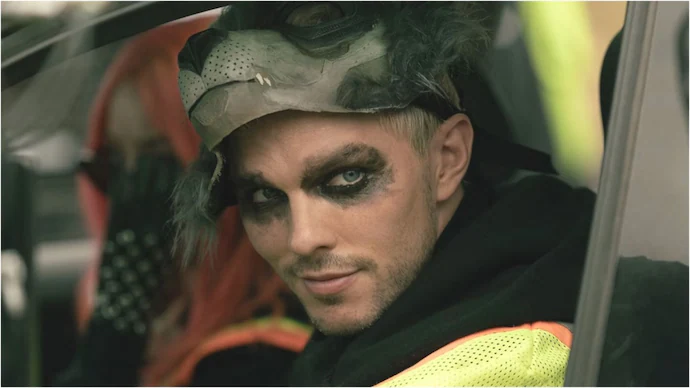
The gang’s approach is different from that of conventional criminals. Rather than treating their operations as activities that should remain hidden, they deliberately turn them into performances. Animal masks, multiple camera angles, flashy edits and carefully created online identities become part of their strategy. The robberies are designed not only to succeed but also to attract an audience.
This gives the film an entertaining starting point. The gang understands that attention can be as valuable as money in an internet-driven culture. Their criminal activities become a form of content, and their growing popularity turns them into recognisable online personalities.
The idea also creates an interesting contradiction. The gang wants to remain ahead of the authorities while making its activities increasingly visible to the public. Every new video brings more attention, but that attention also increases the risk of being identified and caught.
Their growing notoriety eventually puts them in the sights of FBI agent John West, played by John C. Reilly. He joins forces with Reagan Gardner, a hacker and software expert portrayed by Zoe Kravitz, to investigate the group and uncover its operations.
Nicholas Hoult’s film explores internet fame and millennial frustration
One of the more interesting aspects of How to Rob a Bank is its portrayal of criminals who understand the internet as a tool for building influence. The gang’s activities reflect a culture in which almost anything can be turned into content, provided it attracts enough attention. Even a bank robbery becomes a carefully packaged spectacle when there is an audience ready to watch.
Although the film’s presentation may initially suggest a story about Gen Z internet culture, its central characters are millennials. Their rebellion is connected to a longer experience of economic uncertainty and frustration with institutions they believe have failed ordinary people. They are not simply chasing online popularity. They also see their criminal activities as a response to a system they consider unfair.
This distinction gives the film a slightly different perspective on digital fame. Social media is not presented merely as an escape or a source of Entertainment. It becomes a platform through which the gang communicates its anger, constructs an identity and attracts supporters.
Their Robin Hood-like image is central to the story. By positioning themselves against financial institutions, they attempt to make their robberies appear like acts of rebellion rather than ordinary theft. The film invites viewers to understand the frustration behind their actions, even as it keeps the consequences of those actions at a distance.
David Leitch brings energetic action and a fast-moving visual style
Director David Leitch is familiar with action-driven storytelling, having previously directed films such as Bullet Train and The Fall Guy. His approach to How to Rob a Bank relies on movement, quick editing and an intentionally heightened visual style.
The camera rarely stays still for long. Action sequences are assembled through rapid cuts, shifting perspectives and visual flourishes that reflect the gang’s approach to filming its robberies. The influence of online videos and gaming is visible in the way the film presents its characters, their activities and their relationship with an audience.
The result is a film that rarely feels visually dull. Its action scenes have an energetic quality, while the soundtrack helps maintain the rebellious mood. Music plays an important role in keeping the screenplay lively, particularly when the emotional storyline threatens to slow down the momentum.
Leitch also understands the comic possibilities of the premise. Watching criminals approach a bank robbery as though they are producing a viral video creates opportunities for visual humour. The contrast between the seriousness of the crime and the gang’s enthusiasm for its online image gives the film some of its most amusing moments.
However, the frenetic style cannot compensate for every weakness in the writing. The film has plenty of movement, but its narrative does not always develop with the same confidence. Some sequences feel more concerned with maintaining energy than advancing the characters or making the investigation genuinely suspenseful.
Corporate greed and the American Dream give the heist a political edge
Beyond the action and comedy, How to Rob a Bank attempts to build a larger argument about money, inequality and the relationship between ordinary people and powerful institutions. Ryan and his gang are not presented as criminals motivated exclusively by personal wealth. Their anger is directed at a financial system they believe has left people like them with limited opportunities.
The film touches on corporate greed, the widening wealth gap and the frustration of younger generations who feel that the promise of the American Dream is increasingly difficult to achieve. The idea that hard work will automatically lead to financial security is questioned through characters who believe they have been denied a fair chance.
Ryan’s personal circumstances provide the emotional foundation for this rebellion. His grief and personal tragedy are presented as reasons behind his increasingly extreme choices. This backstory is intended to make the character more than an impulsive criminal and encourage viewers to understand the emotional experiences shaping his decisions.
It is an accessible premise because the frustrations explored by the film are recognisable. Economic insecurity, unequal access to opportunity and distrust of powerful institutions are issues that extend beyond the fictional world of the story. The gang’s actions may be illegal, but the film wants audiences to consider the anger that motivates them.
That emotional connection also makes it easier to root for the characters at certain points. The problem is that the screenplay does not always distinguish between understanding someone’s motivations and justifying their behaviour. It makes the robbers sympathetic without spending enough time examining the people affected by their crimes.
The shift from a comic heist to a grief-driven drama feels uneven
The biggest challenge for How to Rob a Bank is its attempt to combine two different kinds of storytelling. On one side, it is a cheeky action comedy about criminals who turn their robberies into internet entertainment. On the other, it wants to be an emotional drama about loss, economic injustice and the personal circumstances that can push people towards rebellion.
Neither direction is inherently unsuitable for the story. A heist film can use humour and spectacle while exploring serious social questions. However, the transition between these elements needs to feel natural. Here, the emotional material sometimes interrupts the playful momentum rather than adding another dimension to it.
Ryan’s tragedy is important to understanding his choices, but the film spends considerable time establishing his emotional wounds. As a result, the actual heist story occasionally takes a back seat. The audience is asked to enjoy the gang’s outrageous activities while also taking its motivations seriously, but the screenplay does not always connect those two impulses convincingly.
The political commentary faces a similar limitation. The film raises questions about inequality, institutional power and the influence of social media, but it rarely explores them beyond their most obvious interpretations. Its Robin Hood comparison makes the gang’s position easy to understand, yet the story could have benefited from a more complicated examination of what happens when criminals decide that their own sense of justice gives them the right to break the law.
Nicholas Hoult leads a cast with uneven character development
Nicholas Hoult gives Ryan an appealing intensity. He brings the anger and emotional instability required by the role, making the character’s frustration understandable even when his decisions are difficult to defend. However, the writing gives him limited space to develop beyond his grief and resentment.
Anna Sawai’s Emi is central to the gang’s story, but her character does not receive enough depth. The film establishes her importance to Ryan and the group’s activities without fully exploring her individual motivations. This leaves the relationship and her personal journey less developed than they could have been.
Pete Davidson and Rhenzy Feliz bring personality to Vince and Hugo. Their presence helps give the group some variation, preventing the gang from feeling like a collection of interchangeable criminals. Still, neither character gets enough substantial development to make a lasting impression.
The more entertaining character combination comes from Zoe Kravitz and John C. Reilly. As Reagan Gardner and FBI agent John West, they bring contrasting personalities and approaches to the investigation. Their generational differences create opportunities for humour, while their interactions provide a welcome change from the central gang’s increasingly familiar dynamics.
Kravitz and Reilly share an easy screen presence, and their scenes often have a liveliness that the film’s other character interactions lack. Their investigative partnership could have become one of the strongest elements of the story if the screenplay had spent more time developing it.
Why How to Rob a Bank never becomes a memorable heist thriller
The film’s biggest missed opportunity is its limited exploration of the consequences of the gang’s actions. By making the robbers entertaining and giving them understandable grievances, the story encourages viewers to see them as rebellious outsiders. But the moral questions surrounding their activities remain largely unexplored.
A more layered screenplay could have examined the difference between challenging an unjust system and causing harm to individuals caught in the middle. It could also have explored how the gang’s pursuit of online fame changes its understanding of risk, responsibility and success. Instead, the film often settles for the straightforward appeal of criminals taking on powerful institutions.
The investigation also loses some of its excitement as the story progresses. The central conflict promises a compelling contest between the gang and the people trying to identify them, but the cat-and-mouse dynamic does not consistently deliver the tension expected from a heist thriller.
This is particularly disappointing because the premise offers several opportunities for suspense. The gang’s decision to publish footage of its crimes could create a constant battle between visibility and anonymity. Its online popularity could become both an advantage and a vulnerability. Yet these possibilities are not explored with enough depth to make the investigation truly gripping.
How to Rob a Bank verdict: An entertaining one-time watch
How to Rob a Bank works best when it embraces its most straightforward identity: an energetic popcorn entertainer about criminals who turn bank robberies into viral spectacles. David Leitch’s action-oriented direction, the film’s playful visual language and the cast’s screen presence provide enough entertainment to keep it moving.
Nicholas Hoult makes for an engaging lead, while Zoe Kravitz and John C. Reilly offer some of the film’s most enjoyable interactions. Its ideas about internet celebrity, financial inequality and frustration with institutions also give the story more to work with than a conventional robbery caper.
Unfortunately, the film does not fully develop these ideas. Its emotional storyline sometimes clashes with its comic tone, its supporting characters remain underwritten, and its social commentary rarely moves beyond familiar observations. The result is a film that is enjoyable in the moment but lacks the narrative sharpness needed to stand out in the crowded heist genre.
How to Rob a Bank is a fun but forgettable watch for viewers looking for a light action film with a contemporary premise. It has the energy to entertain, but once the credits roll, its biggest ideas and most exciting moments are unlikely to stay with the audience for long.
How to Rob a Bank released in India on November 20.
For breaking news and live news updates, like us on Facebook or follow us on Twitter and Instagram. Read more on Latest Reviews on thefoxdaily.com.






COMMENTS 0