The Image That Lingers
In sport, endings matter. The way careers close, the manner in which service is acknowledged and transitions are managed, tells you something important about the institutions that govern a sport and the values they hold. Results matter most. But the way you treat people who have given you those results matters too, and when the two things come apart, the uncomfortable questions that follow tend to outlast the original decision by a considerable distance.
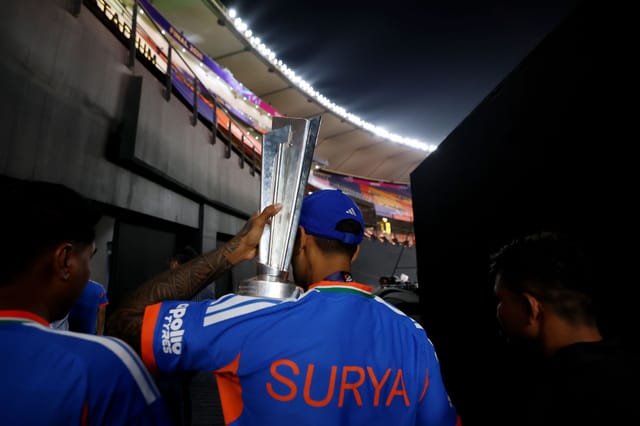
On Saturday, June 6, the BCCI announced India’s 16-member T20I squad for the upcoming series against Ireland and England. Shreyas Iyer was named as the new captain. Suryakumar Yadav was not merely relieved of the captaincy he had held. He was dropped from the squad entirely. The last image of him in an India T20I jersey, therefore, is the one from the 2026 T20 World Cup final: holding the trophy, having just led India to the title against New Zealand, at the peak of whatever a career achieves when it delivers a World Cup.
That image is now, potentially, the last one. And former India opener Aakash Chopra has asked, loudly and clearly on his YouTube channel, whether it needed to end this way.
Who is questioning this? Aakash Chopra, former India Test opener and one of cricket’s most prominent analysts, speaking at 48 years old with the perspective of someone who has watched careers begin and end across decades of the game. What is the concern? That a cricketer who captained India to a World Cup title received no formal off-ramp, no acknowledgment, no announced farewell series before being removed from the squad. When did this happen? The squad announcement came on Saturday, June 6, 2026. Where does Suryakumar stand now? Omitted from India’s T20I setup with no clarity about whether this is permanent or temporary. Why does it matter? Because the manner of a champion’s exit reflects on everyone involved in that exit, not just the champion.
The World Cup Trophy and the Dropped Player: A Jarring Sequence
Chopra’s emotional response to the squad announcement was captured in its purest form in the opening of his YouTube commentary. The shock was genuine, the concern was real, and the phrase he reached for first was not tactical analysis but something closer to disbelief:
“I mean, wow, because the last image you’ll have is him holding the World Cup trophy. World Cup trophy and then he gets dropped from the team. That doesn’t happen, man. That usually doesn’t happen.”
The observation is worth sitting with. Suryakumar Yadav’s final act in an India T20I jersey, as of this squad announcement, was lifting the 2026 T20 World Cup. That is not an ordinary final act. That is one of the highest points a cricket career can reach. The standard management of such a situation, in almost every sporting context, is to provide the departing player with some form of acknowledged transition: a farewell series, a formal announcement that specific upcoming matches will be their last, or at minimum a private conversation that gives the player the dignity of knowing their time is ending before it actually ends.
What Chopra is articulating is the absence of that transition. Whether the private conversation happened, he admits he cannot know. But the public record shows a World Cup-winning captain removed from both leadership and the squad simultaneously, with no announced farewell, no acknowledgment of the service rendered, and no opportunity for the player, the fans, or the institution to mark the end of an era appropriately.
The “Off-Ramp” Argument: How It Should Have Been Done
Chopra’s specific suggestion for how the transition could have been managed is worth examining in detail, because it represents a model that professional sport regularly fails to follow despite its obvious merits:
“What I believed was that he should have been given an ‘off-ramp’ like telling him, ‘these are your last two series, play them, we’re making you captain. After this, it’s goodbye.’ If you don’t say goodbye, then we will drop you and that would have been the fair thing to do. But I don’t know whether that conversation has happened or not.”
The off-ramp model is simple and dignified. It acknowledges that a player’s time in a setup is coming to an end. It gives them the chance to conclude their chapter with the awareness that it is, in fact, a conclusion. It allows them to prepare psychologically for the transition, to say whatever they want to say publicly about their time in the role, and to be thanked formally by the institution for which they performed at the highest level.
For the fans, the off-ramp provides the opportunity for the kind of farewell that sporting moments deserve. The crowd’s response to a player’s final game, when everyone knows it is their final game, carries an emotional weight that a retroactive announcement of retirement cannot replicate. The moment Suryakumar lifted the 2026 World Cup trophy could have been that farewell moment, properly framed and acknowledged. Instead, it appears to have passed without that framing, and the next squad announcement delivered the news that his time was over without ceremony or context.
A Career That Deserved Better Than This Ending
The statistical record of Suryakumar Yadav’s T20I career does not require embellishment. The numbers speak clearly enough about what he brought to India’s white-ball setup from his debut in March 2021 through the 2026 World Cup final.
| Metric | Suryakumar Yadav | Context |
|---|---|---|
| T20I Matches | 113 | Significant career volume |
| T20I Runs | 3,272 | India’s third-highest T20I run-scorer |
| T20I Average | 36.35 | Exceptional for the format |
| T20I Strike Rate | 162.94 | Among the best in the world |
| T20I Fifties / Centuries | 25 fifties, 4 centuries | Highest score 117 |
| Matches as Captain | 52 | Substantial leadership tenure |
| Wins as Captain | 42 | Second-most wins by India T20I captain (behind Rohit’s 50) |
| Losses as Captain | 8 | 2 no results |
| T20I Debut | March 2021 | Career spanning over five years |
A T20I batting average of 36.35 at a strike rate of 162.94 places Suryakumar among the most complete T20 batters the format has produced. His 3,272 runs make him India’s third-highest scorer in the format behind only Rohit Sharma (4,231) and Virat Kohli (4,188) — both of whom are legends of the game whose runscoring was accumulated over careers of extraordinary longevity. That Suryakumar stands in their company, having debuted as late as March 2021 at an age when many players are winding down, is a remarkable statement about the impact he made in a relatively compressed period.
His captaincy record is equally compelling. Forty-two wins from 52 matches is a win percentage of over 80 percent — a number that places him among the most successful T20I captains in Indian Cricket history. He led India to the 2026 World Cup title, which is the apex of what T20I captaincy can achieve. His eight losses as captain came in a format where no team wins every game and where a single bad performance on a knockout day can end any campaign. The record, assessed honestly, is one of the best captaincy tenures in Indian T20 history.
The Emotional Side That Chopra Acknowledges
One of the most honest moments in Chopra’s commentary was his acknowledgment that his concern about the manner of Suryakumar’s exit is driven by emotion as much as principle:
“I really hope it has, but what difference would it have made to play one or two more series? A new era has to begin, an old era has to end. But could this have been done a little better? It’s just the emotional side of me speaking. Because I’m thinking that my last image of him might end up being his last match itself. I mean, that is just too heartbreaking in a sense.”
The emotional honesty here is disarming and, frankly, more persuasive than a purely analytical argument would be. Chopra is not claiming that the selection decision itself is wrong. A new T20I era requires a new captain, requires new players given extended opportunities, and requires someone to step back to make room. If Suryakumar Yadav’s best T20I cricket is behind him, which at 35 in a format that increasingly rewards youth is a reasonable assessment, then the selection committee’s decision to move on is defensible on cricketing grounds.
But the emotional argument, which Chopra articulates precisely, is separate from the cricketing argument. A player who delivered a World Cup deserved to know his time was ending before it ended. He deserved the opportunity to prepare a final message, to play a final innings with the awareness that it was his final innings, and to walk off the field for the last time in the way that every great servant of the game should be permitted to walk off — acknowledged, celebrated, and properly sent on their way.
The BCCI’s Response: Silence as Policy
The BCCI has not publicly addressed the manner of Suryakumar’s exit. Chief selector Ajit Agarkar’s squad announcement comments, in which he noted that “there will always be players who miss out” and that the committee is “very happy with this group,” do not engage with the specific question of how the transition was communicated to Suryakumar privately.
Chopra explicitly acknowledges the possibility that the right conversation did happen behind closed doors: “I don’t know whether that conversation has happened or not.” The absence of public information does not mean the absence of private dignity. It is entirely possible that Suryakumar was given the courtesy of advance notice, an honest conversation about the direction of the team, and the opportunity to respond to that information before the public announcement was made.
But the public record is what the public sees. And the public record shows a World Cup-winning captain announced as surplus to requirements in a squad announcement that did not acknowledge his service, frame his exit as a farewell, or provide any of the contextual dignity that the career he built across 113 T20Is might have warranted.
What Comes Next: An Era Ended, A Chapter Opened
Suryakumar Yadav is 35 years old. At the IPL level he remains a significant figure, and his white-ball skills have not suddenly evaporated. Whether India’s decision represents a permanent end to his T20I career or a temporary interruption that a strong domestic showing could reverse is a question that only future squad announcements will answer.
For Shreyas Iyer, stepping into the captaincy with the backing of Rohit Sharma, Suryakumar’s endorsement at the Wankhede on Saturday, and the institutional confidence of the selection committee, the challenge is to build something rather than simply maintain what was inherited. The transition between eras is always awkward. The team that Suryakumar led to a World Cup title was built across years of development and cannot simply be handed intact to a new captain. New players will be integrated. Some of the previous era’s trusted performers will be rotated out. The process is normal and necessary, even when it is uncomfortable.
But Chopra’s question, stripped of its emotional framing and considered purely on its merits, remains valid: could the ending have been handled better? Not the decision itself, perhaps, but the manner of the announcement, the absence of a farewell framework, and the possibility that a cricketer who held the Suzanne Lenglen Cup of T20 Cricket walked off the field in a final without knowing it was his final.
Conclusion: The Trophy Image and the Unanswered Question
The last image of Suryakumar Yadav in an India T20I jersey is him holding the World Cup trophy. That is, by any reasonable measure, a glorious way to be remembered. The tournament title, the captain’s lift of the cup, the celebration that followed — these are images that belong permanently in the record of Indian cricket’s achievements.
What Aakash Chopra is arguing, and what many who watched Saturday’s squad announcement felt, is that this image deserved a more deliberate goodbye attached to it. Not a different outcome, not a reversal of the selection decision, but the simple human acknowledgment that an era was ending, that the service rendered was significant, and that the person who rendered it deserved to walk off with the full awareness that they were walking off.
Could this have been done a little better? The question lingers. The trophy image remains. And somewhere in the gap between them is the story of how professional sport too often handles the endings of the people who make it worth watching.
A World Cup winner, 113 T20Is, 42 wins as captain, and the cup held high at the last. Suryakumar Yadav’s T20I career ends, officially or temporarily, the way too many great careers end: not with a goodbye, but with an announcement.
For breaking news and live news updates, like us on Facebook or follow us on Twitter and Instagram. Read more on Latest Sports on thefoxdaily.com.






COMMENTS 0