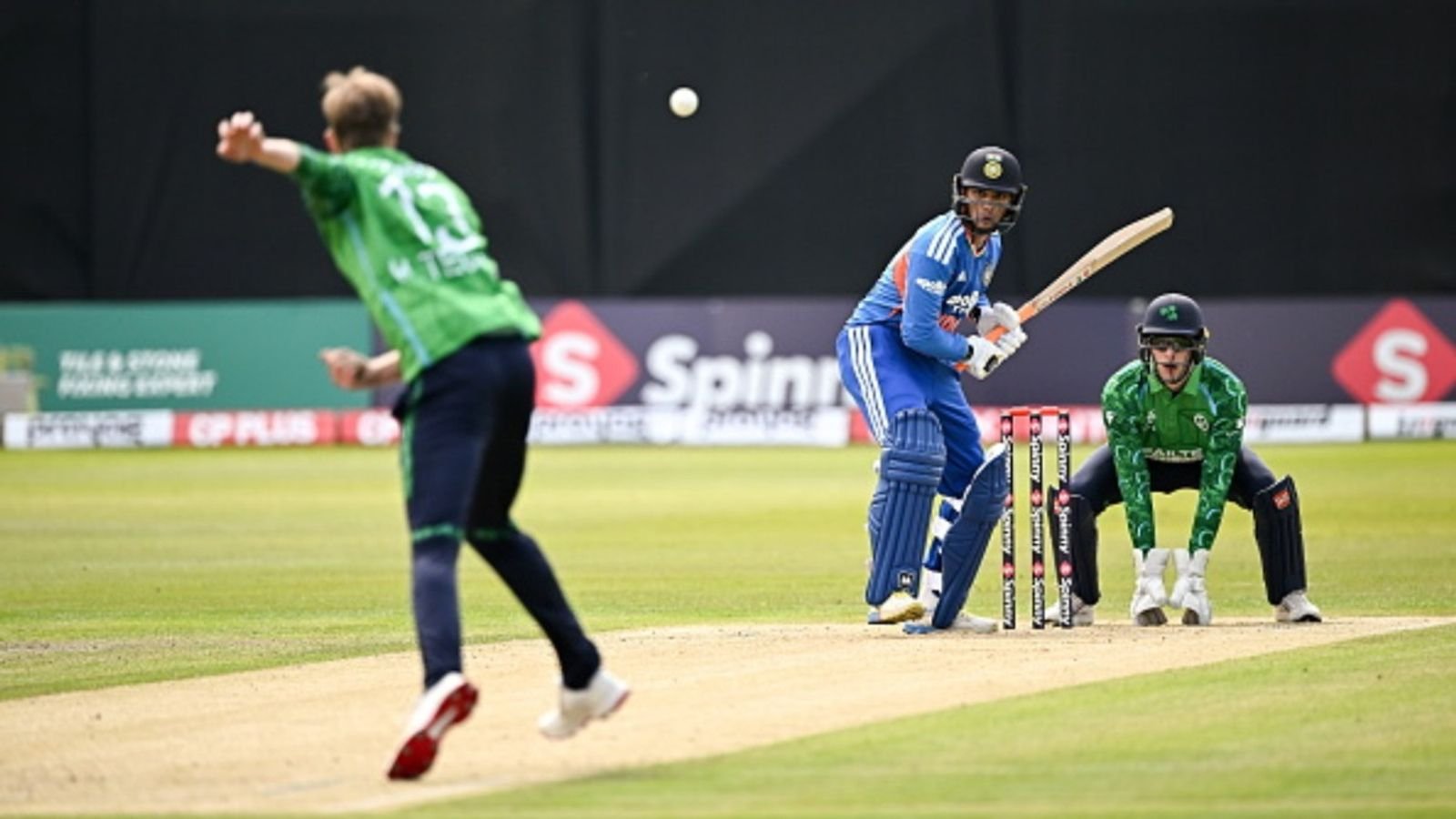
Abhishek Sharma unwanted T20I record became one of the biggest talking points during India’s difficult chase against Ireland in the second T20I. The young left-handed opener, known for his fearless stroke play and aggressive approach, suffered a rare failure when he was dismissed for a first-ball duck, putting him into an unwanted list among Full Member players in T20 international cricket.
The dismissal came at a crucial moment as India were chasing 155 runs after Ireland posted a competitive total. Instead of providing the explosive start India expected, Abhishek’s early departure increased pressure on a batting lineup already under challenge.
While a single failure does not define a player’s career, the incident highlights a larger discussion around aggressive T20 batting — where players are often expected to attack from the first delivery, but the risk of early dismissals remains extremely high.
Abhishek Sharma’s first-ball dismissal against Ireland
India’s chase started in the worst possible way when the top order immediately came under pressure.
Abhishek Sharma attempted to play an attacking pull shot against Ireland pacer Jai Moondra on the very first ball he faced. However, the timing was not right, and the mistimed shot found Matthew Hollard, who completed the catch to send the Indian opener back without scoring.
The dismissal was particularly damaging because India were chasing a target that required a strong powerplay. In modern T20 cricket, teams often rely on aggressive starts to reduce pressure during the middle overs.
The unwanted record Abhishek Sharma registered
With this first-ball duck, Abhishek Sharma recorded his sixth duck in T20 internationals during the 2026 calendar year.
That placed him among the players with the most ducks in T20Is in a calendar year for Full Member nations.
| Player | Number of Ducks | Year |
|---|---|---|
| Saim Ayub | 7 | 2025 |
| Richard Ngarava | 6 | 2024 |
| Abhishek Sharma | 6 | 2026 |
The record is not a reflection of his overall ability, but it shows the unpredictable nature of T20 cricket, where even elite attacking players can face difficult periods.
Why aggressive openers face this problem in T20 cricket
The modern T20 opening role has changed dramatically. Openers are no longer expected only to build an innings; they are expected to attack immediately.
Players like Abhishek Sharma are selected because they can change the momentum of a match within a few overs. Their ability to hit boundaries early gives teams a major advantage.
However, this approach also creates vulnerability.
- More attacking shots mean higher dismissal risk.
- Fast bowlers often target aggressive batters with early movement.
- Fielding restrictions encourage attacking play but also create catching opportunities.
- Opposition teams prepare specific plans against power hitters.
The challenge for modern T20 batters is not simply scoring quickly — it is knowing when to attack and when to absorb pressure.
Abhishek Sharma’s importance in India’s T20 setup
Despite the unwanted record, Abhishek Sharma remains one of India’s most exciting young T20 players.
His value comes from his ability to provide explosive starts, his left-handed batting advantage and his ability to influence games within a short period.
India’s T20 strategy has increasingly focused on fearless cricket, and players like Abhishek represent that philosophy.
However, consistent success at the international level requires balancing aggression with adaptability.
India’s batting collapse adds pressure after strong bowling effort
The disappointment of Abhishek’s dismissal was amplified because India’s bowlers had already created a strong foundation.
Debutant Prince Yadav delivered an impressive performance, taking three wickets in his spell, while Arshdeep Singh and Shivam Dube also contributed with important breakthroughs.
Ireland were restricted to 154 runs, giving India a realistic opportunity during the chase.
However, Ireland’s new-ball attack changed the momentum immediately.
Jai Moondra caused major damage with early wickets, while Matthew Hollard also added pressure as India struggled to build partnerships.
The bigger lesson from Abhishek Sharma’s duck
The biggest takeaway from this dismissal is not the failure itself but the importance of match awareness.
Modern T20 cricket rewards fearless players, but the best performers combine aggression with calculation.
Players such as Virat Kohli, Jos Buttler and other successful T20 batters have shown that attacking cricket does not always mean attacking every ball.
The ability to recognise conditions, understand the bowler’s plan and choose the right moments separates good T20 players from great ones.
Comparison: Powerplay aggression vs long-term consistency
| Approach | Advantage | Risk |
|---|---|---|
| Ultra-aggressive batting | Quick runs and momentum | Higher chance of early dismissal |
| Balanced aggression | Better innings control | Slightly slower start |
| Conservative approach | Lower dismissal risk | May lose powerplay advantage |
What this means for Abhishek Sharma’s future
The next challenge for Abhishek will be converting his natural talent into consistent international performances.
India’s selectors and team management are likely to continue backing his attacking ability because match-winning players often require patience during development phases.
The key improvement area will be handling difficult starts and improving shot selection against quality new-ball bowling.
Conclusion
Abhishek Sharma’s unwanted T20I record after his duck against Ireland highlights the unpredictable nature of the shortest format. The same fearless style that makes him dangerous can also create moments of vulnerability.
For India, the bigger concern is finding consistency at the top of the order. For Abhishek, the challenge is transforming explosive potential into reliable match-winning performances.
In T20 cricket, one ball can create history — sometimes the kind a player wants, and sometimes the kind he hopes to leave behind.
For breaking news and live news updates, like us on Facebook or follow us on Twitter and Instagram. Read more on Latest Sports on thefoxdaily.com.






COMMENTS 0