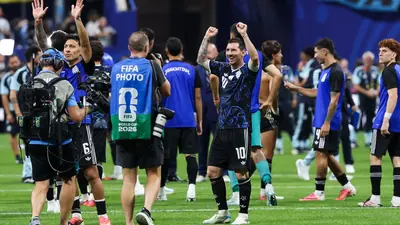
The argentina vs England FIFA World Cup 2026 semi-final delivered everything football fans could have hoped for: goals, drama, intensity, tactical battles, and another Lionel Messi masterclass. Yet within minutes of the final whistle, much of the global conversation shifted away from football and toward something increasingly familiar in modern tournaments—VAR controversy and accusations of favoritism.
Argentina’s 2-1 comeback victory secured their place in the FIFA World Cup 2026 final against Spain, but it also reignited one of football’s longest-running debates: are major international tournaments truly free from bias, or do controversial decisions inevitably fuel conspiracy theories when elite teams and legendary players are involved?
While there is no evidence supporting claims of institutional favoritism, the reaction following Argentina’s victory demonstrates how technology, social media, and football fandom have combined to create an environment where every major decision is scrutinized more intensely than ever before.
Why the Argentina vs England Match Became So Controversial
The controversy surrounding the semi-final did not stem from a single decision. Instead, it emerged from several incidents that collectively created doubt among sections of the football community.
In high-pressure matches, especially World Cup knockout games, every marginal call carries enormous significance. A single decision can influence momentum, public perception, and ultimately the narrative surrounding a tournament.
Following Argentina’s victory, fans immediately began analyzing multiple moments:
- Enzo Fernandez’s opening goal.
- A potential foul involving Lionel Messi during the build-up to Argentina’s second goal.
- An early challenge by Fernandez that some supporters believed warranted a red card.
- The speed and visibility of VAR reviews.
Individually, none of these incidents conclusively proved wrongdoing. Collectively, however, they provided enough material for social media debates to explode across multiple platforms.
The Enzo Fernandez Goal Debate
The first major talking point involved Argentina’s equalizing goal.
Many viewers questioned whether Enzo Fernandez may have been in an offside position during the attacking move. Modern broadcasts have conditioned fans to expect lengthy VAR reviews accompanied by detailed offside graphics and calibration lines.
When the goal was approved without an extended televised review, speculation quickly followed.
However, it is important to understand how VAR operates during international tournaments.
Every goal is automatically reviewed by video officials regardless of whether broadcasters show the process. In many cases, checks are completed within seconds when officials determine there is no clear infringement.
The absence of visible graphics does not necessarily indicate a lack of review. Nevertheless, perception often becomes reality in the social media era.
For many supporters watching at home, not seeing the evidence created an information vacuum that conspiracy theories rapidly filled.
Messi’s Involvement in the Winning Goal
Argentina’s second goal generated another significant debate.
The move began with Lionel Messi battling for possession before launching the attack that eventually resulted in the decisive strike.
England supporters argued that Messi may have committed a foul during the challenge. Others viewed the moment as a routine physical duel commonly seen in knockout football.
This disagreement highlights one of football’s most subjective areas: interpretation.
Unlike offside decisions, which are largely objective, physical contests often depend on how referees interpret intensity, intent, and fairness.
What one supporter considers a foul may appear perfectly legal to another.
Such incidents rarely produce universal agreement, particularly when they occur moments before a crucial goal.
The Early Tackle That Sparked Heated Reactions
Perhaps the most emotionally charged incident arrived within the opening minutes.
Enzo Fernandez’s challenge on England midfielder Elliot Anderson immediately divided opinion.
Some fans believed the tackle endangered the opponent and deserved a straight red card. Others argued it was a robust challenge typical of high-intensity knockout football.
The referee chose not to issue a red card and allowed play to continue after calming tensions between players.
This decision became another focal point for criticism after the match.
Retrospective analysis often changes how incidents are viewed. When a team eventually wins, controversial moments earlier in the game receive far greater attention than they might have otherwise.
How VAR Has Changed Football Forever
Ironically, VAR was introduced to reduce controversy. In many ways, it has succeeded.
Clear offside goals, mistaken identities, and obvious errors are now corrected more consistently than at any point in football history.
Yet VAR has also created a new problem: the expectation of perfection.
Supporters now assume technology can eliminate all disputes, which is impossible because football still contains subjective decisions.
VAR can determine whether a player is offside by centimeters, but it cannot completely remove human interpretation from challenges, handballs, or physical contests.
As a result, controversies have not disappeared—they have evolved.
| Before VAR | After VAR |
|---|---|
| Arguments about missed incidents | Arguments about reviewed incidents |
| Limited camera angles | Multiple slow-motion replays |
| Referee decisions rarely revisited | Every major decision scrutinized |
| Less online analysis | Instant global debate |
The technology has improved accuracy while simultaneously increasing scrutiny.
Why Argentina Faces More Scrutiny Than Most Teams
One reason conspiracy theories persist is Argentina’s unique position in world football.
The nation possesses one of the sport’s most passionate fanbases and is home to Lionel Messi, arguably the most celebrated player of the modern era.
When a global icon is involved, every decision naturally attracts greater attention.
This phenomenon is not unique to Argentina.
Historically, football superpowers such as Brazil, Germany, Italy, France, and England have all faced allegations of receiving favorable treatment during major tournaments.
Success often amplifies suspicion.
The deeper a team progresses, the more controversial moments accumulate, creating narratives that supporters and critics interpret differently.
The Role of Social Media in Modern Football Conspiracies
The FIFA World Cup 2026 has demonstrated how rapidly narratives can spread online.
Within minutes of controversial incidents, thousands of clips, screenshots, and edited videos circulate across social media platforms.
These clips often focus on isolated moments rather than complete sequences.
A freeze-frame may suggest one conclusion, while a wider-angle replay reveals another.
Algorithms further intensify the situation by promoting emotionally charged content.
Posts alleging corruption, bias, or conspiracy typically generate more engagement than balanced explanations.
This creates a feedback loop where dramatic claims travel faster than nuanced analysis.
Football’s History of World Cup Conspiracy Theories
The controversy surrounding Argentina and England is only the latest chapter in a long football tradition.
World Cup history is filled with matches that generated debate for decades:
- The “Hand of God” incident in 1986.
- South Korea’s controversial victories in 2002.
- Frank Lampard’s disallowed goal in 2010.
- Numerous penalty decisions in recent tournaments.
These moments remain part of football folklore because the sport thrives on emotion, interpretation, and debate.
Unlike sports dominated entirely by objective measurements, football frequently exists in gray areas where certainty is elusive.
What FIFA Can Learn From This Controversy
Even if officials made correct decisions, the reaction highlights an important lesson for football’s governing bodies.
Transparency matters.
Supporters increasingly want to understand how decisions are reached.
Several sports have embraced greater communication between officials and spectators. Rugby, cricket, and American football often provide clearer explanations of reviews.
Football may eventually move further in that direction.
Publishing additional VAR audio, expanding referee explanations, or improving broadcast graphics could help reduce confusion and build trust.
How This Impacts the FIFA World Cup Final
The timing of the controversy is significant because Argentina now faces Spain in the World Cup final.
Every refereeing decision in that match will likely receive extraordinary attention.
Officials will understand that even routine calls could become major discussion points if the game remains close.
The pressure will not only be on the players but also on the refereeing team and VAR officials responsible for overseeing football’s biggest stage.
The Bigger Picture: Debate Is Part of Football’s DNA
Despite technological advancements, controversy remains inseparable from football.
Fans debate decisions because they care deeply about outcomes.
Every generation believes its controversial moments are unique, yet history repeatedly shows that disputed calls are woven into the fabric of the sport.
The challenge for football is not eliminating disagreement entirely—that is impossible.
The real goal is ensuring decisions are made fairly, consistently, and transparently.
Conclusion
The Argentina vs England VAR controversy has once again placed FIFA, referees, and video technology under intense scrutiny. While accusations of bias continue to circulate online, there remains no definitive evidence supporting claims that Argentina received institutional favoritism.
What the semi-final truly reveals is the modern reality of football: every decision is analyzed in unprecedented detail, every replay is dissected frame by frame, and every controversial moment can instantly become a global debate.
As Argentina prepares to face Spain in the FIFA World Cup 2026 final, the spotlight will remain firmly fixed on both the players and the officials. Regardless of the outcome, the controversy surrounding the semi-final serves as another reminder that football’s greatest strength—and perhaps its greatest challenge—is its ability to generate endless discussion long after the final whistle has blown.
For breaking news and live news updates, like us on Facebook or follow us on Twitter and Instagram. Read more on Latest Sports on thefoxdaily.com.






COMMENTS 0