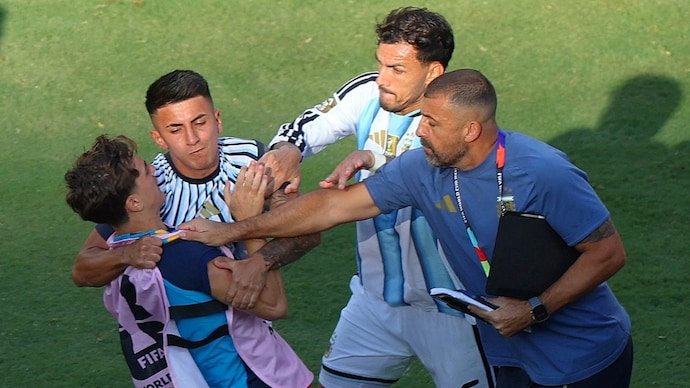
The 2026 FIFA World Cup final delivered drama, emotion, and history as Spain defeated Argentina 1-0 to lift the trophy at MetLife Stadium. However, while Ferran Torres’ winning goal ultimately decided the match, much of the post-final conversation has shifted toward a controversial confrontation involving Argentina midfielder Leandro Paredes.
What initially appeared to be a straightforward disciplinary decision has evolved into one of the most debated incidents of the tournament. Reports indicated that Paredes had been shown a red card following a heated altercation with Spanish players after the final whistle. Yet moments later, that dismissal reportedly disappeared from FIFA’s official commentator information system, creating confusion and fueling allegations of inconsistency.
The controversy has once again highlighted a broader issue facing modern football: how governing bodies maintain transparency and accountability when dealing with disciplinary matters involving the sport’s biggest stars and most high-profile matches.
What Happened After the FIFA World Cup 2026 Final?
The final whistle should have marked the beginning of Spain’s celebrations after securing a historic World Cup triumph. Instead, emotions quickly boiled over as players from both teams became involved in a tense confrontation on the pitch.
Argentina’s disappointment after narrowly missing out on the trophy was evident. Several players reacted emotionally as Spanish footballers celebrated their victory, creating a volatile atmosphere in the immediate aftermath of the match.
Leandro Paredes emerged as one of the central figures during the confrontation. Television footage captured a heated exchange involving the Argentine midfielder and Spanish defender Eric Garcia. As tensions escalated, other players entered the situation, turning a disagreement into a larger confrontation.
Spain midfielder Gavi also became involved while attempting to separate players and calm the situation. The scenes quickly spread across social media and global sports broadcasts, generating significant attention.
Why the Red Card Confusion Became a Major Story
The biggest controversy was not necessarily the altercation itself but the confusion surrounding the disciplinary response.
Initial information available through FIFA’s match communication systems suggested that referee Slavko Vincic had issued a red card to Paredes. Commentators and viewers around the world reported the dismissal as an official decision.
However, shortly afterward, the reported red card disappeared from the official system.
This unexpected change created immediate questions:
- Was a red card originally issued?
- If so, why was it removed?
- Did officials review the incident after the fact?
- Was there a communication error?
- Could disciplinary action still follow later?
The lack of immediate clarity transformed a routine disciplinary matter into an international football controversy.
Understanding FIFA’s Disciplinary Process
Many supporters assume that disciplinary decisions end when a match concludes. In reality, FIFA possesses extensive authority to review incidents after the final whistle.
For major tournaments such as the World Cup, governing bodies often conduct additional reviews using video footage, referee reports, and independent investigations.
This process allows FIFA to examine incidents that may not have been fully addressed during the match itself.
| Stage | Purpose |
|---|---|
| Referee Decision | Immediate disciplinary action during the match |
| Match Reports | Official documentation from referees and officials |
| Video Review | Examination of available footage |
| Disciplinary Committee Review | Assessment of potential rule violations |
| Final Ruling | Suspensions, fines, warnings, or dismissal of charges |
Because of this structure, the absence of an immediate red card does not automatically mean a player escapes punishment.
Why FIFA Has Launched a Formal Investigation
Recognizing the seriousness of the incidents following the final whistle, FIFA established a disciplinary panel and appointed an independent disciplinary and ethics prosecutor to examine what occurred.
The investigation extends beyond a single player and focuses on the wider confrontation involving multiple individuals from both teams.
Such inquiries typically seek to determine:
- Who initiated confrontations.
- Whether physical aggression occurred.
- If players violated fair play principles.
- Whether coaching staff contributed to tensions.
- If actions damaged the reputation of the competition.
World Cup finals represent the highest-profile matches in football. As a result, governing bodies often apply heightened scrutiny to incidents that occur on such a prominent stage.
Could Leandro Paredes Still Face Punishment?
Yes.
Even though reports indicate no immediate disciplinary action was officially recorded during the match, FIFA regulations provide multiple avenues for sanctions after a tournament fixture.
If investigators determine that a player engaged in violent conduct, unsporting behavior, or actions that harmed the image of the competition, disciplinary measures can still be imposed.
Possible consequences include:
- Match suspensions in future international fixtures.
- Financial penalties.
- Formal warnings.
- Additional disciplinary conditions imposed by FIFA.
The final outcome will depend entirely on the evidence reviewed by FIFA’s disciplinary bodies.
What FIFA’s Fair Play Rules Actually Say
Fair play remains one of the central principles governing international football.
FIFA’s disciplinary framework gives officials authority to punish behavior that undermines sportsmanship, damages football’s reputation, or violates expected standards of conduct.
Importantly, disciplinary reviews are not limited to events occurring during active play. Actions after the final whistle can be treated just as seriously, particularly when they involve physical confrontations.
This is why post-match incidents often receive significant attention from disciplinary committees.
Why This Case Matters Beyond One Player
The debate surrounding Paredes extends beyond the actions of a single footballer.
Instead, it touches on larger questions regarding consistency, transparency, and credibility in international football governance.
Supporters increasingly expect governing bodies to provide clear explanations when controversial decisions occur. In an era dominated by instant replays, social media analysis, and global broadcasting, confusion surrounding disciplinary actions can quickly become a major story.
The incident also highlights the challenge FIFA faces when balancing due process with public expectations for immediate accountability.
Comparing Immediate Punishment vs Post-Match Review
| Immediate Match Sanction | Post-Match Investigation |
|---|---|
| Occurs during the game | Occurs after the final whistle |
| Based on referee observations | Uses multiple evidence sources |
| Provides instant punishment | Allows deeper examination |
| Can influence match outcome | Protects procedural fairness |
| Limited by real-time decisions | Includes detailed review process |
The Paredes controversy sits at the intersection of these two approaches, making it particularly complex.
The Broader Impact on Argentina and FIFA
The investigation could potentially affect more than individual players.
Football associations can face penalties if governing bodies determine that teams failed to maintain discipline or contributed to disorderly conduct.
For Argentina, any sanctions would add another chapter to an emotionally charged tournament that ended in heartbreak after reaching the final.
For FIFA, the situation presents an opportunity to demonstrate consistency and transparency at a time when scrutiny of football governance remains intense.
Could This Influence Future Tournament Policies?
Major controversies often become catalysts for procedural changes.
If investigators identify weaknesses in communication systems, disciplinary reporting, or post-match protocols, FIFA could face pressure to improve transparency around future decisions.
Clearer explanations regarding disciplinary actions, real-time reporting standards, and public communication strategies may become increasingly important in future tournaments.
As football becomes more globally connected, expectations surrounding accountability continue to rise.
What Happens Next?
The disciplinary panel’s findings will ultimately determine whether additional sanctions are warranted. Until that process concludes, speculation surrounding the incident is likely to continue.
The key question is no longer whether a red card appeared in a system or was subsequently removed. Instead, attention has shifted toward whether FIFA’s investigation concludes that any player crossed the line between emotional disappointment and punishable misconduct.
Conclusion
The Leandro Paredes controversy has become one of the most talked-about stories following the 2026 FIFA World Cup final. What began as a post-match confrontation quickly evolved into a debate about transparency, disciplinary consistency, and the credibility of football’s governing processes.
While confusion over the reported red card sparked the initial headlines, the larger issue now centers on FIFA’s investigation and whether meaningful sanctions will follow. The outcome will not only affect the individuals involved but could also influence perceptions of how football’s biggest governing body handles high-profile disciplinary cases.
As FIFA’s disciplinary review continues, fans, players, and officials across the football world will be watching closely to see whether accountability, fairness, and transparency remain at the heart of the game’s global governance.
For breaking news and live news updates, like us on Facebook or follow us on Twitter and Instagram. Read more on Latest Sports on thefoxdaily.com.






COMMENTS 0