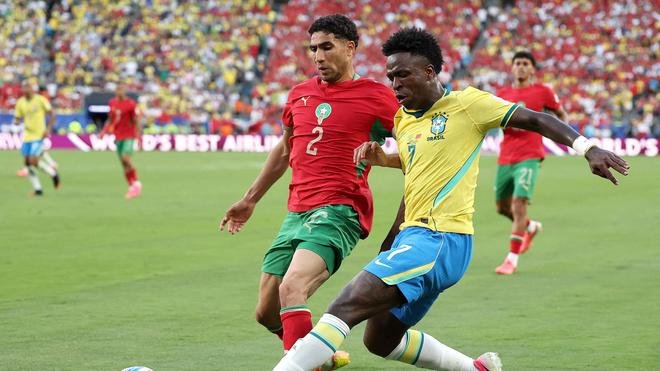
Brazil’s quest to reclaim football’s most prestigious trophy began with frustration rather than celebration as the five-time world champions were held to a 1-1 draw by Morocco in their opening Group C match of the FIFA World Cup 2026. Despite entering the tournament as one of the favorites, Brazil struggled to impose themselves for long periods against a tactically disciplined Moroccan side that once again demonstrated why it has become one of the most respected teams in international football.
The match, played in New Jersey before a packed crowd, showcased two contrasting approaches. Morocco relied on organization, quick transitions, and defensive discipline, while Brazil sought to unlock spaces through individual quality and attacking creativity. Ultimately, Vinicius Jr’s stunning equalizer ensured Brazil escaped with a point after Ismael Saibari’s first-half strike had given Morocco a deserved lead.
Although neither side claimed all three points, the result could have significant implications for the Group C standings and may influence qualification scenarios later in the tournament.
Brazil’s World Cup Journey Begins Under Pressure
Few teams enter a FIFA World Cup carrying greater expectations than Brazil. Every tournament is viewed through the lens of history, with supporters expecting nothing less than a genuine challenge for the title.
The 2026 edition carries additional significance as Brazil continues its search for a first World Cup triumph since 2002. With an experienced squad and renowned coach Carlo Ancelotti at the helm, expectations are understandably high.
However, opening matches often present unique challenges.
Teams must adapt to tournament intensity, manage nerves, and quickly find rhythm against opponents who are equally determined to make a statement. Brazil experienced exactly those difficulties against Morocco, a side that arrived with confidence and a clear tactical plan.
Morocco Continues Its Rise on the Global Stage
Morocco’s performance was another reminder that its success in recent years has been no coincidence.
Once considered outsiders against traditional football powers, the North African nation has transformed into a team capable of competing with anyone on the international stage.
The squad combines technical quality, tactical discipline, and athleticism, creating a difficult challenge for even the strongest opponents.
Against Brazil, Morocco displayed all of those qualities. The players remained organized defensively, pressed intelligently when opportunities arose, and attacked with purpose whenever space became available.
The result reinforced Morocco’s growing reputation as one of the most dangerous teams outside football’s traditional elite.
Perfect Start for Morocco Through Ismael Saibari
Morocco’s positive approach was rewarded in the 21st minute when Ismael Saibari finished a superb counter-attacking move.
The goal highlighted one of Morocco’s greatest strengths: the ability to transition rapidly from defense to attack.
After winning possession, the team moved forward with precision and speed. Brahim Diaz delivered an intelligent through ball that split the Brazilian defense, allowing Saibari to burst through the center and finish confidently.
The move was executed with clinical efficiency and exposed vulnerabilities in Brazil’s defensive structure.
At that stage, Morocco looked the more dangerous team and fully deserved its advantage.
How Morocco Controlled the First Half
One of the most surprising aspects of the match was Morocco’s control during large portions of the opening half.
Rather than retreating after taking the lead, the team continued to compete aggressively in midfield and limit Brazil’s attacking opportunities.
Several factors contributed to Morocco’s success:
- Compact defensive organization.
- Quick transitions into attack.
- Disciplined midfield positioning.
- Effective pressing in key areas.
- Limiting space for Brazil’s creative players.
These tactical strengths prevented Brazil from establishing sustained attacking pressure and forced the South Americans into difficult positions.
Vinicius Jr Produces a Moment of Magic
When teams struggle collectively, individual brilliance often becomes decisive.
For Brazil, that brilliance came from Vinicius Jr.
The winger produced one of the standout moments of the match in the 32nd minute, demonstrating why he is regarded as one of the world’s most dangerous attacking players.
Receiving the ball on the left flank, Vinicius drove inward before unleashing a magnificent right-footed strike that curled into the top corner.
The goal required exceptional technique, confidence, and precision.
More importantly, it arrived at a crucial moment when Brazil risked losing control of the contest.
Without Vinicius’ intervention, the match could have taken a very different direction.
The Evolution of Vinicius Jr as Brazil’s Main Man
Over the past several years, Vinicius Jr has evolved from an exciting prospect into one of football’s most influential players.
His development has been central to Brazil’s plans for the future.
While previous generations relied heavily on Neymar, the current team increasingly looks toward Vinicius as its primary attacking leader.
| Vinicius Jr’s Key Strengths | Impact on Brazil |
|---|---|
| Dribbling Ability | Creates chances in tight spaces |
| Explosive Pace | Stretches defensive lines |
| Finishing Quality | Converts crucial opportunities |
| Creativity | Generates attacking momentum |
| Big-Match Temperament | Performs under pressure |
His equalizer against Morocco was another example of his growing influence on the national team.
Carlo Ancelotti’s Tactical Adjustments
The second half saw a more aggressive Brazil following tactical changes introduced by Carlo Ancelotti.
Recognizing the need for greater control, the experienced coach made substitutions and adjusted the team’s pressing structure.
Brazil began pushing higher up the field, increasing possession and spending more time in Morocco’s half.
The changes improved Brazil’s territorial dominance and helped the team recover momentum.
However, dominance of possession does not always translate into scoring opportunities, particularly against a well-organized defensive unit.
Morocco’s Defensive Discipline Stands Firm
As Brazil increased pressure, Morocco demonstrated impressive defensive resilience.
The team adopted a compact low block that limited space between defensive lines and forced Brazil to attack from less dangerous positions.
Breaking down such structures is one of the most difficult challenges in modern football.
Morocco’s defenders maintained concentration throughout the second half, successfully neutralizing many of Brazil’s attacking combinations.
Even when Brazil controlled possession, clear scoring chances remained limited.
This defensive organization was a major reason Morocco secured a valuable point.
What the Result Means for Group C
The draw leaves Group C finely balanced after the opening round of matches.
While neither team secured maximum points, both remain firmly in contention for qualification.
A point against Brazil represents an encouraging result for Morocco and could prove valuable later in the group stage.
For Brazil, however, the outcome creates additional pressure heading into future fixtures.
The team will likely need stronger performances in upcoming matches to secure a favorable path into the knockout rounds.
Brazil’s Biggest Positives From the Match
Despite failing to win, Brazil can take several positives from the encounter.
- Vinicius Jr demonstrated world-class quality.
- The team responded positively after falling behind.
- Ancelotti’s adjustments improved second-half performance.
- The squad avoided an opening defeat.
- There is still room for improvement moving forward.
In tournament football, learning lessons without losing can often be valuable.
Areas Brazil Must Improve
If Brazil hopes to challenge for the World Cup title, several aspects of its performance require improvement.
- Defensive transitions need greater organization.
- Chance creation against compact defenses must improve.
- Midfield control needs to be more consistent.
- The team must start matches with greater intensity.
- Attacking combinations require better execution.
Addressing these issues quickly will be essential as the tournament progresses.
Can Morocco Be This Year’s Surprise Package?
Every World Cup produces teams that exceed expectations, and Morocco has already shown signs that it could be one of the tournament’s most dangerous outsiders.
The squad possesses several qualities associated with successful tournament teams:
- Strong defensive structure.
- Quick counter-attacking ability.
- Tactical flexibility.
- Team unity and discipline.
- Confidence against elite opponents.
If Morocco continues performing at this level, advancing deep into the competition is not beyond reach.
Prediction: Brazil Will Improve, But Morocco Has Sent a Message
Opening matches rarely define an entire World Cup campaign, and Brazil remains one of the strongest teams in the tournament.
Under Carlo Ancelotti, the squad has the talent and experience necessary to improve significantly as the competition progresses.
However, Morocco’s performance should not be overlooked.
The North African side demonstrated that it can compete with world-class opponents and has the tactical discipline required to trouble any team in the competition.
Both nations left the field with reasons for optimism, even if neither achieved the perfect start.
Conclusion
Brazil’s 1-1 draw against Morocco served as a reminder that reputation alone guarantees nothing at the FIFA World Cup. Morocco produced an outstanding performance built on organization, discipline, and intelligent counter-attacking football, while Vinicius Jr’s brilliant equalizer rescued a point for the South American giants.
Although Brazil will be disappointed not to secure victory, the match also highlighted the growing importance of Vinicius Jr as the team’s attacking leader. Meanwhile, Morocco’s display reinforced its status as one of international football’s most capable and resilient sides.
With the group stage still in its early stages, both teams remain well-positioned to pursue qualification. If this opening encounter is any indication, Group C could become one of the most competitive and entertaining groups of the FIFA World Cup 2026.
For breaking news and live news updates, like us on Facebook or follow us on Twitter and Instagram. Read more on Latest Sports on thefoxdaily.com.






COMMENTS 0