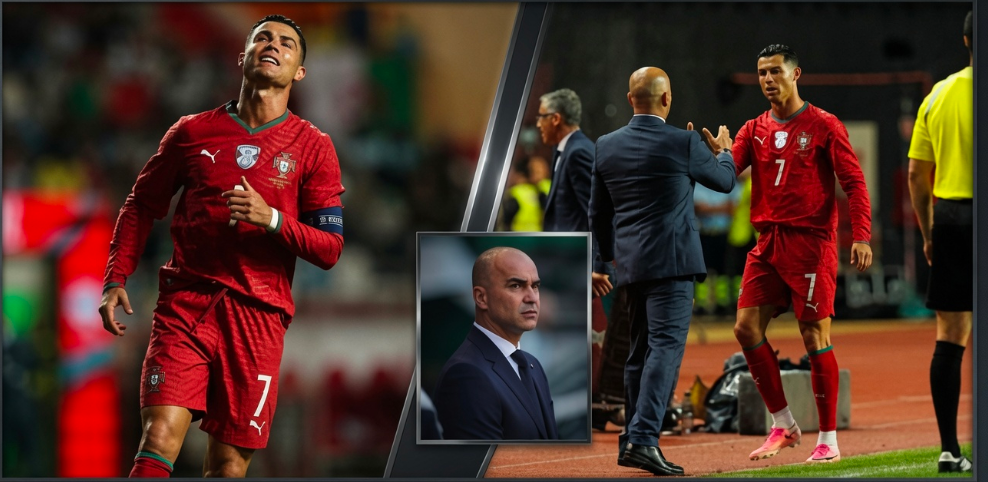
The discussion around Roberto Martinez explains cristiano ronaldo substitution decision has become one of the most talked-about tactical narratives in modern international football. After Portugal’s narrow 2-1 win over Nigeria in a pre-World Cup friendly on June 11, 2026, head coach Roberto Martínez addressed why captain Cristiano Ronaldo was not substituted earlier despite missing several key chances.
The match, played in Leiria, Portugal, saw the 41-year-old forward struggle to convert opportunities, raising immediate questions among fans and analysts about his sharpness and role in the team. However, Martínez clarified that Ronaldo’s playing time was not reactionary but part of a carefully pre-planned workload strategy designed to optimize fitness ahead of the 2026 FIFA World Cup opener against DR Congo.
This explanation opens a deeper conversation about modern football management, where tactical planning, sports science, and squad rotation increasingly outweigh emotional decision-making, even when it involves iconic players like Cristiano Ronaldo.
Pre-Planned Minutes: Why Ronaldo’s Substitution Was Not Tactical Panic
Roberto Martínez revealed that Portugal entered the match with a strict minutes-management blueprint for several key players. According to the plan, Cristiano Ronaldo was scheduled to play approximately 60 minutes, regardless of in-game performance.
This is a critical shift from traditional coaching logic, where a struggling striker is often substituted early. Instead, Portugal’s coaching staff prioritized physical conditioning, tournament preparation, and tactical consistency over immediate performance reactions.
The substitution structure included:
- Cristiano Ronaldo – 60-minute planned workload
- Diogo Costa – full 90-minute match rhythm
- Nuno Mendes – controlled defensive minutes
- Vitinha & João Neves – staggered 30–45 minute rotations
This demonstrates that Ronaldo’s substitution timing was not influenced by missed chances but by long-term performance management targeting peak World Cup readiness.
Why Modern Football Uses Planned Substitutions Instead of Reactive Decisions
The decision to keep Ronaldo on the pitch despite inefficiency reflects a broader transformation in elite football strategy. Modern international teams now rely heavily on data-driven performance tracking, muscle load monitoring, and fatigue prediction systems.
Rather than reacting to missed chances, coaches evaluate:
- Distance covered and sprint intensity
- Muscle fatigue thresholds
- Injury risk probability
- Tactical execution consistency
For a 41-year-old forward like Ronaldo, this becomes even more significant. His experience remains invaluable, but his physical output must be carefully managed to prevent burnout during a condensed tournament schedule.
Cristiano Ronaldo’s Performance Against Nigeria: A Deeper Tactical Reading
While headlines focused on missed chances, Ronaldo’s performance against Nigeria requires deeper tactical interpretation. The veteran forward had four shots but failed to register a shot on target, missing several high-quality opportunities.
However, focusing only on finishing ignores his broader role in Portugal’s attacking structure. Ronaldo continues to act as:
- A central reference point in the box
- A decoy to stretch defensive lines
- A leadership figure guiding attacking movement
Portugal’s system under Martínez does not rely solely on Ronaldo scoring goals. Instead, it distributes attacking responsibility across wide forwards and midfield runners, reducing dependency on a single finisher.
This evolution is crucial as Portugal transition toward a more balanced attacking identity heading into the World Cup.
The 60-Minute Plan: Sports Science Behind Ronaldo’s Game Time
The most important insight from Martínez’s explanation is the structured 60-minute plan for Cristiano Ronaldo. This reflects modern sports science principles that prioritize peak output windows rather than full-match endurance.
| Factor | Ronaldo vs Nigeria | Strategic Purpose |
|---|---|---|
| Planned minutes | 60 minutes | Maintain freshness for World Cup |
| Actual minutes played | ~64 minutes | Minor extension due to match flow |
| Shots on target | 0 | Performance inefficiency not linked to substitution |
| Substitution timing | After 60+ minutes | Pre-determined rotation phase |
This structured approach ensures Ronaldo remains physically sharp for high-stakes matches rather than being overexposed in friendlies.
Martínez’s Tactical Philosophy: System Over Emotion
Roberto Martínez has consistently emphasized a system-driven approach since taking charge of Portugal. His management style prioritizes collective structure over individual emotional reactions during matches.
His explanation reinforces three key tactical principles:
- Pre-planned substitution cycles instead of reactive changes
- Balanced squad usage across all 26 players
- Performance evaluation based on long-term impact, not isolated moments
This approach reflects elite club football trends seen in teams like Manchester City and Bayern Munich, where player management is deeply integrated into tactical planning.
Impact on Ronaldo’s Role Ahead of the 2026 World Cup
Ronaldo’s situation is now one of the most closely watched narratives in world football. At 41, he is not just competing for a starting place—he is also managing physical sustainability across a demanding international tournament.
His recent friendlies suggest a shift in role:
- Starter in select tactical matchups
- Rotational striker in high-intensity games
- Possible impact substitute in late knockout stages
Martínez’s comments suggest that Ronaldo will not be guaranteed full matches, especially against physically demanding opponents. Instead, Portugal may use him strategically depending on game context.
Comparison: Reactive Coaching vs Planned Load Management
| Aspect | Reactive Coaching | Martínez Approach |
|---|---|---|
| Substitution trigger | Performance-based | Pre-determined plan |
| Player evaluation | In-game mistakes | Physical + tactical data |
| Risk management | Short-term adjustments | Long-term tournament fitness |
| Star player treatment | Immediate benching if ineffective | Structured minutes regardless of form |
This comparison highlights why Ronaldo remained on the pitch despite criticism. The decision was not about emotion or reaction—it was about maintaining the integrity of a pre-designed performance plan.
Why Fans Criticized Ronaldo Despite Tactical Logic
Football fans often evaluate performance through visible outputs: goals, assists, and chances converted. In Ronaldo’s case, missing three major opportunities naturally triggered criticism.
However, this perspective often ignores the tactical ecosystem around him. Portugal’s attacking structure relies on fluid movement, and not every missed chance reflects poor decision-making or declining ability.
The disconnect between fan perception and coaching strategy is one of the biggest challenges in modern football analysis. While fans see inefficiency, coaches see workload balance and long-term optimization.
Risk Factor: Could Structured Rotation Backfire?
Despite its advantages, Martínez’s rigid rotation system carries potential risks.
Over-structuring substitutions can sometimes:
- Interrupt attacking rhythm
- Limit player confidence recovery during matches
- Reduce adaptability to unexpected game situations
If Portugal face a high-pressure knockout match where momentum shifts rapidly, sticking too closely to pre-planned substitution windows could become a tactical limitation.
This is where managerial flexibility will be tested during the World Cup.
Broader Implications for Portugal’s World Cup Strategy
The explanation behind Ronaldo’s substitution timing is not an isolated incident—it reflects Portugal’s entire World Cup preparation model.
The team is clearly being prepared for a tournament where:
- Depth matters more than fixed starting elevens
- Every player is treated as a potential starter
- Game management outweighs emotional decision-making
This approach positions Portugal as one of the most tactically flexible teams in the tournament, but also one of the most unpredictable in terms of lineup consistency.
Conclusion: A Controlled Experiment Before Football’s Biggest Stage
The statement where Roberto Martínez explains Cristiano Ronaldo substitution decision reveals far more than just one tactical choice—it exposes the blueprint of Portugal’s entire World Cup strategy.
Ronaldo’s 60-minute plan against Nigeria was not a response to missed chances but a calculated step in a broader performance management system. It reflects the growing influence of sports science, data analytics, and structured rotation in elite football.
As Portugal head toward the 2026 FIFA World Cup, the balance between tactical discipline and in-game adaptability will define their success. Ronaldo remains central to the narrative, but no longer untouchable in terms of minutes or match control.
If Martínez’s system works, Portugal could enter the tournament with unmatched squad freshness and tactical unpredictability. If it fails, questions will arise about whether structure outweighed instinct at the highest level of the sport.
Either way, this is no longer just about Ronaldo’s finishing—it is about the future of how football teams are managed on the world’s biggest stage.
For breaking news and live news updates, like us on Facebook or follow us on Twitter and Instagram. Read more on Latest Sports on thefoxdaily.com.






COMMENTS 0