- Who Was Abu-Bilal al-Minuki?
- Why Africa Has Become a Major Terrorism Battleground
- Trump Framed the Operation as a Major Counterterror Victory
- Islamic State Is Weaker But Not Defeated
- Why ISWAP Remains Dangerous
- The Operation Also Highlights Nigeria’s Security Challenges
- Trump Previously Ordered Strikes in Nigeria
- Counterterrorism Is Entering a New Phase
- Why the Global Security Community Will Watch Closely
- Conclusion: A Tactical Victory Amid a Larger, Ongoing Conflict
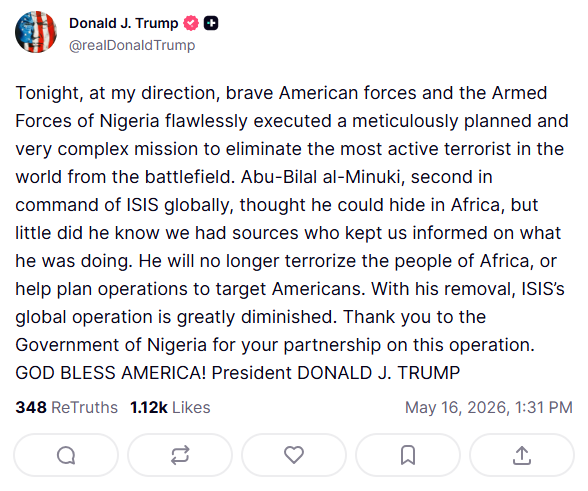
US President Donald Trump on Saturday announced that the second-in-command of the Islamic State terror network had been killed during what he described as a “meticulously planned” joint operation involving American and Nigerian forces.
The target of the operation was Abu-Bilal al-Minuki, also known as Abu Bakr Muhammad al-Mainuki, a senior figure linked to the Islamic State’s operations in Africa.
According to Trump, the operation took place in Nigeria and was carried out under direct US authorization with support from Nigerian security forces.
“He will no longer terrorise the people of Africa, or help plan operations to target Americans,” Trump wrote on Truth Social while announcing the operation.
The US President further claimed that the elimination of al-Minuki had “greatly diminished” the global operational capability of ISIS.
While independent confirmation remains limited and the Islamic State has not publicly responded to the claim, the announcement underscores the increasing importance of Africa in global Counterterrorism strategy.
Who Was Abu-Bilal al-Minuki?
Abu-Bilal al-Minuki was considered one of the Islamic State’s most influential figures operating in Africa, particularly within the Sahel region and areas linked to the Islamic State West Africa Province (ISWAP).
Although relatively unknown to the broader public, counterterrorism experts viewed him as an important operational and financial coordinator inside the extremist network.
According to the Counter Extremism Project, al-Minuki played a central role in:
- Coordinating terror cells
- Managing international funding channels
- Supporting recruitment operations
- Strengthening Islamic State networks in Africa
- Facilitating regional expansion efforts
In June 2023, the US State Department formally designated him as a Specially Designated Global Terrorist (SDGT), citing his involvement in supporting Islamic State-linked activities across multiple regions.
| Abu-Bilal al-Minuki Profile | Details |
|---|---|
| Known aliases | Abu Bakr Muhammad al-Mainuki |
| Affiliation | Islamic State West Africa Province (ISWAP) |
| Primary region | Sahel and West Africa |
| US designation | Specially Designated Global Terrorist (2023) |
| Role | Operational and financial coordinator |
Why Africa Has Become a Major Terrorism Battleground
Although ISIS lost much of its territory in Iraq and Syria years ago, extremist organizations linked to the group have increasingly shifted operations toward Africa.
Security analysts now view regions like the Sahel, northern Nigeria and parts of Central Africa as some of the fastest-growing zones for jihadist activity.
Several factors have contributed to this shift:
- Weak state control in remote regions
- Political instability
- Cross-border smuggling networks
- Poverty and unemployment
- Ongoing local insurgencies
Groups affiliated with ISIS and Al-Qaeda have exploited these conditions to expand recruitment, establish training camps and launch attacks against civilians, military targets and infrastructure.
That broader regional instability is one reason Western governments increasingly see African counterterror operations as strategically important.
Trump Framed the Operation as a Major Counterterror Victory
Trump used characteristically forceful language while describing the operation.
Calling the mission “very complex,” he praised both American and Nigerian forces for what he portrayed as a flawless execution.
The statement also appeared designed to reinforce Trump’s long-standing emphasis on aggressive counterterror policies and military strength.
Notably, Trump suggested the US Military had reliable intelligence assets operating within Africa.
That detail hints at the extent of ongoing American surveillance and counterterror partnerships across the continent.
The United States has steadily expanded intelligence-sharing and military cooperation with several African governments over the past decade as extremist threats evolved beyond the Middle East.
Islamic State Is Weaker But Not Defeated
While ISIS today is far weaker than it was during its peak territorial expansion in the mid-2010s, experts caution against viewing the organization as fully dismantled.
At its height, the Islamic State controlled large parts of Iraq and Syria while inspiring or directing attacks globally.
Although that territorial “caliphate” collapsed, the group adapted by decentralizing operations and relying more heavily on regional affiliates.
Today, ISIS-linked branches remain active in:
- West Africa
- The Sahel
- Afghanistan
- Syria and Iraq
- Parts of Southeast Asia
That decentralized structure makes the organization more difficult to eliminate entirely.
Even senior leadership losses often weaken operations temporarily rather than ending them altogether.
Why ISWAP Remains Dangerous
The Islamic State West Africa Province, or ISWAP, remains one of the most active jihadist organizations operating in Africa.
Originally emerging from factions linked to Boko Haram, ISWAP evolved into a more organized and internationally connected extremist network.
The group has carried out attacks targeting:
- Military bases
- Villages
- Religious communities
- Government infrastructure
- Regional security forces
Its operations have destabilized parts of Nigeria and neighboring countries for years.
Counterterrorism officials have repeatedly warned that ISWAP’s regional influence makes it one of the Islamic State’s most strategically important affiliates outside the Middle East.
The Operation Also Highlights Nigeria’s Security Challenges
The announcement once again draws attention to Nigeria’s long-running security crisis.
Nigeria continues facing multiple overlapping threats, including:
- Jihadist insurgencies
- Bandit violence
- Kidnapping networks
- Communal conflict
- Economic instability
Despite years of military operations, extremist groups continue operating in several regions, particularly in the northeast.
The Nigerian government has repeatedly sought international support, intelligence cooperation and military assistance to contain these threats.
The joint operation announced by Trump reflects how deeply internationalized Nigeria’s counterterror efforts have become.
Trump Previously Ordered Strikes in Nigeria
This is not the first time Trump has linked American military action in Africa to the fight against ISIS.
Last year, he publicly accused extremists in Nigeria of targeting Christian communities and subsequently defended US military strikes against alleged ISIS camps in the region.
Those comments sparked political debate because Nigerian authorities disputed aspects of Trump’s characterization of the violence.
Nevertheless, the episode highlighted how Africa has become increasingly central to global counterterror policy discussions in Washington.
Counterterrorism Is Entering a New Phase
The reported operation against al-Minuki also illustrates how counterterror strategy has evolved since the peak years of the “War on Terror.”
Modern operations increasingly rely on:
- Precision intelligence
- International partnerships
- Surveillance technology
- Special operations forces
- Local military coordination
Rather than large-scale invasions or occupation campaigns, many governments now prefer targeted missions aimed at eliminating key leadership figures.
However, experts remain divided on how effective leadership strikes are in producing long-term stability.
While such operations can disrupt planning and weaken morale, extremist organizations often adapt quickly by promoting new commanders.
Why the Global Security Community Will Watch Closely
If confirmed independently, the death of Abu-Bilal al-Minuki could represent a significant tactical blow to Islamic State operations in Africa.
But the broader strategic picture remains complicated.
The underlying drivers of extremism instability, weak governance, poverty and regional conflict continue affecting large parts of the Sahel and West Africa.
That means military victories alone may not fully eliminate the long-term threat.
Security analysts will likely monitor whether the operation:
- Disrupts ISWAP leadership structures
- Reduces operational coordination
- Weakens funding channels
- Triggers retaliatory attacks
- Changes recruitment dynamics
Conclusion: A Tactical Victory Amid a Larger, Ongoing Conflict
Donald Trump’s announcement regarding the killing of Islamic State commander Abu-Bilal al-Minuki highlights both the continuing threat posed by extremist groups and the growing importance of Africa in international counterterrorism operations.
The operation, if fully confirmed, would mark a significant tactical success for US and Nigerian forces.
But it also serves as a reminder that the Islamic State has evolved rather than disappeared.
Its decentralized network now stretches across multiple regions, with Africa emerging as one of the organization’s most active operational theaters.
For the United States and its allies, the challenge is no longer just preventing another ISIS caliphate.
It is containing a fragmented but resilient global extremist ecosystem capable of adapting to new environments and surviving even major leadership losses.
For breaking news and live news updates, like us on Facebook or follow us on Twitter and Instagram. Read more on Latest World on thefoxdaily.com.



COMMENTS 0