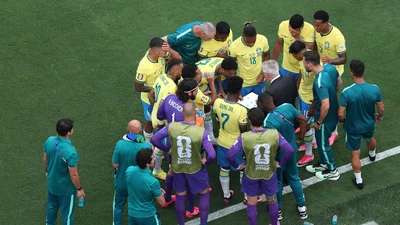
Brazil’s shocking elimination from the FIFA World Cup 2026 has triggered a wave of criticism, frustration, and soul-searching across one of football’s most passionate nations. While Norway deserves immense credit for producing one of the tournament’s biggest upsets, the spotlight has inevitably shifted toward Brazil and head coach Carlo Ancelotti.
For many supporters, the defeat was not simply about losing a football match. It represented the continuation of a troubling trend that has haunted Brazil for more than a decade: repeated failures against European opposition in World Cup knockout football.
From tactical choices and squad selection to missed opportunities and questionable in-game decisions, Brazil’s 2-1 defeat raised uncomfortable questions about whether the national team has truly evolved since its previous World Cup disappointments.
Most importantly, the result has intensified debate about whether Carlo Ancelotti’s highly anticipated project is moving Brazil closer to another world title—or further away from it.
Brazil’s European World Cup Curse Continues
Historically, Brazil has been football’s most successful World Cup nation. However, recent tournaments have revealed a recurring pattern.
Whenever Brazil encounters elite European opposition in the knockout rounds, the journey often comes to a painful end.
The defeat against Norway added another chapter to a growing list of disappointments.
| World Cup | Opponent | Result |
|---|---|---|
| 2010 | Netherlands | Eliminated |
| 2018 | Belgium | Eliminated |
| 2022 | Croatia | Eliminated |
| 2026 | Norway | Eliminated |
Although each defeat occurred under different circumstances, a common theme has emerged: Brazil often possesses exceptional individual talent but struggles to impose a cohesive tactical identity against organized European teams.
The Norway match reinforced that perception.
The Promise Behind Ancelotti’s Appointment
When Carlo Ancelotti accepted the Brazil job, expectations soared.
Few coaches in football history possess a résumé as impressive as the Italian manager. His success across Europe, particularly in the UEFA Champions League, made him one of the most respected tactical minds in the sport.
Brazil’s football federation viewed him as the ideal figure to modernize the national team while preserving its attacking traditions.
The vision appeared straightforward:
- Blend Brazilian creativity with European tactical discipline.
- Create a more balanced team structure.
- Maximize the country’s abundance of attacking talent.
- Build a squad capable of competing against the world’s strongest teams.
For much of the tournament, that plan appeared to be working.
Then came Norway.
Why Brazil Struggled Against Norway
The most surprising aspect of Brazil’s defeat was not the result itself but how disconnected the team looked during critical moments.
Brazil possessed more than enough attacking quality to trouble Norway. The squad included technically gifted players capable of creating opportunities from almost any situation.
Yet the attack rarely functioned as a coordinated unit.
Instead, many of Brazil’s most dangerous moments emerged from isolated transitions, individual dribbles, or flashes of brilliance rather than sustained attacking patterns.
Norway, meanwhile, appeared far more organized.
They understood their strengths, remained disciplined defensively, and executed their game plan with remarkable consistency.
The Bruno Guimarães Substitution That Changed Everything
One of the most debated moments came when Ancelotti decided to remove Bruno Guimarães.
Throughout the match, Guimarães served as Brazil’s most effective progressive midfielder. His ability to move the ball forward and connect defense with attack provided an essential link within the team structure.
When he left the field, Brazil lost more than a midfielder.
They lost:
- Their primary ball progressor.
- A reliable passing outlet.
- Control in midfield.
- The ability to sustain possession.
The decision appeared designed to inject additional energy and support a more direct attacking approach.
Instead, Norway gained greater control of the match.
Within minutes, Brazil found themselves chasing possession rather than dictating play.
The momentum shift ultimately contributed to Norway’s decisive breakthrough.
The Endrick Debate: Was Brazil’s Future Left on the Bench?
Perhaps no selection issue generated more discussion than the handling of Endrick.
The teenage sensation entered the tournament as one of the most exciting young players in world football. Many supporters viewed him as a symbol of Brazil’s future.
Yet throughout the competition, his opportunities remained limited.
While coaches often protect young talents from excessive pressure, knockout football frequently rewards courage and unpredictability.
Critics argue that Brazil lacked exactly those qualities during key moments against Norway.
The debate is not necessarily about whether Endrick would have changed the result.
Instead, it revolves around trust.
Did Brazil place too much faith in established names while underutilizing emerging talent capable of altering matches?
Neymar’s Emotional Farewell and the Selection Question
Neymar’s inclusion in the squad was among the most emotional storylines of the tournament.
As one of the greatest players in Brazilian football history, his presence carried symbolic importance.
However, football decisions must ultimately be evaluated through a competitive lens.
Questions emerged throughout the tournament regarding Neymar’s role, fitness, and ability to influence matches at this stage of his career.
Although he scored a late penalty against Norway, the goal arrived after the match had largely slipped away.
His retirement announcement following the defeat added emotional weight to the occasion but also highlighted the challenge facing Brazil as it transitions into a new era.
The Penalty Decision That Sparked Controversy
World Cup matches are often decided by small moments.
One of those moments arrived when Brazil earned an early penalty.
Bruno Guimarães stepped forward but failed to convert, allowing Norway to remain level and maintain confidence.
In hindsight, the miss became one of the defining moments of the contest.
The decision over penalty responsibility quickly became a major talking point.
Supporters questioned whether another player should have taken the kick, particularly given the pressure of the occasion.
Although statistical reasoning may have supported the choice, knockout football frequently demands more than numbers alone.
Psychology, momentum, and confidence often prove equally important.
Norway’s Tactical Flexibility Made the Difference
While criticism of Brazil has dominated headlines, Norway deserves significant praise.
One of the key reasons for their success was tactical adaptability.
Rather than remaining rigid, Norway adjusted throughout the match.
They combined direct attacks with intelligent possession, introduced fresh creative players when necessary, and continually searched for weaknesses within Brazil’s structure.
As the game progressed, Norway looked increasingly comfortable.
Brazil looked increasingly uncertain.
That contrast ultimately proved decisive.
The Missing Midfield Structure
Modern international football is often won in midfield.
The best teams create balance between attack and defense through intelligent ball progression and positional discipline.
Against Norway, Brazil struggled in this area.
Several problems became apparent:
- Difficulty progressing the ball from deep areas.
- Limited support between defensive and attacking units.
- Insufficient control during possession phases.
- An overreliance on individual moments.
When Guimarães departed, those issues became even more visible.
The result was a team that possessed enormous talent but lacked cohesion.
Why Individual Brilliance Wasn’t Enough
Brazil’s squad featured players from some of Europe’s biggest clubs.
On paper, the team appeared capable of competing with any nation in the world.
Yet modern football increasingly rewards collective systems over individual stars.
Teams that press together, defend together, and attack with structure often outperform squads relying primarily on talent.
Norway demonstrated that principle perfectly.
While Brazil may have possessed more famous names, Norway operated more effectively as a unit.
The lesson is clear: talent remains essential, but organization converts talent into victories.
What Brazil Must Learn Before the 2030 World Cup
The defeat offers several lessons for Brazil’s football leadership.
| Challenge | Potential Solution |
|---|---|
| Overreliance on individual stars | Develop stronger collective systems |
| Midfield imbalance | Improve ball progression structures |
| Youth integration | Increase trust in emerging talent |
| Tactical predictability | Create greater flexibility in matches |
| European knockout struggles | Prepare specifically for elite opposition |
The coming years will determine whether Brazil views the Norway defeat as merely another disappointment or as an opportunity for meaningful evolution.
Can Carlo Ancelotti Rebuild Trust?
Despite the criticism, it is important to remember that Ancelotti remains one of football’s most accomplished managers.
One tournament result does not erase decades of success.
However, international football operates differently from club football.
Managers have less time to implement ideas, fewer opportunities to correct mistakes, and immense pressure during major tournaments.
Ancelotti now faces the challenge of rebuilding confidence while proving that his long-term vision can deliver results.
The next cycle will likely define his legacy with Brazil.
Conclusion: Brazil’s Biggest Problem Was Not Talent—It Was Structure
Brazil’s World Cup 2026 exit cannot be explained by a lack of talent. The squad featured elite players capable of competing against any team in the world. The deeper issue was the inability to transform that talent into a consistently functioning collective unit.
Carlo Ancelotti arrived with a reputation for creating winning systems around star players. Against Norway, however, Brazil appeared trapped between identities—neither fully embracing possession football nor fully committing to a counter-attacking model.
Norway exploited that uncertainty and deservedly advanced.
For Brazil, the defeat represents more than another painful World Cup elimination. It is a warning that modern football increasingly rewards organization, tactical clarity, and adaptability over reputation alone.
If the Seleção hopes to end its long wait for a sixth world title, the lessons from this defeat may prove more important than the result itself.
For breaking news and live news updates, like us on Facebook or follow us on Twitter and Instagram. Read more on Latest Sports on thefoxdaily.com.





COMMENTS 0