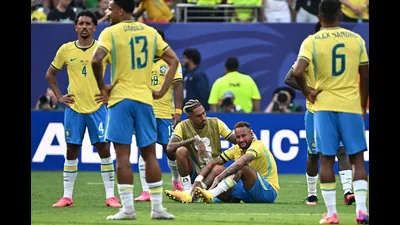
For generations, Brazil represented everything magical about football. The yellow jersey symbolized flair, creativity, confidence, and an almost unmatched ability to perform on the biggest stage. From Pelé and Garrincha to Romário, Rivaldo, Ronaldinho, Ronaldo, and Neymar, Brazil consistently produced stars who inspired millions and terrified opponents.
Today, however, the story feels dramatically different.
Brazil’s elimination from the FIFA World Cup 2026 in the Round of 16 has reignited uncomfortable questions about the direction of the nation’s football program. While defeats can happen to any team in tournament football, the manner of Brazil’s recent World Cup exits suggests a pattern rather than an isolated setback.
Once feared by every opponent, Brazil now enters major tournaments carrying uncertainty. Once defined by attacking brilliance, the team increasingly appears reactive rather than dominant. Once football’s trendsetter, Brazil now finds itself chasing standards established by others.
The biggest concern is not simply that Brazil lost. It is that many observers were no longer surprised.
From World Cup Giants to Repeated Disappointments
Brazil remains the most successful nation in World Cup history, but history alone cannot win modern tournaments.
The reality is that the country’s recent World Cup record paints a troubling picture. Since lifting the trophy in 2002, Brazil has repeatedly fallen short when facing elite opposition during the knockout stages.
Several exits have followed a remarkably similar script:
- Strong expectations entering the tournament.
- Promising performances during earlier rounds.
- Tactical or psychological collapse against top opponents.
- Questions about leadership and decision-making.
These recurring patterns suggest structural weaknesses that extend beyond individual coaches or players.
| World Cup | Key Exit | Major Concern |
|---|---|---|
| 2006 | Quarter-final defeat | Tactical complacency |
| 2010 | Quarter-final defeat | Mental collapse after setbacks |
| 2014 | Semi-final defeat | Psychological breakdown |
| 2018 | Quarter-final defeat | Missed opportunities |
| 2022 | Quarter-final defeat | Game management issues |
| 2026 | Round of 16 exit | Lack of identity and attacking threat |
The trajectory is difficult to ignore. Instead of moving closer to another world title, Brazil appears to be drifting further away from the standard it once set.
What Happened to Brazil’s Football Identity?
One of the defining characteristics of great football nations is a recognizable identity.
Spain became associated with possession football. Germany became known for organization and efficiency. Argentina combined passion with tactical flexibility.
Brazil traditionally represented attacking freedom and technical excellence.
Yet modern Brazil often appears uncertain about what it wants to be.
At times the team attempts possession-based football. At other moments it relies heavily on counterattacks. Against stronger opponents, Brazil frequently retreats into conservative structures that seem inconsistent with its footballing heritage.
This lack of a clear identity creates problems during high-pressure matches.
Teams perform best when players instinctively understand their roles. Uncertainty often leads to hesitation, and hesitation can be fatal in elite competition.
The Long-Term Impact of the 2002 World Cup Triumph
Ironically, Brazil’s last World Cup victory may have unintentionally delayed necessary changes.
The 2002 triumph was built around extraordinary individual talent, including one of the greatest attacking trios ever assembled.
However, football evolved rapidly during the years that followed.
European clubs invested heavily in tactical innovation, sports science, analytics, and player development systems. National teams increasingly reflected these advancements.
Brazil continued producing talented footballers, but talent alone became less decisive.
Modern tournaments reward teams capable of combining individual brilliance with sophisticated collective structures.
In many cases, Brazil has struggled to strike that balance.
Why Brazil’s Striker Problem Is Bigger Than It Appears
For decades, Brazil could rely on world-class forwards capable of deciding matches against any opposition.
The country produced an extraordinary line of attackers who combined technical quality with ruthless finishing.
Today, the situation looks very different.
While Brazil still develops exciting attacking talents, it has struggled to consistently produce complete center-forwards capable of leading the line at the highest level.
This issue affects more than goal scoring.
A reliable striker influences:
- Defensive positioning.
- Attacking movement.
- Counterattacking effectiveness.
- Set-piece threat.
- Team confidence.
Without a dependable focal point, attacking sequences often become less efficient and more predictable.
The Neymar Era: Brilliant Yet Incomplete
No discussion of modern Brazilian football is complete without addressing Neymar.
Statistically and technically, Neymar ranks among the most gifted players in the country’s history. He carried enormous expectations and frequently delivered exceptional performances.
However, his international career also coincided with a period of recurring disappointment for the national team.
This does not mean Neymar was responsible for Brazil’s failures. In many cases, he was one of the few players capable of changing matches individually.
Instead, his era highlights a broader issue.
Brazil often relied too heavily on individual brilliance rather than developing a balanced system capable of succeeding regardless of which star players were available.
Elite football nations create environments where systems elevate individuals. Too often, Brazil expected individuals to rescue the system.
The Tactical Gap Between Brazil and Europe
Another uncomfortable reality has emerged over the past two decades.
European nations have repeatedly outperformed Brazil in knockout matches.
This trend is not accidental.
European football has become increasingly sophisticated in areas such as:
- Defensive organization.
- Pressing systems.
- Transition management.
- Set-piece strategy.
- Sports science integration.
- Tactical adaptability.
Brazil possesses exceptional individual talent, but tournament football often rewards collective execution more than individual ability.
The most successful teams are usually those capable of maintaining structure under pressure.
That has become a recurring challenge for Brazil.
The Mentality Question Refuses to Disappear
Perhaps the most worrying aspect of Brazil’s recent World Cup history is the psychological pattern that repeatedly emerges during critical moments.
Championship teams remain composed when matches become chaotic.
Brazil has often done the opposite.
Several eliminations featured moments where emotional reactions appeared to override strategic thinking.
The infamous 7-1 defeat in 2014 remains the most dramatic example, but smaller versions of the same issue have surfaced in multiple tournaments.
Whether protecting leads, responding to setbacks, or handling pressure situations, Brazil has frequently appeared vulnerable.
Talent wins matches. Mental resilience wins tournaments.
This may be the most important lesson Brazil must absorb before the next major competition.
Carlo Ancelotti’s Difficult Mission
Brazil’s current project now centers around one of football’s most respected coaches.
Carlo Ancelotti has built a reputation for managing elite players, winning major trophies, and creating balanced teams capable of performing under pressure.
However, the challenge he faces with Brazil may be among the toughest of his career.
He is not merely rebuilding a squad.
He is attempting to rebuild confidence, identity, and belief.
Several key questions remain unanswered:
- Who becomes the next midfield leader?
- Can Brazil develop world-class full-backs again?
- Which young attackers can become consistent match winners?
- How can the team regain psychological strength?
- What tactical identity should define the next era?
The answers will determine whether Brazil returns to the top or continues drifting further from its historical standard.
The Youth Generation Offers Hope
Despite the disappointment, there are reasons for optimism.
Brazil remains one of football’s most productive talent factories. Every year, young players emerge with the technical qualities that have long defined the nation.
The challenge is not discovering talent.
The challenge is developing that talent within a coherent long-term vision.
Young prospects must be integrated into a structure that emphasizes tactical intelligence, emotional maturity, and collective responsibility alongside technical skill.
If Brazil can successfully combine traditional creativity with modern football principles, the foundations for a revival already exist.
Why the 2028 Copa America Could Be a Turning Point
The next major benchmark for Brazilian football may arrive at the 2028 Copa America.
By then, many emerging talents will have gained valuable experience at club level and on the international stage.
More importantly, the coaching staff will have additional time to implement a consistent philosophy.
Major football rebuilds rarely happen overnight.
Successful transformations require patience, clear planning, and strong leadership.
The next two years could therefore become one of the most important periods in modern Brazilian football history.
Key Reasons Behind Brazil’s World Cup 2026 Failure
| Factor | Impact |
|---|---|
| Lack of Clear Identity | Created uncertainty in crucial moments |
| Attacking Inefficiency | Reduced ability to convert opportunities |
| Psychological Vulnerability | Affected performances under pressure |
| Tactical Inconsistency | Limited adaptability against elite opponents |
| Leadership Transition | Created gaps in key positions |
| European Competition Gap | Exposed structural weaknesses |
Conclusion: Brazil Must Decide What It Wants to Be
Brazil’s Round of 16 exit at the FIFA World Cup 2026 is not merely another disappointing tournament result. It represents a warning sign for a nation accustomed to competing for football’s highest honors.
The issues extend beyond individual players, coaches, or tactical systems. They involve identity, development, mentality, and long-term planning.
For too long, Brazil has relied on its reputation and talent production to remain competitive. Modern football demands much more.
The world’s most successful teams combine technical quality with tactical sophistication, psychological resilience, and organizational excellence.
Brazil still possesses the talent to return to the summit of world football. The country’s football culture remains unmatched, and its ability to produce gifted players remains extraordinary.
However, talent alone is no longer enough.
The coming years will determine whether Brazil can reinvent itself for a new era or continue living in the shadow of past glories. By the time the 2028 Copa America arrives, the football world should have a clearer answer.
Until then, one question will continue to linger: can the most successful nation in World Cup history rediscover what made it great in the first place?
For breaking news and live news updates, like us on Facebook or follow us on Twitter and Instagram. Read more on Latest Sports on thefoxdaily.com.






COMMENTS 0