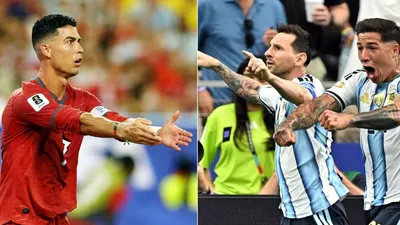
For nearly twenty years, Cristiano Ronaldo and Lionel Messi have dominated football in a way few athletes have ever dominated any sport. They shattered scoring records, collected individual awards, won major trophies, and elevated football’s global popularity to unprecedented heights.
Yet as the legends approach the final chapters of their extraordinary careers, the conversation has evolved.
The debate is no longer about who has scored more goals or won more trophies. Instead, the focus has shifted toward a fascinating tactical question: Why does Argentina appear more cohesive and liberated with Lionel Messi, while Portugal often seem constrained despite possessing one of the most talented squads in international football?
The answer is far more complex than blaming or praising a single player. It involves leadership styles, tactical systems, squad construction, coaching philosophy, and the difficult challenge of integrating iconic superstars into modern team football.
The FIFA World Cup 2026 has provided perhaps the clearest example yet of how two footballing giants can inspire their national teams in very different ways.
The Messi and Ronaldo Era Is Entering Its Final Act
Football may never witness another rivalry quite like the one between Cristiano Ronaldo and Lionel Messi.
Between them, they have accumulated countless individual honors, scored thousands of professional goals, and dominated Ballon d’Or discussions for almost two decades.
However, age eventually affects every athlete.
Neither player is physically identical to the versions that terrorized defenders during their peak years.
What remains unchanged is their influence.
Both continue to command attention, shape tactical plans, and influence how teammates and opponents approach matches.
Ironically, that influence can sometimes become both a strength and a challenge.
Why Argentina Have Found the Perfect Formula Around Messi
One of the biggest transformations in international football over the past several years has been Argentina’s evolution from a Messi-dependent team into a complete footballing machine.
For much of Messi’s international career, critics argued that Argentina relied too heavily on their captain.
Every attack seemed to flow through him.
Every major moment required his involvement.
Every disappointment generated questions about whether he had enough support.
That narrative changed dramatically under modern Argentina’s tactical structure.
Instead of forcing Messi to carry every responsibility, the team was redesigned to maximize his strengths while reducing unnecessary burdens.
Today, Argentina can dominate matches even when Messi is not directly involved in every attack.
This tactical freedom has arguably extended his effectiveness at the highest level.
How Lionel Scaloni Changed Argentina’s Identity
The biggest reason behind Argentina’s success is not simply Messi’s brilliance.
It is the system built around him.
Modern Argentina operate with clearly defined roles across every area of the pitch.
- Midfielders control tempo and possession.
- Defenders initiate attacks from the back.
- Forwards create movement and pressing pressure.
- Creative players share attacking responsibilities.
- Messi is allowed to focus on decisive moments.
This structure ensures the team does not become predictable.
Opponents cannot simply neutralize Messi and expect Argentina to collapse.
Instead, they face multiple threats capable of deciding matches.
The result is a team that appears confident, flexible, and tactically mature.
Why Messi Looks More Dangerous Than Ever
One surprising aspect of Argentina’s evolution is that reducing Messi’s workload has actually increased his effectiveness.
Modern football demands enormous physical effort, especially in pressing systems.
By surrounding Messi with energetic teammates who handle defensive and transitional responsibilities, Argentina allow their captain to conserve energy for moments that truly matter.
As a result, Messi spends more time in dangerous areas and less time chasing possession.
His influence becomes concentrated rather than diluted.
Instead of touching the ball constantly, he often appears at exactly the right moment to change a game.
That efficiency has been one of Argentina’s greatest strengths during the World Cup.
Portugal’s Challenge Is Bigger Than Cristiano Ronaldo
Whenever Portugal struggle, public discussion inevitably returns to Ronaldo.
Some argue that the team remains too dependent on him. Others believe he is unfairly blamed for broader tactical issues.
The reality likely sits somewhere in between.
Portugal possess one of the strongest squads in international football.
Across midfield, attack, and defense, they feature elite players competing for Europe’s biggest clubs.
On paper, they have the quality required to challenge any nation at the World Cup.
Yet performances have often failed to match expectations.
This suggests the underlying issue extends beyond one player.
The Weight of Ronaldo’s Legacy
Few athletes in sports history carry a legacy as significant as Cristiano Ronaldo’s.
His achievements have elevated Portugal from an occasional contender into a nation expected to compete for major trophies.
That success, however, creates unique challenges.
When a player becomes larger than the team itself, tactical decisions become more complicated.
Managers must balance football logic with public expectations.
Teammates may consciously or unconsciously defer to the superstar.
Opponents may focus their entire defensive strategy on stopping him.
Media narratives can dominate every discussion.
These factors influence team dynamics even when nobody explicitly intends them to.
Portugal’s Midfield Has Not Reached Its Full Potential
Perhaps the most surprising aspect of Portugal’s World Cup campaign has been the inconsistent performance of its midfield.
On talent alone, few nations can match Portugal’s options.
The squad includes players renowned for creativity, technical quality, passing range, and tactical intelligence.
Yet football is not played on paper.
Elite individuals do not automatically create an elite collective.
At times, Portugal’s midfield has struggled to establish rhythm and control against organized opponents.
This has limited service into attacking areas and reduced the team’s overall fluidity.
As a consequence, criticism often shifts toward Ronaldo, even when the underlying problems originate elsewhere on the pitch.
Argentina vs Portugal: A Tactical Comparison
| Category | Argentina | Portugal |
|---|---|---|
| Team Identity | Clearly Defined | Still Evolving |
| Dependence on Superstar | Moderate | Higher |
| Midfield Balance | Excellent | Inconsistent |
| Role Distribution | Well Structured | Sometimes Overlapping |
| Tactical Flexibility | High | Moderate |
| Collective Performance | Strong | Variable |
The comparison reveals that the difference is less about individual quality and more about collective organization.
The Psychology of Playing With a Global Icon
One factor often overlooked in Football Analysis is psychology.
Playing alongside a global icon can inspire teammates, but it can also create pressure.
Young players may hesitate to take risks.
Teammates may look for the superstar too often instead of choosing the best available option.
Decision-making can become influenced by reputation rather than circumstance.
Argentina have largely overcome this challenge by creating a system where every player understands their role.
Portugal are still working toward achieving the same level of balance.
World Cups Are Won by Systems, Not Just Stars
History consistently supports one important lesson.
The greatest player does not always win the World Cup.
Football’s biggest prize is usually claimed by the most complete team.
Consider recent champions:
- Strong defensive structures
- Balanced midfields
- Clear tactical identities
- Effective squad depth
- Defined player roles
- Collective resilience
Individual brilliance remains crucial, but it works best when supported by a strong system.
Argentina currently appear closer to that ideal than Portugal.
Can Portugal Still Change the Narrative?
Absolutely.
One of the dangers of knockout football is drawing definitive conclusions too early.
Portugal possess enough talent to defeat any team remaining in the tournament.
The challenge is ensuring that individual quality translates into collective excellence.
If the midfield finds greater cohesion and the attack becomes more fluid, Portugal could rapidly emerge as a genuine title contender.
The margin between success and failure at World Cups is often remarkably small.
A single tactical adjustment or standout performance can completely alter perceptions.
The Bigger Lesson From Messi and Ronaldo’s Final World Cup Years
Perhaps the most fascinating takeaway from World Cup 2026 is that both Messi and Ronaldo continue to teach football important lessons.
Messi demonstrates how a superstar can thrive within a collective structure designed to maximize efficiency.
Ronaldo’s situation illustrates the challenges teams face when integrating a legendary figure whose influence extends far beyond the pitch.
Neither example diminishes their greatness.
Instead, it highlights how modern football increasingly prioritizes systems, balance, and collective intelligence.
The sport has evolved beyond reliance on any single player, regardless of how extraordinary that player may be.
Conclusion
The contrasting trajectories of Argentina and Portugal at the FIFA World Cup 2026 are not simply a story of Lionel Messi succeeding while Cristiano Ronaldo struggles. The reality is far more nuanced.
Argentina have built a system that allows Messi to influence matches without carrying every responsibility. Portugal, meanwhile, continue searching for the ideal balance between maximizing Ronaldo’s strengths and unlocking the full potential of an exceptionally talented squad.
The difference lies less in the players themselves and more in the environments surrounding them.
As the tournament progresses, both nations remain capable of achieving greatness. But the lessons from their journeys are already clear: football’s biggest trophies are rarely won by individuals alone. They are won by teams that understand how to transform legendary talent into collective success.
For breaking news and live news updates, like us on Facebook or follow us on Twitter and Instagram. Read more on Latest Sports on thefoxdaily.com.






COMMENTS 0