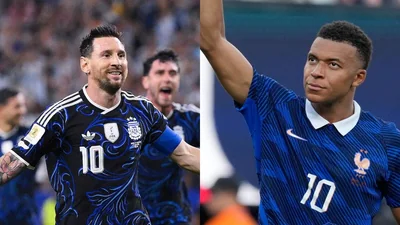
Gary Neville has never been one to mince words. The former Manchester United and England defender built his career on psychological warfare, tactical discipline, and an unshakable belief that football is won as much in the mind as on the pitch. So when he labels Argentina as the only team capable of stopping France at the 2026 World Cup—and uses words like “nasty” and “horrible” to describe them—the football world should pay attention.
As France cruise through the tournament with devastating ease, scoring 13 goals in four matches while conceding just twice, Neville’s assessment raises a critical question: Is raw attacking firepower enough to win a World Cup, or does victory require something darker, something more ruthless?
This article dissects Neville’s controversial claim, examines the tactical and psychological battlelines, and explores whether a potential France-Argentina final could deliver another all-time classic—or whether the South American champions have the tools to finally dethrone the reigning European powerhouses.
The Rise of France and Argentina’s Resilience
France’s journey to World Cup dominance has been methodically constructed over the past decade. Since their 2018 triumph, Les Bleus have maintained a conveyor belt of generational talent. The 2026 squad, led by Kylian Mbappé at his peak, represents perhaps the most complete international team since Spain’s 2010-2012 dynasty.
Their group stage campaign was a statement of intent: 3-1 against Senegal, 3-0 against Iraq, and 4-1 against Norway. The Round of 32 demolition of Sweden (3-0) only reinforced the narrative. This is a team that doesn’t just win—they dominate, suffocate, and entertain in equal measure.
Argentina, by contrast, have built their success on a different philosophy. Since their 2022 World Cup victory, La Albiceleste have evolved under Lionel Scaloni into a team that embraces the ugly side of the game. They grind out results, defend with collective discipline, and possess an almost telepathic unity forged through years of tournament football.
The Timeline: A Rivalry Forged in Fire
The France-Argentina rivalry is remarkably young but intensely fierce. Their first significant meeting came in the 2018 World Cup Round of 16—a thrilling 4-3 victory for France that announced Mbappé’s arrival on the global stage. That match, where a 19-year-old Mbappé tore Argentina apart with his pace and precision, marked the passing of the torch from the Messi generation to the new order.
Then came the 2022 World Cup Final in Qatar—arguably the greatest final in tournament history. Argentina led 2-0, France fought back to 2-2, Argentina scored again in extra time, and Mbappé completed a hat-trick to force penalties. Argentina won the shootout, Messi lifted the trophy, and football’s ultimate rivalry was born.
Now, in 2026, the two teams sit on opposite sides of the draw. A rematch of the 2022 final is not just possible—it feels almost inevitable. And Neville believes the outcome will be determined not by talent, but by mentality.
Key Developments: Deconstructing France’s Dominance
Before we examine Argentina’s chances, we must understand why France are such overwhelming favorites. The numbers are staggering: 13 goals scored, just 2 conceded. Their frontline of Mbappé, Ousmane Dembélé, Bradley Barcola, and Désiré Doué has accounted for every single goal. Michael Olisé, operating as the #10, has provided five assists—the most in the tournament.
What makes France terrifying is not just their individual quality but their collective synergy. Mbappé is the explosive spearhead, Dembélé provides creativity and unpredictability, Barcola offers pace and directness, and Olisé orchestrates from deep. This four-pronged attack has caused nightmares for every defense they’ve faced.
Neville’s admission—”I don’t know how they stop that, to be fair”—reflects the helplessness felt by opponents. France’s attacking quartet possesses a blend of speed, skill, and movement that is virtually impossible to contain for 90 minutes.
Argentina’s Defensive Masterclass
Yet Argentina have quietly built a defensive wall that rivals any in the tournament. They have conceded just one goal in four matches—only Colombia and Spain have better defensive records (0 conceded). Their expected goals against (xGA) of 1.61 is second only to Spain’s 0.54, indicating that their defensive solidity is not luck but design.
Furthermore, Argentina rank among the tournament leaders in tackles per 90 minutes, trailing only Paraguay. This aggressive, high-intensity approach is the “nastiness” Neville refers to—a willingness to disrupt, foul, and pressurize opponents into mistakes.
The psychological dimension cannot be overstated. Argentina’s squad is battle-hardened. They have experienced the agony of defeat (2014 final, 2018 exit, 2019 Copa América disappointment) and the ecstasy of victory (2021 Copa América, 2022 World Cup). They know how to win ugly, and they are not afraid to do so.
Table: France vs Argentina – Key Tournament Stats Comparison
| Statistic | France | Argentina |
|---|---|---|
| Goals Scored | 13 | 6 |
| Goals Conceded | 2 | 1 |
| Expected Goals (xG) | 8.7 | 5.2 |
| Expected Goals Against (xGA) | 3.1 | 1.61 |
| Tackles per 90 | 18.4 | 21.7 |
| Possession % | 62% | 53% |
| Pass Accuracy | 88% | 84% |
Expert Analysis: What Neville Really Means by ‘Nastiness’
Neville’s choice of words—”nastiness,” “horribleness,” “experience”—is deliberate and revealing. In footballing parlance, these terms describe a team’s capacity to engage in the dark arts: tactical fouls, gamesmanship, psychological intimidation, and the ability to disrupt an opponent’s rhythm.
France, for all their attacking brilliance, are a relatively “clean” team. They rely on skill and movement rather than physical intimidation. Against teams that allow them space, they are unstoppable. But Argentina will not give them space. They will press high, tackle hard, and commit tactical fouls to break up France’s attacking flow.
This is where the “experience” factor becomes crucial. Argentina’s core—Lionel Messi, Ángel Di María, Nicolás Otamendi, Rodrigo De Paul—have been through every possible scenario. They know how to manage a game, how to absorb pressure, and how to score against the run of play. They have the composure to handle the big moments that France’s younger players might find overwhelming.
The Mbappé-Messi Dynamic: A Subplot Within the Main Event
Any France-Argentina clash inevitably revolves around the two iconic figures: Kylian Mbappé and Lionel Messi. They are the tournament’s leading scorers, the faces of their respective nations, and the symbols of two different eras.
Mbappé represents the new order—relentless, explosive, and unburdened by history. Messi embodies wisdom, vision, and the weight of destiny. Their personal rivalry, played out across multiple World Cups, adds a layer of intrigue that transcends tactical analysis.
Neville’s assessment, however, suggests that Messi’s experience and Argentina’s collective “nastiness” might neutralize Mbappé’s brilliance. If Argentina can frustrate France’s attack, disrupt their passing rhythm, and turn the game into a physical contest, they can nullify the very attributes that make France so dangerous.
Real-World Impact: The Psychological Battle
Neville’s comments reflect a deeper truth about international football: tournaments are won by teams that can handle pressure, adversity, and the weight of expectation. France have not been tested yet. Their matches have been one-sided affairs where they dominated possession and scored freely. They have not faced a team that has stood up to them physically and psychologically.
Argentina, by contrast, have been tested. Their 1-0 victory over Nigeria in the group stage was a gritty, nervy affair. They defended deep, absorbed pressure, and scored from a set-piece. They showed the resilience that championship teams require.
This psychological edge is what Neville is highlighting. France are the “beautiful” team; Argentina are the “ugly” winners. In a tournament setting, ugly often triumphs over beautiful—especially in the knockout stages.
The Broader Implications for European Football
Neville’s prediction also carries implications for European football’s dominance. Since 2006, European nations have won four of the five World Cups (Italy, Spain, Germany, France), with Argentina’s 2022 victory the only exception. A second consecutive Argentina triumph would signal a shift in the global balance of power—a validation of South American football’s resilience and tactical evolution.
Furthermore, it would cement Messi’s legacy as not just the greatest player of his generation but the most influential figure in World Cup history. To win two consecutive World Cups, especially in the face of a French team this dominant, would be an achievement that transcends the sport.
Predicting the Future: A Rematch in the Making?
France face Paraguay in the Round of 16, with a potential quarterfinal against Morocco and a semifinal against Spain on the horizon. Argentina are on the opposite side of the draw, likely facing a similar path. A final showdown is not guaranteed—but it feels increasingly likely.
If France and Argentina do meet, Neville’s prediction will be put to the ultimate test. Can Argentina’s “nastiness” truly stop France’s firepower? Or will France’s attacking brilliance prove too much even for the most disciplined defense?
Neville himself acknowledges the uncertainty: “Something may emerge. England, Spain, Portugal, we may see a step up.” He leaves the door open for other contenders, but his conviction about Argentina’s unique ability to challenge France is unwavering.
Comparison: France’s Attack vs Argentina’s Defense – A Tactical Breakdown
To fully assess Neville’s claim, we must analyze the specific tactical battlelines. France’s attack operates through width, pace, and interchanging movements. Mbappé drifts inside, Dembélé provides crosses, Barcola stretches defenses, and Olisé orchestrates from deep.
Argentina’s defense, by contrast, is built on compactness and discipline. They defend in a low block, funnel attacks into wide areas, and rely on their center-backs—Otamendi and Cristian Romero—to dominate aerial duels. Their full-backs tuck inside to deny space for inverted wingers like Dembélé and Barcola.
The midfield battle is equally crucial. Argentina’s Rodrigo De Paul and Alexis Mac Allister will need to disrupt Olisé’s ability to find passes to the front four. If they can cut off the supply line, France’s attack becomes isolated and less effective.
Ultimately, Neville’s prediction hinges on whether Argentina can impose their game plan on France. If they can drag France into a physical, stop-start contest, they have a genuine chance. If France are allowed to play their fluid, attacking football, Argentina will struggle to contain them.
Conclusion: Is Neville Right?
Gary Neville’s claim that only Argentina possess the “nastiness” to stop France is bold but defensible. Argentina’s defensive record, tactical discipline, and psychological resilience make them uniquely equipped to handle France’s attacking firepower. Their experience in high-pressure matches, combined with their willingness to engage in the darker aspects of the game, gives them an edge that other teams lack.
However, France’s attacking brilliance is unparalleled. Their front four are arguably the most dangerous unit in World Cup history. Stopping them requires not just tactical acumen but a degree of luck, resilience, and possibly the best individual performance of a player’s career.
Whether Argentina can deliver that performance remains to be seen. But one thing is certain: if these two teams meet in the final, football fans around the world will be treated to another clash for the ages.
Future Outlook
The 2026 World Cup is shaping up to be a defining moment for both France and Argentina. For France, victory would confirm their status as one of the greatest international teams ever. For Argentina, back-to-back World Cups would cement their place in football folklore and elevate Messi to an untouchable pedestal.
Neville’s prediction will be tested in the coming weeks. If Argentina do stop France, his words will be remembered as prophetic. If France prevail, they will have proven that brilliance can overcome even the nastiest opposition.
“The only team I can see stopping France right now, because of the mentality, is Argentina. Because of the nastiness and the horribleness and their experience.” – Gary Neville on ITV Sport
Key Takeaways
- Defensive Solidity: Argentina have conceded just one goal in four matches, with an xGA of 1.61, making them the tournament’s second-best defense.
- Psychological Edge: Neville’s “nastiness” refers to Argentina’s willingness to engage in tactical fouls, gamesmanship, and physical intimidation to disrupt opponents.
- France’s Attack: Les Bleus have scored 13 goals, all from their front four, with Mbappé leading the charts and Olisé providing five assists.
- Tactical Battle: The key matchup will be Argentina’s midfield disrupting Olisé’s supply line to France’s fearsome attack.
- Legacy at Stake: A potential final rematch of 2022 would determine whether France’s brilliance or Argentina’s resilience defines this World Cup.
Final Thought: Gary Neville’s prediction is a reminder that football is not just about skill—it is about will, mentality, and the willingness to do whatever it takes to win. Argentina possess that in abundance. Whether it will be enough to stop France is the question that will define the 2026 World Cup.
Disclaimer: Statistical comparisons are based on publicly available tournament data and are intended for analytical and discussion purposes. The views expressed are those of the individuals quoted.
“`
For breaking news and live news updates, like us on Facebook or follow us on Twitter and Instagram. Read more on Latest Sports on thefoxdaily.com.





COMMENTS 0