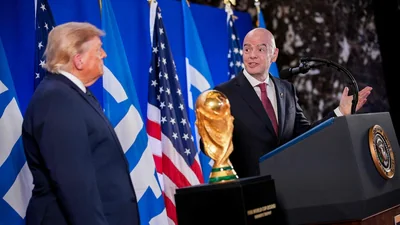
For nearly a decade, Gianni Infantino has been one of the most powerful figures in world football. Since becoming FIFA president in 2016, he has overseen significant expansion projects, commercial growth, and structural changes that have reshaped the global game. Yet as the road to the 2027 FIFA presidential election begins, signs are emerging that his leadership may face its most serious challenge to date.
Reports suggesting that several UEFA member associations are exploring support for a rival candidate have transformed what was expected to be a routine re-election campaign into a potentially defining political battle for the future of football governance.
While no major challenger has formally entered the race, growing dissatisfaction across parts of European football, combined with controversies surrounding the FIFA World Cup 2026, has created an environment where opposition to Infantino appears stronger than at any point during his presidency.
The significance extends beyond one election. The outcome could influence how football is governed, how major tournaments are organized, and how power is distributed between FIFA, continental confederations, clubs, and national associations over the next decade.
Why the FIFA Presidency Matters More Than Ever
The FIFA president is effectively the most influential administrator in global football.
Beyond overseeing the World Cup, the position impacts international competition structures, financial distributions, development programs, refereeing policies, commercial partnerships, and relationships between football’s governing bodies.
In recent years, FIFA’s influence has expanded dramatically.
The introduction of larger tournaments, expanded commercial opportunities, and increasing geopolitical attention have elevated the presidency into one of the most powerful roles in international sport.
As a result, any election challenge carries implications far beyond Football Politics.
How Gianni Infantino Consolidated Power
When Infantino succeeded Sepp Blatter in 2016, FIFA was attempting to rebuild credibility following one of the biggest corruption scandals in sports history.
He positioned himself as a reform-minded leader focused on transparency, modernization, and global development.
During his tenure, FIFA introduced several major initiatives:
- Expansion of the FIFA World Cup format.
- Increased investment in football development programs.
- Growth in commercial revenues.
- Expansion of women’s football initiatives.
- Introduction of new international competitions.
Supporters argue that FIFA has become financially stronger and more globally influential under his leadership.
Critics, however, believe that increased centralization of power and controversial decision-making have generated new concerns.
Why FIFA World Cup 2026 Has Become a Political Issue
The FIFA World Cup 2026 was expected to showcase football’s continued global growth.
Instead, several controversies have generated debate about tournament management and governance.
Issues raised by critics have included:
- Visa complications affecting supporters.
- Travel and logistical concerns.
- Questions regarding officiating decisions.
- Disputes surrounding disciplinary rulings.
- Concerns about consistency in tournament administration.
While no major tournament escapes criticism, the accumulation of controversies has intensified scrutiny of FIFA’s leadership.
For some football administrators, these incidents have reinforced concerns about accountability and decision-making at the highest level of the organization.
Why UEFA’s Position Is So Important
Although FIFA represents every football association globally, UEFA remains the most powerful continental confederation in terms of commercial value, competitive quality, and political influence.
European nations account for many of football’s largest markets, biggest clubs, most valuable competitions, and strongest national teams.
Historically, tensions between FIFA and UEFA have periodically shaped football politics.
Disagreements have emerged over:
- International match calendars.
- Club competition scheduling.
- Player workload concerns.
- Revenue distribution models.
- Governance and decision-making structures.
If UEFA associations unite behind a challenger, the election could become considerably more competitive than many observers anticipated.
Nasser Al-Khelaifi: The Name Generating the Most Attention
Among the individuals reportedly discussed as potential challengers, Paris Saint-Germain chairman Nasser Al-Khelaifi has attracted significant attention.
Over the past decade, Al-Khelaifi has become one of football’s most influential executives.
His influence extends beyond PSG through leadership roles in European football organizations and relationships with clubs, broadcasters, and governing bodies.
Supporters view him as someone capable of representing the interests of both clubs and federations in an increasingly complex football landscape.
However, reports indicate that he currently has no intention of entering the presidential race.
Even if substantial support emerged, persuading him to run could prove difficult.
Why Al-Khelaifi Is Seen as a Serious Possibility
- Strong influence across European football.
- Extensive experience in sports administration.
- Deep understanding of football’s commercial ecosystem.
- Relationships with leading clubs and governing bodies.
- Global profile within the sport.
His candidacy would instantly transform the election into a major political contest.
Other Potential Challengers Being Discussed
While Al-Khelaifi has dominated headlines, several other names have reportedly been mentioned in football circles.
| Potential Candidate | Background | Potential Strength |
|---|---|---|
| Dariusz Mioduski | Football executive and club owner | European football experience |
| Victor Montagliani | Senior football administrator | International governance expertise |
| Patrice Motsepe | African football leader | Strong continental influence |
| Nasser Al-Khelaifi | PSG chairman and football executive | Global football influence |
At this stage, none has formally declared an intention to challenge Infantino.
Nevertheless, the mere existence of discussions reflects growing political movement behind the scenes.
The Donald Trump Factor and FIFA’s Public Image
One of the more unusual dimensions of recent FIFA discussions has been the recurring involvement of political narratives surrounding major tournament decisions.
Comments from prominent political figures regarding refereeing controversies and disciplinary matters have attracted widespread attention.
Although FIFA maintains that sporting decisions are made independently through established procedures, the public perception of political influence can create governance challenges.
In modern sport, perception often matters nearly as much as reality.
Football governing bodies increasingly face pressure to demonstrate transparency, consistency, and independence in every major decision.
The Bigger Governance Debate Behind the Election
The upcoming election is not simply about personalities.
It reflects competing visions for football’s future.
Several key questions are shaping discussions across the sport:
- How much power should FIFA hold?
- What role should clubs play in decision-making?
- How should revenues be distributed globally?
- How can player workload be managed?
- What balance should exist between commercial growth and sporting integrity?
These issues will likely become central themes throughout the election cycle.
A Comparison With Previous FIFA Elections
Historically, FIFA presidential elections have often been influenced by regional alliances and political negotiations.
However, the modern football environment is changing rapidly.
Today’s administrators must navigate:
- Global media scrutiny.
- Social media accountability.
- Commercial expansion.
- Geopolitical considerations.
- Increasing demands from clubs and players.
This means future elections may be driven as much by governance philosophy as by traditional voting blocs.
What Could Determine the Outcome?
Several factors will likely shape the final result.
| Key Factor | Potential Impact |
|---|---|
| World Cup Legacy | How FIFA’s tournament management is ultimately judged. |
| UEFA Unity | Whether European associations rally behind a single candidate. |
| Global Development Funding | Support from smaller federations benefiting from FIFA programs. |
| Commercial Performance | Financial growth under FIFA leadership. |
| Governance Concerns | Perceptions of transparency and accountability. |
Infantino remains a strong favorite due to his established international network and FIFA’s broad global reach. However, strong opposition from major football stakeholders could create a far more competitive race than expected.
A Unique Insight: Why This Election Could Be Football’s Most Important Political Battle of the Decade
One aspect many observers overlook is that football governance is entering a transformational period.
Emerging technologies, expanded tournaments, rising commercial revenues, growing player influence, and increasing geopolitical interest are fundamentally changing how the sport operates.
The next FIFA president will likely oversee:
- The evolution of the expanded World Cup.
- New commercial partnerships.
- Future international competition reforms.
- Artificial intelligence integration in officiating.
- Major decisions affecting clubs and national teams worldwide.
In other words, the 2027 election may determine not only who leads FIFA, but also what football looks like in the 2030s.
Prediction: Will Infantino Face a Serious Challenge?
At the moment, Gianni Infantino remains the most likely winner if he seeks another term.
His global influence, established alliances, and FIFA’s financial strength provide significant advantages.
However, the situation is notably different from previous election cycles.
The growing willingness of influential football figures to discuss alternative candidates suggests that opposition is becoming more organized.
If UEFA successfully unites behind a credible challenger with international appeal, the election could become the most competitive FIFA presidential contest in years.
Conclusion
Gianni Infantino’s leadership of FIFA is entering a critical phase. While he remains one of the most powerful figures in global sport, growing criticism surrounding governance issues, World Cup controversies, and FIFA’s relationship with key stakeholders has created momentum for potential challengers.
The discussion surrounding candidates such as Nasser Al-Khelaifi, Victor Montagliani, Patrice Motsepe, and Dariusz Mioduski highlights increasing interest in alternative leadership options.
Whether a serious rival ultimately emerges remains uncertain. What is clear, however, is that the 2027 FIFA presidential election is shaping up to be far more than a routine vote.
It may become a referendum on football’s future direction, its governance model, and the balance of power within the world’s most popular sport.
For breaking news and live news updates, like us on Facebook or follow us on Twitter and Instagram. Read more on Latest Sports on thefoxdaily.com.



COMMENTS 0