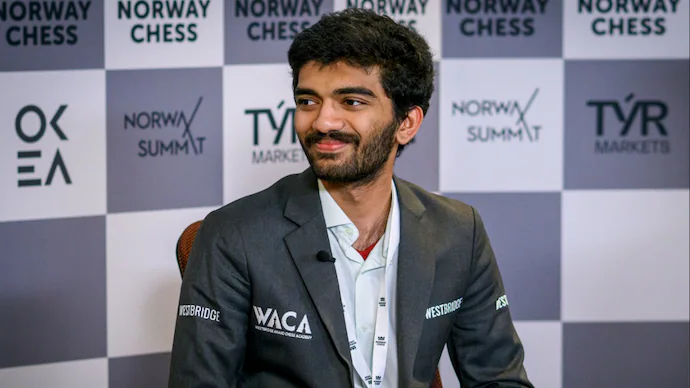
Defending champion D Gukesh was unable to make his first appearance with the white pieces count as he played out a second consecutive draw against challenger Javokhir Sindarov in Game 2 of the World Chess Championship. The encounter ended after just 20 moves through threefold repetition, with Sindarov successfully neutralising Gukesh’s London System and preventing the Indian from building any meaningful advantage.
After being put under pressure in the opening game on Tuesday, Gukesh had hoped to produce a stronger performance with White. However, the 20-year-old struggled to find a way through Sindarov’s preparation. The Uzbek challenger appeared comfortable throughout the encounter and ensured that the defending champion never gained control of the position.
Sindarov’s early queen manoeuvre played an important role in disrupting Gukesh’s plans. By moving his queen towards the queenside and targeting a vulnerable pawn, he forced White to adjust his development instead of following the familiar setup associated with the London System.
Gukesh spent considerable time calculating his options, but the additional thinking did not produce a clear advantage. As the game progressed, he also fell behind Sindarov on the clock. With neither player creating meaningful threats, the position gradually settled into a situation where pushing for a victory would have required unnecessary risks.
The players eventually repeated the same moves three times, bringing Game 2 to an end after only 20 moves. The result leaves the championship match level at 1-1, with both players having secured a draw in the opening two encounters.
Sindarov’s preparation neutralises the London System
Gukesh entered Game 2 looking to make better use of the white pieces after spending much of the opening encounter defending against Sindarov’s pressure. Instead, the challenger demonstrated that he was prepared for the Indian’s opening choice.
The London System is a familiar opening setup, but Sindarov’s early queen movement disrupted the usual development plans. His approach forced Gukesh to respond to the queenside pawn threat rather than build the position in the way he might have preferred.
That early decision helped Sindarov take control of the opening’s direction. The challenger did not need to create immediate attacking threats to achieve his objective. By neutralising White’s plans and keeping the position balanced, he limited Gukesh’s opportunities to generate complications.
Gukesh invested a significant amount of time trying to find a more ambitious continuation. However, Sindarov remained comfortable and maintained a healthy advantage on the clock. The defending champion’s calculation did not lead to a position where he could put his opponent under serious pressure.
As the game moved towards the middle stages, neither player had a clear reason to take unnecessary risks. With the position offering limited opportunities for either side, the repeated moves provided a straightforward route to a draw.
Gukesh describes Game 2 as a soft encounter
Following the game, Gukesh openly acknowledged that Sindarov had been ready for his opening choice. The Indian described the encounter as a soft game and accepted that his opponent’s preparation had made it difficult to achieve anything substantial.
“Today was a very soft game. I think my opponent was ready for my opening. It’s okay. It was a good game,” Gukesh said.
His assessment reflected the limited action on the board. Unlike the opening game, where Gukesh had to find several defensive resources under pressure, Game 2 offered relatively few major complications.
Gukesh also defended his decision to play the London System after the quiet nature of the encounter attracted criticism. He questioned why the opening had received so much negative attention.
“I don’t know why it gets so much hate. It’s a cool opening,” he said, referring to the London System.
His comments indicated that he remained comfortable with the opening choice despite the result. The difficulty was not necessarily the system itself, but the way Sindarov responded to it and prevented White from establishing the kind of position Gukesh wanted.
Game 2 contrasts with the tense opening encounter
The second draw was very different from the opening game played on Tuesday. In Game 1, Sindarov had White and managed to put Gukesh under sustained pressure during the middlegame.
The challenger created a difficult position for the defending champion, who also had to deal with time trouble. Gukesh was forced to calculate carefully and find accurate defensive moves to prevent Sindarov from converting his pressure into a victory.
Despite the difficulties, Gukesh found the necessary defensive resources and managed to secure a draw after 38 moves. That encounter demonstrated Sindarov’s ability to challenge the champion and create problems even in the early stages of the title match.
Game 2 offered a different picture. With Gukesh playing White, the defending champion was expected to look for opportunities to take the initiative. However, Sindarov’s preparation ensured that White never established a meaningful opening advantage.
The clock situation added to Gukesh’s difficulties, but the position itself also provided limited opportunities to create winning chances. The contrast between the two games highlighted how effectively Sindarov had prepared for the London System.
World Championship match remains level at 1-1
With both opening games ending in draws, the World Chess Championship remains level at 1-1. Neither player has managed to secure an advantage in the match, although their performances have offered different indications of their strengths.
Sindarov can take confidence from his performance across the first two games. He put Gukesh under sustained pressure in Game 1 and then comfortably neutralised the defending champion’s opening plans in Game 2.
For Gukesh, the second encounter will provide an opportunity to review his opening preparation and consider how to create more challenging positions in the games ahead. His first outing with White did not produce the advantage he wanted, but the match remains at an early stage.
The consecutive draws also underline the importance of preparation and time management in a World Championship contest. Even when a player has the advantage of moving first, the opponent’s opening knowledge can make it difficult to establish control.
What comes next for Gukesh and Sindarov?
As the championship moves into its next phase, both players will look for ways to gain an advantage without exposing themselves to unnecessary risks. Gukesh will need to find more effective ways to challenge Sindarov’s preparation, particularly after the challenger demonstrated that he could neutralise the London System.
Sindarov, meanwhile, will aim to build on the confidence gained from the opening two games. His ability to defend comfortably with Black in Game 2, combined with the pressure he created in the first encounter, gives him positive signs heading into the remaining contest.
The 1-1 scoreline means the championship is still wide open. Gukesh remains focused on defending his title, while Sindarov has shown that he is capable of challenging the reigning champion through careful preparation and disciplined play.
After a tense 38-move opening game and a much shorter 20-move second encounter, attention now turns to whether either player can break the deadlock. Both will need to find new opportunities as the battle for the World Championship continues.
For breaking news and live news updates, like us on Facebook or follow us on Twitter and Instagram. Read more on Latest Sports on thefoxdaily.com.






COMMENTS 0