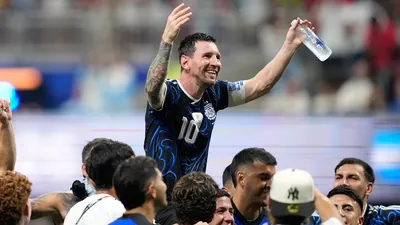
When Lionel Messi walks onto the field for the FIFA World Cup 2026 final against Spain, it will represent more than just another chapter in his legendary career.
It will also serve as a reminder of one of football’s greatest “what-if” stories.
In an alternate reality, Messi could have been wearing Spain’s red jersey instead of Argentina’s famous blue and white stripes.
The thought sounds almost impossible today. Messi has become synonymous with Argentina, leading his nation to Copa America glory, World Cup success, and countless unforgettable moments. Yet there was a period during his teenage years when Spain had a genuine opportunity to secure his international future.
What prevented that from happening was a remarkable chain of events involving a VHS tape, a scouting mission, and Argentina’s determination to avoid losing the most gifted footballer of his generation.
The Background: Why Spain Had a Real Chance to Sign Messi
Lionel Messi moved from Rosario, Argentina, to Barcelona in 2000 when he was just 13 years old.
Barcelona offered him an opportunity that few clubs were willing to provide at the time. The Spanish giants agreed to support treatment for his growth hormone deficiency while integrating him into the club’s famed La Masia academy.
Over the next several years, Messi developed almost entirely within Spanish football.
He attended school in Spain, trained in Spain, and progressed through Barcelona’s youth system. Because of his residency status and football development within the country, Spain had a legitimate pathway to convince him to represent La Roja internationally.
At the time, Messi was not yet a global superstar.
He was simply an exceptionally talented teenager whose future remained uncertain.
That uncertainty created a race between two footballing nations.
The Forgotten VHS Tape That Started Everything
The turning point came in 2002.
Argentina manager Marcelo Bielsa and assistant Claudio Vivas were visiting Europe to meet Argentine players following the FIFA World Cup in South Korea and Japan.
While they were in Barcelona, an unexpected visitor approached them.
Horacio Gaggioli, one of Messi’s early representatives, arrived carrying a VHS tape filled with highlights of a young Lionel Messi.
The purpose was simple.
Argentina needed to understand what kind of player was developing thousands of miles away from home.
At that stage, many football officials in Argentina had heard little about Messi despite his growing reputation within Barcelona’s academy.
What happened next has since become part of football folklore.
When Claudio Vivas showed the footage to Marcelo Bielsa, the legendary coach reportedly believed the video was being played at an accelerated speed.
The dribbling, acceleration, balance, and ball control seemed unnatural for a teenager.
Only after realizing the tape was playing normally did Bielsa fully appreciate what he was watching.
Argentina suddenly understood that an extraordinary talent was emerging in Barcelona.
Why Argentina Nearly Missed Out
Despite recognizing Messi’s potential, Argentina still faced a major problem.
There was no guarantee he would choose them.
Spain’s football federation was monitoring his development closely and understood his eligibility situation.
At the same time, Argentina’s youth setup had not yet fully integrated Messi into its plans.
This delay almost proved costly.
During preparations for the 2003 FIFA U-17 World Cup, Messi was not selected by Argentina’s youth coaches.
The decision would later be viewed as one of the biggest scouting oversights in modern football history.
Argentina eventually lost to Spain during that tournament, and multiple people connected to Spanish football reportedly questioned how Argentina could overlook a player of Messi’s quality.
That criticism became a wake-up call.
The Emergency Mission to Secure Messi’s Future
Following the tournament, Argentine officials moved quickly.
The country’s football federation understood the risk of losing Messi permanently.
A plan was developed to get him officially involved with Argentina’s youth teams as soon as possible.
The process was far more complicated than many fans realize.
International eligibility rules required official documentation, recognized matches, and proper registration procedures.
Argentina needed to ensure Messi was formally tied to their national team pathway before Spain could make a serious move.
A youth international match was arranged against Paraguay.
The objective extended beyond simple player evaluation.
Argentina wanted Messi officially participating within their system.
Once he stepped onto the field, any lingering doubts disappeared.
Those present immediately recognized they were watching a special talent.
Why Messi Always Leaned Toward Argentina
Although administrative decisions played a major role, the most important factor was Messi himself.
Despite spending most of his developmental years in Spain, he never lost his connection to Argentina.
Family influence proved crucial.
His parents maintained strong ties to their homeland, and Messi continued identifying deeply with Argentine culture throughout his time in Barcelona.
According to people close to the situation, Messi’s preference remained remarkably consistent.
He wanted to represent Argentina.
Spain offered opportunity, stability, and familiarity.
Argentina offered identity.
For Messi, that distinction mattered.
What If Messi Had Chosen Spain?
This remains one of football’s most fascinating hypothetical scenarios.
The impact could have altered international football history.
| Scenario | Potential Outcome |
|---|---|
| Messi plays for Spain | Spain potentially becomes even stronger during its golden era |
| Argentina loses Messi | Argentina’s attacking identity changes dramatically |
| 2010 World Cup | Messi potentially becomes a World Cup winner with Spain |
| 2022 World Cup | Argentina may not win the tournament without Messi’s leadership |
| Football legacy | One of sport’s greatest stories unfolds differently |
Spain’s dominant period between 2008 and 2012 already produced two European Championships and one World Cup title.
Adding Messi to a squad featuring Xavi, Andres Iniesta, Sergio Busquets, David Villa, and Iker Casillas could have created perhaps the strongest national team in football history.
At the same time, Argentina’s modern football identity would have looked completely different.
The Unique Connection Between Messi and Barcelona
One overlooked aspect of this story is that Messi’s loyalty was never divided between Barcelona and Argentina.
Many athletes struggle when club and country expectations collide.
Messi viewed both as complementary parts of his life.
Barcelona transformed him into a global superstar.
Argentina represented his roots.
This dual commitment explains why he never seriously entertained the idea of abandoning either side.
His career became one of football’s rare examples where club loyalty and national loyalty coexisted successfully for more than two decades.
Why the VHS Tape Story Matters Today
The VHS tape story is more than an amusing anecdote from football’s past.
It highlights how talent identification worked before the age of social media, instant scouting databases, and digital analytics.
Today, a player with Messi’s ability would be known worldwide by age 12.
Videos would circulate online instantly.
Scouting departments would track every touch.
National federations would already have detailed development plans.
In the early 2000s, however, information traveled much slower.
A physical videotape could genuinely influence the future of international football.
That reality feels almost unimaginable in today’s hyperconnected sporting landscape.
Messi vs Spain: A Full-Circle Moment
The timing of this story’s renewed attention is remarkable.
More than two decades after Argentina rushed to secure Messi’s international future, he now stands one victory away from defeating the very nation he almost represented.
The FIFA World Cup 2026 final presents a symbolic conclusion to one of football’s most extraordinary eligibility stories.
Had events unfolded differently, Messi might have spent his entire international career helping Spain chase World Cup glory.
Instead, he enters the final as Argentina’s captain, leader, and arguably the greatest player in the nation’s history.
A Lesson for Modern Football
The Messi saga also offers a valuable lesson for football federations around the world.
Elite talent cannot be taken for granted.
Globalization means young players often possess multiple eligibility options.
National teams must actively build relationships, create pathways, and demonstrate commitment long before players reach senior level.
Argentina ultimately succeeded because it recognized the urgency of the situation and acted decisively.
Had officials delayed even slightly longer, football history might have changed forever.
Conclusion
The story of how Lionel Messi almost played for Spain instead of Argentina remains one of the most remarkable near-misses in sports history. A simple VHS tape, a chance meeting in Barcelona, and a rapid response from Argentine officials helped ensure that one of football’s greatest talents represented the nation of his birth rather than the country where he developed.
As Messi prepares to face Spain in another World Cup final, the irony is impossible to ignore. The nation that once hoped to recruit him now stands as the final obstacle between Argentina and another world title.
For Argentina, the VHS tape may be remembered as one of the most important pieces of footage ever delivered. Without it, the country might never have secured the player who would go on to redefine its football history and inspire an entire generation.
For breaking news and live news updates, like us on Facebook or follow us on Twitter and Instagram. Read more on Latest Sports on thefoxdaily.com.






COMMENTS 0