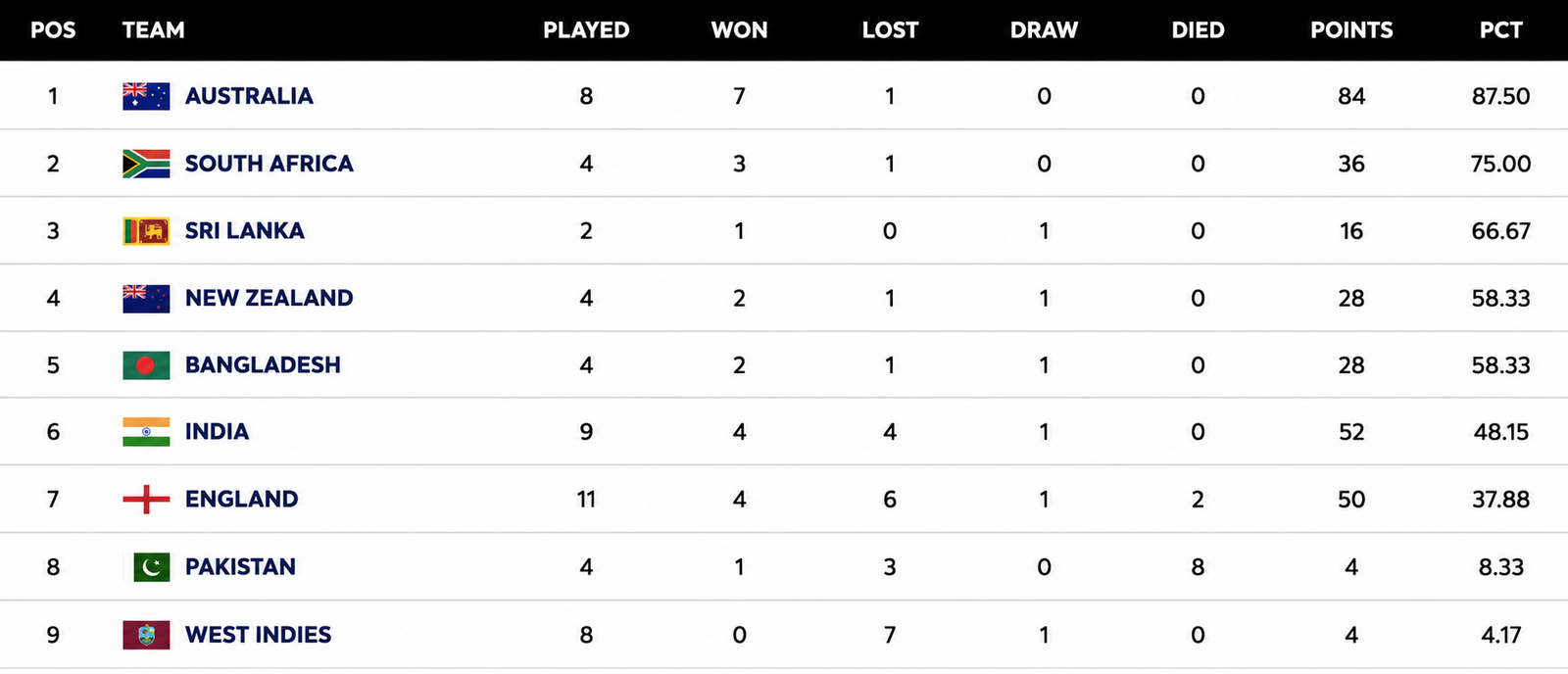
England’s 115-run victory over New Zealand at Lord’s has produced significant movement in the ICC World Test Championship standings. The hosts rise to a win percentage of 37.88 while New Zealand, who entered the match second in the cycle standings with a win percentage of 77.78, plummet to fourth after a single result changes their position dramatically.
Why One Test Result Can Reshape the WTC Table So Sharply
The World Test Championship’s points-based system has a structural peculiarity that casual observers sometimes miss: when a team has played very few matches in a cycle, a single result carries disproportionate weight on their win percentage. New Zealand’s situation before the Lord’s Test was a perfect illustration of this dynamic. They had played three Tests in the cycle, winning all three in a home series against the West Indies, and held a win percentage of 77.78 as a result. That number looked commanding on paper, but it was built on a small sample that made it extremely vulnerable to a single loss.
England’s 115-run victory at Lord’s was that loss, and the consequence for New Zealand’s standing in the table was stark. A win percentage of 77.78 collapsed to 58.33 in a single result. Second place in the cycle became fourth. The mathematics of the WTC format, which rewards both the accumulation of wins and the management of a consistent sample across more series, punished New Zealand’s lack of volume as cruelly as any on-field defeat could.
The Lord’s Test: How England Produced a Result on a Rain-Affected Surface
Before examining the table implications, the match itself deserves recognition as a performance of considerable grit from Ben Stokes’s England. This was not a dominant, clinical Bazball display. It was a low-scoring, rain-marred Test that required England to adapt, absorb setbacks, and find a way to win through conditions that never offered a clean advantage.
England were bowled out for 140 on Day 1, which represents an uncomfortably low total against New Zealand’s bowling attack. The first innings deficit meant England had to bat their way back into the match before the final innings target became relevant. They managed it, setting a target of 254 that, in the context of how the surface was playing, was more challenging than the absolute number suggests.
The chase unravelled methodically. New Zealand were reduced to 55/5, and although Glenn Phillips led a valiant fightback, he ran out of partners. Only 9.4 overs were bowled on Day 3, which meant the rain interference compressed the available time and placed additional pressure on the batting side to score at a pace the conditions were not always conducive to. New Zealand were eventually dismissed for 138, giving England a 115-run victory.
The win is particularly significant for England because it reversed a narrative of recent domestic struggles. Heading into the match, they had drawn a home series against India and lost the Ashes 1-4 away in Australia. Their WTC credibility had been significantly dented by those results, and a Lord’s win, even in challenging circumstances, begins the process of rebuilding the consistency that a serious WTC campaign requires.
The Updated WTC 2025-27 Cycle Standings
| Position (post-Lord’s) | Team | Win Percentage | Movement |
|---|---|---|---|
| 1 | TBC (leading team per cycle) | TBC | N/A |
| 4 | New Zealand | 58.33 (from 77.78) | Down from 2nd |
| 7 | England | 37.88 (from 31.67) | Remains 7th |
England’s improvement from 31.67 to 37.88 is meaningful progress but still leaves them seventh in the standings. The Ashes defeat and the India home draw combined to place England in a position where simply winning series is no longer sufficient to challenge for a WTC Final place. They need consistency and volume of wins across the remaining matches in the cycle, which includes the second and third Tests against New Zealand at The Oval and Trent Bridge.
New Zealand’s drop from second to fourth is a more dramatic story. The 77.78 figure was always precarious, a mathematical construct of small-sample excellence rather than a genuine reflection of a team that had done more WTC work than their position suggested. The Lord’s defeat has now introduced the first piece of counter-evidence, and with two more Tests to follow in England, the Blackcaps face the prospect of a series defeat that could damage their WTC cycle standing significantly further.
India’s Position: The Sixth-Place Context That Makes England Uncomfortable
India’s position in the WTC standings, sixth at the halfway point of the cycle, is the figure that hangs over the analysis of every individual result in the current period. For a team with India’s resources and historical Test match quality, sixth represents an underperformance that has not gone unnoticed within the BCCI or the team management.
The one-off Test against Afghanistan in New Chandigarh, where India declared their first innings at 564/8 and had Afghanistan at 113/5 by the close of Day 2, will contribute to their WTC standings when the match concludes. But the nine Tests that remain in the cycle are the genuinely important ones, and as Shubman Gill has been advised to focus on them above all else, the management’s prioritisation of WTC cricket over T20I involvement signals clearly how seriously those remaining matches are being taken.
New Zealand’s England Problem: A Historical Pattern That Continues
The Lord’s defeat adds to a pattern that has become one of Test cricket’s more consistent historical footnotes: New Zealand’s difficult relationship with English conditions. Since the start of this century, the Blackcaps have won only two of the 16 Tests they have played in England. The most recent series loss, the 0-3 whitewash at the start of the Bazball era in 2022, established an expectation that England would be competitive at home regardless of recent form elsewhere.
Four consecutive Test defeats in England now extend that run, and the series has two more matches to play. If New Zealand fail to win either of the remaining Tests at The Oval or Trent Bridge, the WTC implications will deepen further. A series defeat will extend their losing streak in England to seven consecutive Test matches, which represents a significant structural challenge for a team management that will eventually need to address why home conditions suit their game so much better than English ones.
For Kane Williamson’s team, the tactical response to England’s Bazball approach has historically been inconsistent. The aggressive field settings and declarations that England used to apply pressure in 2022 have become more anticipated, but anticipating the approach and defending against it successfully remain different challenges. The remaining two Tests will reveal whether New Zealand have developed counter-strategies or whether the same patterns repeat.
England’s Path Back to WTC Contention: What Needs to Happen
England’s win at Lord’s, while welcome, is a floor for their WTC ambitions rather than a ceiling. Seventh place with a win percentage of 37.88 means they need not just to win series but to do so comprehensively and consistently across the remainder of the cycle.
The domestic New Zealand series provides three opportunities to add wins. The subsequent schedule will determine whether other series follow. For Stokes and the England management, the priority of WTC cricket alongside the preparation demands of a concurrent FIFA World Cup in the United States means the summer of 2026 is unusually full of competing narratives, but the Test series against New Zealand is the one where WTC points are actually on offer.
The Lord’s win demonstrates that this England side, even coming off a difficult Ashes, can produce results in conditions they know. The question over the rest of the cycle is whether they can sustain that production with sufficient consistency to climb from seventh to a top-two position that delivers a WTC Final appearance.
The WTC Format: What Makes the Current Cycle So Competitive
The drama of New Zealand’s points-table collapse after a single defeat is a reminder of something important about the WTC format. Unlike a traditional series or a knockout competition, the WTC rewards teams that play a lot of Test cricket and win consistently across a variety of conditions. Teams that have played fewer matches by the midpoint of a cycle are statistically vulnerable to sharp point-percentage swings from individual results.
In the current 2025-27 cycle, several teams are still in the early stages of their match schedule, which means the table will continue to see significant movement as series are completed across all the Test-playing nations. The final picture of the standings, and which two teams qualify for the WTC Final, may look very different from what it does today.
What the Lord’s result confirms is that New Zealand’s early-cycle dominance was real but fragile, and England’s recovery from their difficult period is underway but incomplete. Both teams have significant work to do before the cycle concludes.
Conclusion: One Match, Significant Consequences, Many More to Come
England’s 115-run victory at Lord’s is the kind of result that matters beyond the bilateral series. New Zealand drop from second to fourth. England improve from seventh but stay there. The WTC table, always in flux during the middle stages of a cycle, has registered the significance of what happened on a rain-affected Lord’s surface over four days in early June.
The second Test at The Oval begins June 17. New Zealand need to win it to arrest their decline in the standings and prove that the Lord’s result was an aberration rather than a pattern. England need to win it to maintain momentum and continue climbing the table. For WTC purposes, every point in this series matters for both teams in ways that bilateral series alone cannot fully capture.
The WTC 2025-27 cycle continues to evolve. Lord’s has delivered its verdict. The Oval will deliver the next one on June 17.
For breaking news and live news updates, like us on Facebook or follow us on Twitter and Instagram. Read more on Latest Sports on thefoxdaily.com.






COMMENTS 0