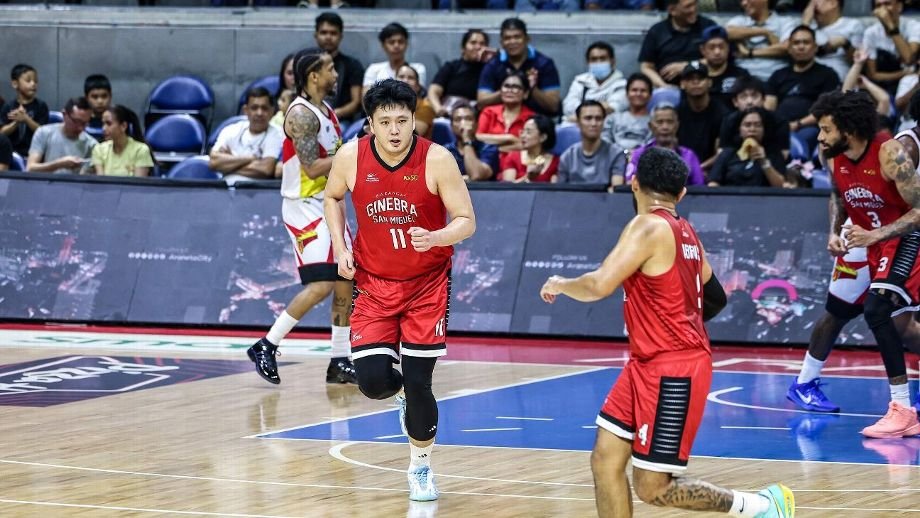
Barangay Ginebra opened its PBA Season 50 Governors’ Cup quarterfinal series against San Miguel Beer with a 104-95 victory on October 27, 2026, at the Smart Araneta Coliseum. While import Jordan Murphy led the Gin Kings with 29 points and 11 rebounds, Isaac Go’s contribution offered head coach Tim Cone an important tactical option against nine-time PBA Most Valuable Player June Mar Fajardo.
Go finished with 14 points on 6-of-10 shooting, including two three-pointers, helping Ginebra establish an offensive advantage against a San Miguel defense built around Fajardo’s size and rim protection. Scottie Thompson added 17 points, 11 rebounds and six assists, while RJ Abarrientos contributed 16 points and six assists.
The result gave Ginebra a 1-0 lead in the best-of-five quarterfinal series. More importantly, the opening game demonstrated how a stretch big man could influence a matchup even without dominating the ball. By using Go as a perimeter threat, Ginebra created additional space for its guards and import to attack the basket.
Why Isaac Go Was a Tactical Matchup for June Mar Fajardo
Fajardo’s presence in the paint presents a difficult problem for opposing teams. His size, positioning and ability to protect the basket can discourage drives, complicate finishing attempts and force opponents to reconsider how they create scoring opportunities near the rim.
For Ginebra, the challenge was not simply to score against Fajardo. It was to make him defend situations in which his size and interior positioning would be less decisive.
One way to accomplish that is through a stretch big man: a frontcourt player who can operate outside the painted area and make perimeter shots. When that player is a credible shooting threat, the opposing center must decide whether to move away from the basket to contest the shot or remain near the rim to protect against drives.
Go gave Ginebra that option. Rather than relying exclusively on traditional interior attacks, the Gin Kings could position him around the perimeter and make San Miguel account for his shooting ability.
The tactical value extended beyond whether Go made every attempt. Even the threat of an open perimeter shot could influence defensive positioning, creating opportunities for teammates elsewhere on the floor.
How Ginebra’s Floor Spacing Created Opportunities for Jordan Murphy
Murphy’s performance was the most obvious offensive highlight of Ginebra’s victory. His 29 points and 11 rebounds provided the production needed to beat San Miguel, but the team’s spacing helped create conditions in which he could attack more effectively.
When a center stays close to the basket, opposing players driving into the lane may encounter a second defender waiting to challenge their attempts. That can force them into difficult finishes, contested shots or passes to teammates positioned outside.
Go’s perimeter positioning offered a different problem for San Miguel. If Fajardo moved outward to contest Go’s shot, he could become less available to provide immediate help near the rim. If he stayed closer to the basket, Go could have more room to shoot from outside.
This created a defensive trade-off rather than an automatic advantage. San Miguel still had other defenders capable of rotating toward Murphy, but moving Fajardo away from his preferred area could change how quickly those rotations needed to happen.
Murphy took advantage of his opportunities, finishing 60% of his two-point attempts. His scoring output showed the importance of having a primary offensive option who could capitalise when the defense had to divide its attention.
The distinction is important: Go did not need to outscore Fajardo directly to influence the matchup. His role was to make San Miguel’s defensive assignments more complicated and help create room for Ginebra’s main scoring threats.
Scottie Thompson Also Benefits From Ginebra’s Offensive Spacing
Go’s presence also helped create a more favourable environment for Thompson, one of Ginebra’s principal playmakers.
Thompson is capable of attacking the basket, creating opportunities for teammates and contributing on the boards. However, driving lanes become harder to use when a dominant interior defender is positioned near the rim and ready to contest an attempt.
By presenting Fajardo with a perimeter assignment, Ginebra could make it more difficult for San Miguel to rely on him as a constant source of help defense. That could give Thompson additional room to turn the corner and attack before other defenders completed their rotations.
Thompson finished with 17 points, 11 rebounds and six assists, recording a double-double while contributing to the team’s overall offensive production.
His numbers also illustrate why Ginebra’s strategy cannot be evaluated solely through Go’s individual scoring. A successful spacing adjustment can benefit several players simultaneously, even when the player responsible for creating that space does not lead the team in points.
When defenders are forced to make difficult choices, the offense gains opportunities to exploit whichever assignment receives less attention. Ginebra’s challenge in the remainder of the series will be to maintain that balance if San Miguel changes its defensive approach.
June Mar Fajardo Held to Three Points in Game 1
Fajardo finished the opening game with just three points on 1-of-6 shooting, a relatively quiet offensive performance for a player who typically serves as a central scoring option for San Miguel.
Go’s physical presence and ability to operate outside the paint were important elements of Ginebra’s approach. By making Fajardo defend a different type of frontcourt matchup, the Gin Kings sought to reduce his ability to influence the game primarily through his work around the basket.
However, it would be inaccurate to attribute Fajardo’s limited scoring entirely to Go. Individual shooting results can reflect several factors, including defensive pressure, shot selection, opportunities created by teammates and the overall flow of a game.
What the result does establish is that San Miguel did not receive its usual level of offensive production from its nine-time MVP in Game 1. Ginebra’s collective defensive effort and tactical adjustments helped restrict the Beermen’s scoring opportunities.
The challenge for San Miguel is to find ways to make Fajardo more involved offensively without giving Ginebra the same opportunities to exploit his defensive positioning.
Isaac Go’s Experience Against San Miguel Provides Valuable Context
Go’s performance was not entirely unexpected for observers familiar with his previous matchups against San Miguel. During his time with Terrafirma, he demonstrated that perimeter shooting could create problems for a defense anchored by Fajardo.
In the 2024 PBA Philippine Cup quarterfinals, Terrafirma pushed San Miguel into a do-or-die game after winning 106-95. Go scored 22 points in that victory, helping the Dyip produce an upset against a team widely regarded as a major contender.
That performance illustrated the potential value of Go’s skill set against San Miguel. His ability to score from outside gave Terrafirma another way to challenge the Beermen’s interior defensive structure.
The comparison with his Ginebra role is useful because the underlying tactical principle remains similar: a big man who can threaten the defense from the perimeter may force an opposing center to make decisions outside his usual comfort zone.
There are differences between the two situations, including teammates, coaching systems and the surrounding matchups. Go’s previous performance does not guarantee the same outcome in a different series, but it provides a relevant example of why Ginebra could consider him a useful option against Fajardo.
Tim Cone Changes Ginebra’s Usual Substitution Pattern
Go’s inclusion also reflected a specific decision by Ginebra’s coaching staff. According to the supplied report, Troy Rosario typically replaces Japeth Aguilar late in the first quarter under the team’s regular substitution pattern. Against San Miguel, however, Go became the first big man off the bench.
The change indicated that Ginebra wanted to test a different matchup rather than rely exclusively on its usual frontcourt rotation.
Basketball rotations are not merely about resting starters. Coaches also use substitutions to create favourable combinations, counter an opponent’s strengths and introduce players whose skills fit a particular tactical requirement.
In this case, Go offered a combination of size, perimeter shooting and decision-making that could be useful against San Miguel’s interior defense. His presence gave the Gin Kings a different way to structure their offense without abandoning the physicality required to compete against a team with Fajardo in the middle.
Go’s 14-point performance rewarded the adjustment. His contribution was particularly significant because it came in a playoff opener, when a coaching decision can influence how both teams approach the remainder of a series.
Richard Del Rosario Explains Why Ginebra Values Isaac Go
Ginebra assistant coach Richard Del Rosario highlighted Go’s basketball intelligence and physical attributes when discussing the matchup against San Miguel.
“We need size especially playing a team like San Miguel and ang maganda naman kay Isaac, skill-wise hindi naman siya ‘yung pinaka-athletic na player but he uses ‘ yung utak niya to play,” Del Rosario said.
The comment points to a useful distinction in basketball evaluation. Athleticism is one component of a player’s effectiveness, but positioning, anticipation, shot selection and understanding of the game can also influence performance.
Go’s role does not require him to match every opponent in speed or explosiveness. Instead, he can contribute by recognising defensive situations, maintaining spacing and making the opposition respond to his shooting threat.
Against a center such as Fajardo, that skill set can be particularly useful because the objective is not necessarily to overpower the opponent physically. It is to create situations in which the defense must choose between protecting the basket and guarding the perimeter.
What San Miguel Must Adjust for Game 2
Ginebra’s victory gives San Miguel a clear tactical problem to address before the next game. The Beermen must find a way to account for Go’s perimeter threat while preventing Murphy and Thompson from benefiting from the resulting space.
One possible adjustment would be to have another defender take greater responsibility for contesting Go’s perimeter attempts. That could allow Fajardo to remain closer to the basket, although the change would depend on San Miguel’s available personnel and the specific lineups used.
Another possibility would be to change the team’s help-defense positioning or place greater pressure on Ginebra’s ball handlers before they reach the lane. Such adjustments could reduce the advantages created by spacing, but they might also open different opportunities for Ginebra’s shooters and playmakers.
San Miguel’s offensive response will be equally important. Finding ways to involve Fajardo more consistently could force Ginebra to reconsider how aggressively it uses Go in the matchup.
These are potential tactical responses rather than confirmed decisions by San Miguel’s coaching staff. The effectiveness of any adjustment will depend on execution and how Ginebra responds.
Why Game 1 Could Shape the Governors’ Cup Quarterfinal Series
Ginebra’s 104-95 victory gave the Gin Kings an early advantage in the best-of-five series, but one win does not settle the matchup. San Miguel has the opportunity to review the opening game and make changes, while Ginebra must determine whether its initial tactical success can be repeated.
The most important question may be whether Go can continue to provide reliable perimeter production while maintaining his defensive responsibilities against Fajardo. If he does, Ginebra will have another option for stretching San Miguel’s defense.
San Miguel, meanwhile, must decide whether to keep Fajardo in his preferred defensive position or accept the risk of moving him farther from the basket to challenge Go. Either choice carries consequences, particularly when Murphy and Thompson are able to attack space created by defensive rotations.
Ginebra’s Game 1 performance suggests that its approach deserves further attention, but the series remains a tactical contest that can change from game to game. The Beermen’s response will help determine whether Go’s role remains a major factor or whether San Miguel can neutralise the advantage.
Isaac Go Gives Ginebra a New Dimension Against San Miguel
Isaac Go’s performance in Game 1 demonstrated how a complementary player can influence a high-stakes matchup through tactical fit rather than scoring alone. His 14 points helped Ginebra defeat San Miguel 104-95, but his greater value came from forcing the Beermen to account for a perimeter threat alongside the scoring of Murphy and Thompson.
By challenging Fajardo’s defensive positioning, Go offered Ginebra another way to create space and attack the basket. His previous experience against San Miguel with Terrafirma provided further context for the decision to use him early in the rotation.
The adjustment does not guarantee success throughout the series, and Fajardo’s quiet night cannot be explained by one matchup alone. Nevertheless, Ginebra showed that disciplined spacing, carefully chosen substitutions and complementary player skills can complicate the task of defending a dominant interior presence.
With a 1-0 lead in the quarterfinals, the Gin Kings have an early advantage. Whether Isaac Go’s role becomes a decisive factor will depend on how both teams adapt in the games ahead.
For breaking news and live news updates, like us on Facebook or follow us on Twitter and Instagram. Read more on Latest Basketball on thefoxdaily.com.



COMMENTS 0