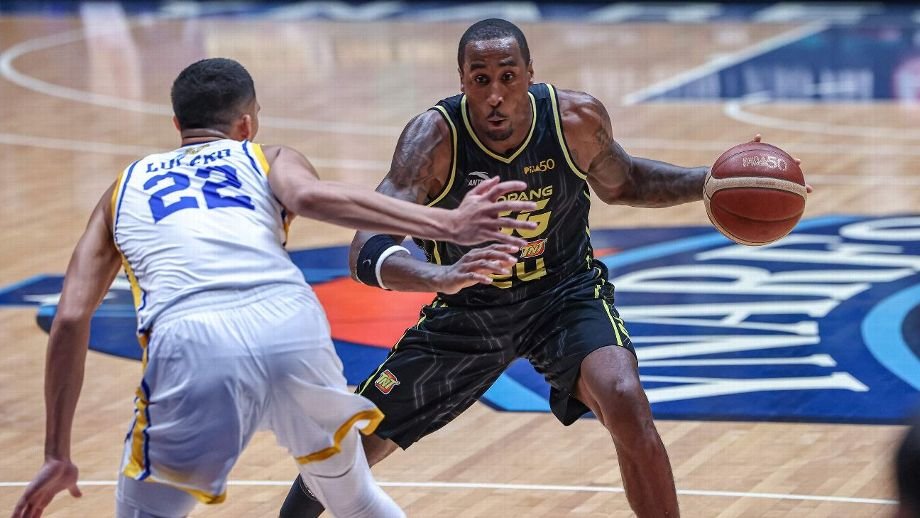
TNT Tropang 5G have turned their PBA Season 50 Governors’ Cup quarterfinal series against Magnolia Hotshots into a test of offensive patience, defensive discipline and individual resilience. At the center of TNT’s growing advantage is import Rondae Hollis-Jefferson, whose contributions on both ends of the court have helped expose Magnolia’s difficulty generating consistent scoring opportunities.
TNT secured a 91-73 victory in Game 2 at the Ynares Center in Antipolo on Wednesday night, moving within one win of a place in the semifinals. The result continued a defensive performance that has significantly disrupted Magnolia’s offense since the start of the quarterfinals.
Magnolia averaged 101 points per game during the elimination round. Across the first two games of its series against TNT, however, the Hotshots have averaged just 71.5 points. That 29.5-point difference highlights the scale of the offensive decline and the challenge facing Magnolia as it attempts to remain competitive in the series.
Hollis-Jefferson has been instrumental in creating those difficulties. His ability to protect the rim allows TNT’s perimeter defenders to apply pressure more aggressively, knowing that a teammate is positioned to provide help if an opponent gets past the first defender.
At the same time, his offensive production makes TNT difficult to contain. Hollis-Jefferson finished Game 2 with 39 points and 15 rebounds, combining physical drives, efficient finishing and relentless pressure around the basket.
The combination has given TNT an advantage that goes beyond a single strong performance. The Tropang 5G have found a way to make Magnolia work harder for its points while relying on their own import to deliver at the other end.
How Rondae Hollis-Jefferson has transformed TNT’s defensive approach
Rim protection is often measured through blocked shots, but its influence on a basketball game extends beyond the official statistics. A defender positioned near the basket can change an opponent’s decision before a shot is even attempted.
Hollis-Jefferson provides TNT with that kind of defensive presence. His three blocks in Game 2 offered a visible example of his impact, but the larger benefit comes from the pressure he places on opposing players who attempt to attack the paint.
When a ballhandler drives past the initial defender, Hollis-Jefferson can move into position to contest the shot, alter its angle or force the attacker to reconsider the attempt. Even if he does not block the ball, his presence can turn a clean scoring opportunity into a difficult finish.
That changes the responsibilities of TNT’s other defenders. Perimeter players can apply pressure to ballhandlers, challenge passing lanes and rotate toward shooters without having to treat every defensive breakdown as an immediate scoring opportunity for Magnolia.
The arrangement is especially valuable against a team trying to create advantages through individual matchups. A guard may initially lose a defensive battle, but the possession can still end in TNT’s favor if Hollis-Jefferson provides effective help at the rim.
His presence therefore supports a collective defensive system rather than functioning as an isolated individual strength. The first defender pressures the ball, help defenders close driving lanes, and the remaining players rotate to cover open teammates.
For Magnolia, the challenge is to find a way to overcome that structure without allowing TNT to dictate every possession.
Magnolia’s mismatch strategy has struggled against TNT
Magnolia has attempted to create favorable offensive matchups by involving TNT’s guards in inverted ball screens with import KJ Buffen.
In a conventional ball screen, a larger player often sets a screen for a guard who handles the ball. An inverted ball screen reverses that arrangement, allowing a bigger ballhandler to target a smaller defender after the switch or use the screen to create space for a drive.
The approach can be effective because it forces the defense to make a decision. TNT can allow a smaller defender to remain against Buffen, attempt to switch the assignment or send help from another player. Each choice can create a different advantage for the offense.
If TNT switches, Buffen may have an opportunity to exploit a size advantage. If the defense sends a second defender, another Magnolia player could become available for a pass. The objective is to make TNT choose between conceding a difficult individual matchup and opening space elsewhere on the floor.
Buffen scored 24 points in Game 2, demonstrating that he can still produce individually. However, his scoring output has not been enough to solve Magnolia’s wider offensive problems.
The distinction is between generating points through a single player and creating an offense in which multiple players consistently receive good opportunities.
If Buffen must repeatedly create difficult shots against a set defense, Magnolia’s other players may struggle to become involved. The team can remain competitive for stretches, but its scoring becomes more vulnerable when the primary option encounters pressure or when supporting players fail to convert their opportunities.
TNT’s defensive structure makes that problem more pronounced. Even when Buffen gains an initial advantage, Hollis-Jefferson can provide help near the basket, forcing the possession to continue against a recovering defense.
Magnolia must therefore find ways to move the ball more effectively, create opportunities before the defense is established and prevent its import from becoming the only reliable answer to difficult possessions.
Magnolia’s three-point shooting has become a major concern
The Hotshots’ perimeter shooting provides another explanation for their scoring difficulties. Magnolia made just five of 26 three-point attempts in Game 2, equivalent to approximately 19.2% shooting from beyond the arc.
The supplied report also puts Magnolia’s three-point shooting percentage for the series at 15.4%, an especially difficult figure for an offense that needs to create additional space around the basket.
Three-point shooting affects more than the number of points a team scores from the perimeter. Reliable outside shooting can force defenders to move farther away from the paint, creating more room for drives, post-ups and cuts toward the basket.
When perimeter shots consistently miss, opposing defenses have less incentive to extend their coverage. Defenders can remain closer to the paint, where they can challenge drives and help contain interior scoring threats.
That is particularly problematic against a team with Hollis-Jefferson’s defensive presence. If Magnolia struggles to make outside shots, TNT can devote more attention to protecting the basket without paying as high a price for leaving some perimeter players with opportunities to shoot.
There is also a difference between poor shooting and poor shot creation. A team can miss open attempts because of ordinary shooting variance, and a short stretch of unsuccessful shots does not automatically establish a permanent problem.
However, an offense that repeatedly reaches the end of the shot clock without creating a clear advantage may be generating difficult attempts rather than simply suffering from bad luck.
When the initial action fails, the paint becomes crowded and players are forced to take contested shots, low conversion rates can reflect the quality of the possessions as well as the execution of the shooters.
Magnolia’s next challenge is to determine whether it can improve both its shot selection and its accuracy. Better movement, more effective screening and quicker decisions could create cleaner opportunities, although no tactical adjustment can guarantee that the shots will fall.
Chot Reyes’ defensive system depends on trust and rotation
Hollis-Jefferson has credited TNT’s defensive performance to communication, trust in help defense and the willingness of teammates to rotate when an opponent moves the ball.
After Game 2, he explained that head coach Chot Reyes had emphasized the importance of trusting the help behind the initial defender. Hollis-Jefferson also described a possession in which Magnolia moved the ball from one side to the other, prompting TNT to rotate and cover the passing options before securing a stop.
The sequence illustrates an important principle of team defense: players must respond to one another’s movements rather than defend each assignment in isolation.
When the ball moves quickly, the original defender may no longer be in position to challenge the next shot. A teammate must close the gap, while other defenders shift to cover the spaces left open by that rotation.
This process requires timing and awareness. If one defender moves too slowly, the offense may find an open shooter. If multiple defenders move toward the same player, another attacker can become available for an uncontested attempt.
Hollis-Jefferson’s role gives TNT more flexibility within that system because he can provide help around the basket after a teammate is beaten. That support allows the perimeter defense to take calculated risks while maintaining protection against drives.
His own explanation emphasized the collective nature of the performance, noting that teammates made it easier for him to provide help, recover in transition and move into position to contest shots.
That point is significant because effective defense cannot depend entirely on a single shot-blocker. Hollis-Jefferson can influence the paint, but the team’s overall performance still relies on communication, positioning and the ability to recover when Magnolia changes the point of attack.
Hollis-Jefferson’s offensive dominance gives TNT a second advantage
While his defense has disrupted Magnolia’s attack, Hollis-Jefferson’s scoring has given TNT another important advantage in the quarterfinals.
He recorded 39 points and 15 rebounds in Game 2, finishing with a reported true shooting percentage of 64.4%. The performance combined high scoring volume with efficient conversion, making him difficult for Magnolia to contain without changing its defensive approach.
True shooting percentage accounts for field goals, three-pointers and free throws, offering a broader measure of scoring efficiency than conventional field-goal percentage. It helps show how effectively a player turns different types of scoring opportunities into points.
Hollis-Jefferson’s style creates several problems for defenders. His strength allows him to attack contact, while his ability to finish through traffic makes it difficult to stop him simply by placing a defender between him and the basket.
He can also exploit gaps before the opposing defense becomes organized. When he attacks early, defenders may have less time to establish help positions, allowing him to reach the rim before additional support arrives.
For Magnolia, containing his drives presents a difficult choice. Sending additional defenders toward him can leave teammates with more room to operate, while relying on a single defender can leave that player responsible for a physically demanding matchup.
Hollis-Jefferson’s rebounding adds another dimension to his influence. His 15 rebounds helped reinforce his presence around the basket and gave him opportunities to contribute beyond scoring.
The overall result is a player who can shape the game at both ends. His defense helps limit Magnolia’s scoring opportunities, while his offense gives TNT a dependable source of production.
Why Hollis-Jefferson prepares for different defensive matchups
Hollis-Jefferson has described a preparation approach built around imagining difficult defensive assignments during training.
“For me, I work out like I’m playing a game,” he said after Game 2.
He explained that he envisions facing the best defender while working in the gym so that he is prepared for different scenarios once the game begins. He also mentioned Lu Dort as an example of the type of defender he imagines facing.
The approach reflects a focus on preparing for resistance rather than expecting favorable conditions. A player who practices against imagined pressure can work on maintaining balance, protecting the ball and making decisions when defenders attempt to disrupt preferred movements.
Such preparation does not eliminate the difficulty of facing a strong opponent, but it can help a player approach different matchups with a consistent offensive mindset.
Hollis-Jefferson’s physical approach is particularly relevant in playoff basketball, where defenses often become more deliberate about denying a player’s preferred options. His ability to attack the basket and finish through contact gives TNT a scoring method that does not depend entirely on outside shooting.
That reliability can become valuable when a team’s perimeter accuracy fluctuates. While Hollis-Jefferson cannot guarantee a particular scoring total in every game, his ability to pressure the rim gives TNT another way to generate offense when other options become less effective.
What Magnolia must change to keep its season alive
With TNT one win away from the semifinals, Magnolia faces the immediate task of correcting the problems that have defined the first two games of the series.
The most obvious concern is scoring. An offense that averaged 101 points during the eliminations has managed only 71.5 points per game through two quarterfinal contests. Reversing that trend will require more than hoping for a better shooting night.
Magnolia needs to create more balanced possessions. Buffen’s ability to score remains important, but the team must also make sure that its other players can contribute when TNT directs additional defensive attention toward him.
Improving ball movement could help prevent the offense from becoming predictable. Quicker passes and better spacing may force TNT’s defenders to cover more ground, potentially reducing the time Hollis-Jefferson has to establish his preferred help position.
The Hotshots must also address their perimeter production. More effective screening and player movement could create cleaner three-point attempts, while successful outside shooting would give Buffen additional room to attack inside.
Defensively, Magnolia faces its own challenge in containing Hollis-Jefferson. Limiting his opportunities without giving TNT’s other players easy scoring chances will require disciplined rotations and a clear approach to help defense.
There is no single adjustment guaranteed to solve both problems. Magnolia must improve its own offensive execution while finding a way to make TNT work harder for its points.
What TNT’s Game 2 victory means for the semifinal race
TNT’s 91-73 win has placed the Tropang 5G within one victory of advancing to the semifinals. Their position reflects the combined effect of Hollis-Jefferson’s individual production and a defensive approach that has sharply reduced Magnolia’s scoring output.
The two sides of that performance are closely connected. Effective defense can create transition opportunities and prevent opponents from establishing offensive rhythm, while efficient scoring can force the opposition to play under increasing pressure.
Hollis-Jefferson has contributed to both outcomes, but TNT’s progress also depends on the teammates who pressure the ball, rotate toward shooters and trust one another to provide help.
For Magnolia, the path forward begins with creating better shots and finding more contributors beyond Buffen. The Hotshots’ three-point struggles have made it easier for TNT to protect the paint, and their reduced scoring average shows how effectively the defensive scheme has disrupted their preferred approach.
The next game will reveal whether Magnolia can make meaningful adjustments or whether TNT can maintain the same defensive control. The result is not predetermined, but the immediate challenge is clear: Magnolia needs to find a more reliable offense against a team that has made difficult possessions increasingly common.
Hollis-Jefferson’s 39-point, 15-rebound performance has put him at the center of the series, yet his greatest value may lie in how his skills support TNT’s broader strategy. His rim protection gives teammates greater freedom to defend aggressively, while his offensive production prevents the team from relying on defense alone.
If TNT continues to combine collective defensive discipline with Hollis-Jefferson’s two-way impact, it will have a strong opportunity to complete the quarterfinal assignment. Magnolia, meanwhile, must find a way to restore its scoring rhythm before TNT turns its current advantage into a semifinal berth.
For breaking news and live news updates, like us on Facebook or follow us on Twitter and Instagram. Read more on Latest Basketball on thefoxdaily.com.


COMMENTS 0