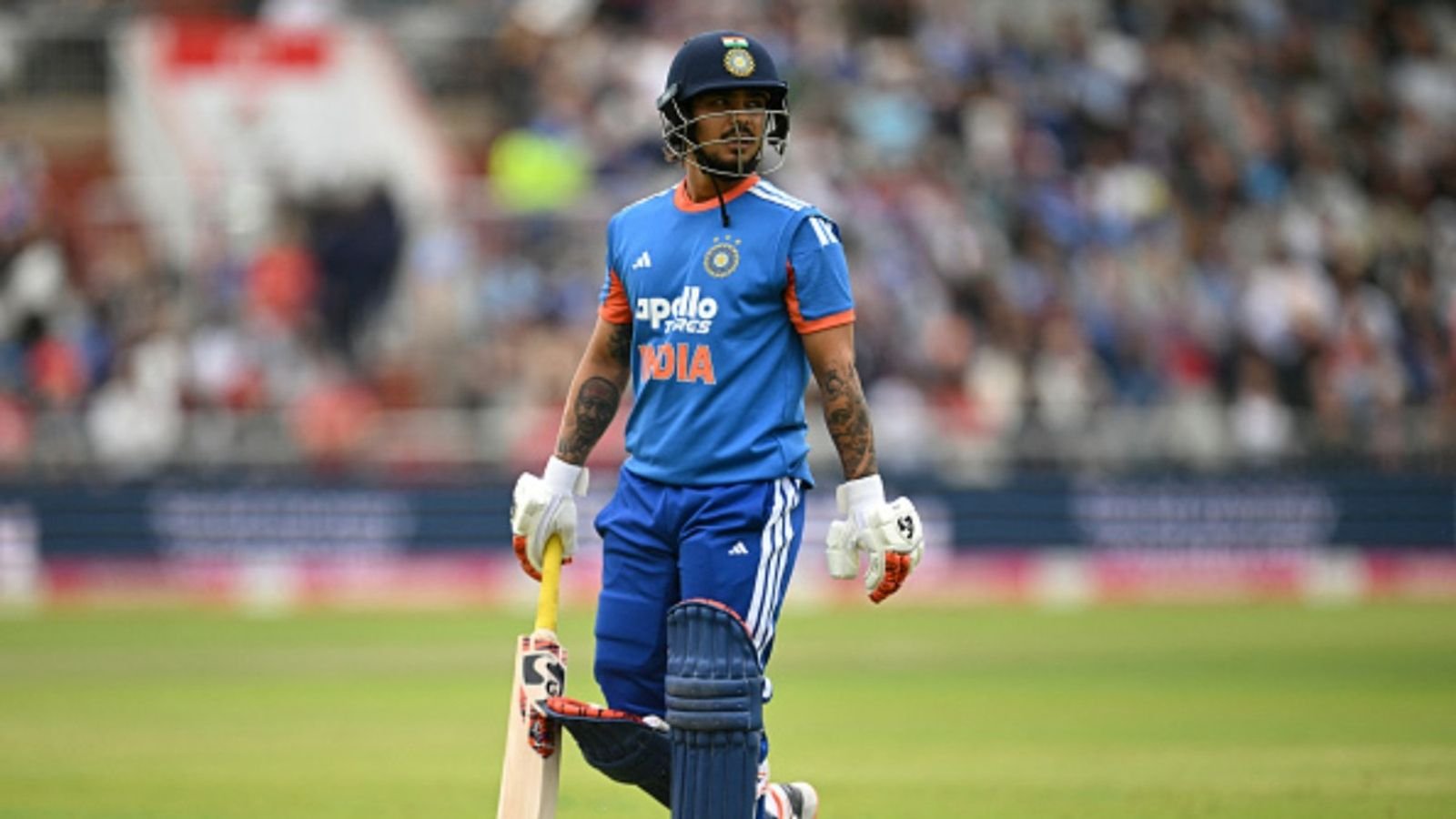
India’s defeat in the second T20I against England has sparked fresh discussions about the team’s batting strategy, balance, and ability to maximize scoring opportunities in modern T20 cricket. While a target of 191 would traditionally be considered competitive, England’s successful chase exposed a growing concern within the Indian camp: the inability to consistently squeeze out crucial extra runs that often decide high-scoring contests.
Following the loss at Old Trafford, wicketkeeper-batter Ishan Kishan delivered an honest assessment of India’s performance. Rather than focusing solely on bowling shortcomings, Kishan pointed to an issue that has increasingly affected T20 teams worldwide—converting good totals into match-winning totals.
His comments offer a valuable insight into how India’s management may approach the remainder of the five-match series and potentially shape preparations for future ICC tournaments.
India vs England 2nd T20I: What Happened?
India entered the second T20I hoping to take control of the series after the opening match was washed out due to rain. Batting first, the visitors posted 191 runs, a score that appeared strong enough to challenge England on a batting-friendly surface.
However, England’s aggressive batting lineup successfully chased down the target with four wickets remaining, exposing areas where India failed to capitalize during key moments of the match.
The defeat left India searching for answers and highlighted how quickly momentum can shift in modern T20 cricket.
| Match Detail | Result |
|---|---|
| Venue | Old Trafford, England |
| India Total | 191 Runs |
| England Result | Won by 4 Wickets |
| Series Status | England lead 1-0 |
| Next Match | 3rd T20I at Trent Bridge |
Ishan Kishan’s Honest Assessment of India’s Batting
One of the most significant takeaways from Kishan’s post-match remarks was his belief that India’s batters collectively need to take greater responsibility.
According to the left-hander, the difference between victory and defeat may simply be an additional 20 runs on the scoreboard.
While 191 is generally considered a challenging total, elite T20 teams increasingly target scores beyond 210, especially on flat pitches with short boundaries and favorable batting conditions.
Kishan emphasized that every batter must identify ways to contribute more effectively, whether through boundary-hitting, smarter strike rotation, or exploiting field placements.
His comments reflect a broader shift in T20 cricket, where teams are no longer satisfied with merely reaching competitive totals—they aim to maximize every over.
Why 20 Extra Runs Matter More Than Ever in T20 Cricket
The modern T20 game has evolved dramatically over the past decade.
Scores once considered match-winning are now frequently chased down by aggressive batting units. Teams such as England have transformed the format through fearless batting, deep lineups, and an attacking mindset from the very first ball.
In such an environment, the gap between 190 and 210 can be enormous.
- 190 often keeps both teams in the contest.
- 210+ forces chasing teams to take significantly greater risks.
- Additional runs create scoreboard pressure.
- Bowlers gain more room for error.
- Captains enjoy greater tactical flexibility.
Kishan’s observation reflects this modern reality. India are not necessarily struggling to post respectable totals; they are struggling to consistently post dominant totals.
England’s Superior Understanding of Conditions
Another key point raised by Kishan was England’s familiarity with local conditions.
Home advantage in cricket extends beyond crowd support. It includes understanding pitch behavior, boundary dimensions, weather conditions, and tactical nuances unique to specific venues.
England’s batters appeared comfortable pacing their chase and identifying scoring opportunities throughout the innings.
India, meanwhile, seemed uncertain at crucial stages, particularly when attempting to accelerate.
Recognizing how opponents exploit local conditions is often the first step toward developing effective counter-strategies.
India’s Batting Approach Under the Microscope
One area likely to receive attention before the third T20I is India’s middle-overs batting.
Many successful T20 teams have adopted a philosophy centered around relentless scoring pressure. Rather than preserving wickets for a late assault, they prioritize maintaining a high run rate throughout the innings.
India’s innings occasionally appeared caught between aggression and caution.
While the team reached a respectable total, there were periods where scoring momentum slowed, preventing the batting lineup from fully capitalizing on favorable conditions.
These small slowdowns often become decisive against elite opposition.
Ishan Kishan’s Own Performance Reflects the Challenge
Kishan’s comments carry additional weight because he personally experienced a difficult innings.
Despite finishing as India’s highest scorer with 49 runs, the innings lacked the fluency typically associated with the explosive left-hander.
His strike rate and overall rhythm suggested that scoring was not as straightforward as the final total might indicate.
This highlights an important reality in T20 cricket: individual contributions must not only produce runs but also maintain scoring momentum.
The difference between a run-a-ball innings and a high-impact innings can significantly affect the final total.
The Bigger Issue: India’s Search for the Ideal T20 Formula
India’s recent performances suggest the team is still refining its ideal T20 combination.
The introduction of young talents, tactical experiments, and changing batting roles indicate that management remains in evaluation mode.
Several questions continue to shape discussions:
- Should India adopt a more aggressive powerplay strategy?
- Is the batting order optimized for modern T20 cricket?
- How can middle-order hitters maximize scoring opportunities?
- What balance should be maintained between youth and experience?
- Can India consistently match England’s scoring tempo?
These questions become increasingly important as preparations for future ICC tournaments continue.
What England Are Doing Better Right Now
England’s recent T20 success is built on a clear and consistent philosophy.
Their batters rarely allow scoreboard pressure to dictate their approach. Instead, they focus on maintaining attacking intent regardless of match situations.
| England Strength | Impact |
|---|---|
| Aggressive Powerplay Batting | Strong starts reduce pressure later |
| Deep Batting Lineup | Allows continuous attacking intent |
| Local Knowledge | Better adaptation to conditions |
| Fearless Approach | Higher scoring rates throughout innings |
| Flexible Roles | Players adapt to match situations quickly |
India’s challenge is not necessarily matching England shot for shot but developing a similarly clear identity.
Selection Questions Ahead of the Third T20I
The third T20I at Trent Bridge could bring important selection decisions.
One of the biggest talking points remains the inclusion of teenage sensation Vaibhav Sooryavanshi, who made his international debut in the second match.
Although the youngster showed flashes of talent, questions remain regarding whether management will continue investing in youth or recall the experienced Sanju Samson.
Team balance, batting depth, and role clarity will all influence the final decision.
Regardless of personnel changes, India’s larger challenge remains improving overall batting efficiency.
Why This Defeat Could Be Valuable for India
Not all defeats are equally damaging.
Some losses expose weaknesses that might otherwise remain hidden until major tournaments.
India’s inability to defend 191 provides useful data for coaches, analysts, and players.
The match highlighted several areas requiring improvement:
- Maximizing scoring opportunities in the middle overs.
- Converting starts into match-defining innings.
- Reading conditions more effectively.
- Building greater scoreboard pressure.
- Developing clearer batting roles.
Addressing these issues now could strengthen the team significantly in the long run.
The Road Ahead for Shreyas Iyer’s India
With England holding a 1-0 advantage in the five-match series, India face an important challenge heading into the third T20I.
A defeat would place enormous pressure on the visitors and leave little margin for error in the remaining matches.
Fortunately for India, the series remains wide open.
The batting talent exists, the bowling attack has quality, and the squad possesses enough experience to recover quickly.
The key lies in implementing the lessons identified by players like Kishan.
Conclusion: India’s Next Step Is Finding Those Missing 20 Runs
Ishan Kishan’s assessment after the defeat may prove more significant than the result itself. His focus on finding an additional 20 runs reflects a modern understanding of elite T20 cricket, where marginal gains often determine outcomes.
India’s batting unit has the talent to post imposing totals, but consistency remains the challenge. Against strong teams like England, merely reaching competitive scores is no longer enough. The objective must be to create totals that place opponents under relentless pressure.
As the series moves to Trent Bridge, India’s response will reveal whether they can transform lessons into results. If the batters successfully identify those missing runs that Kishan referenced, the momentum of the series could quickly shift in their favor.
For now, the message from India’s dressing room is clear: every batter has a responsibility to contribute more, because in modern T20 cricket, 20 runs can mean the difference between frustration and victory.
For breaking news and live news updates, like us on Facebook or follow us on Twitter and Instagram. Read more on Latest Sports on thefoxdaily.com.






COMMENTS 0