India’s loss to England in the second T20I was not merely about a costly over or a missed opportunity to take control of the series. Instead, the match has triggered a larger debate surrounding coaching accountability, technical discipline, and the development of spin bowlers in modern cricket.
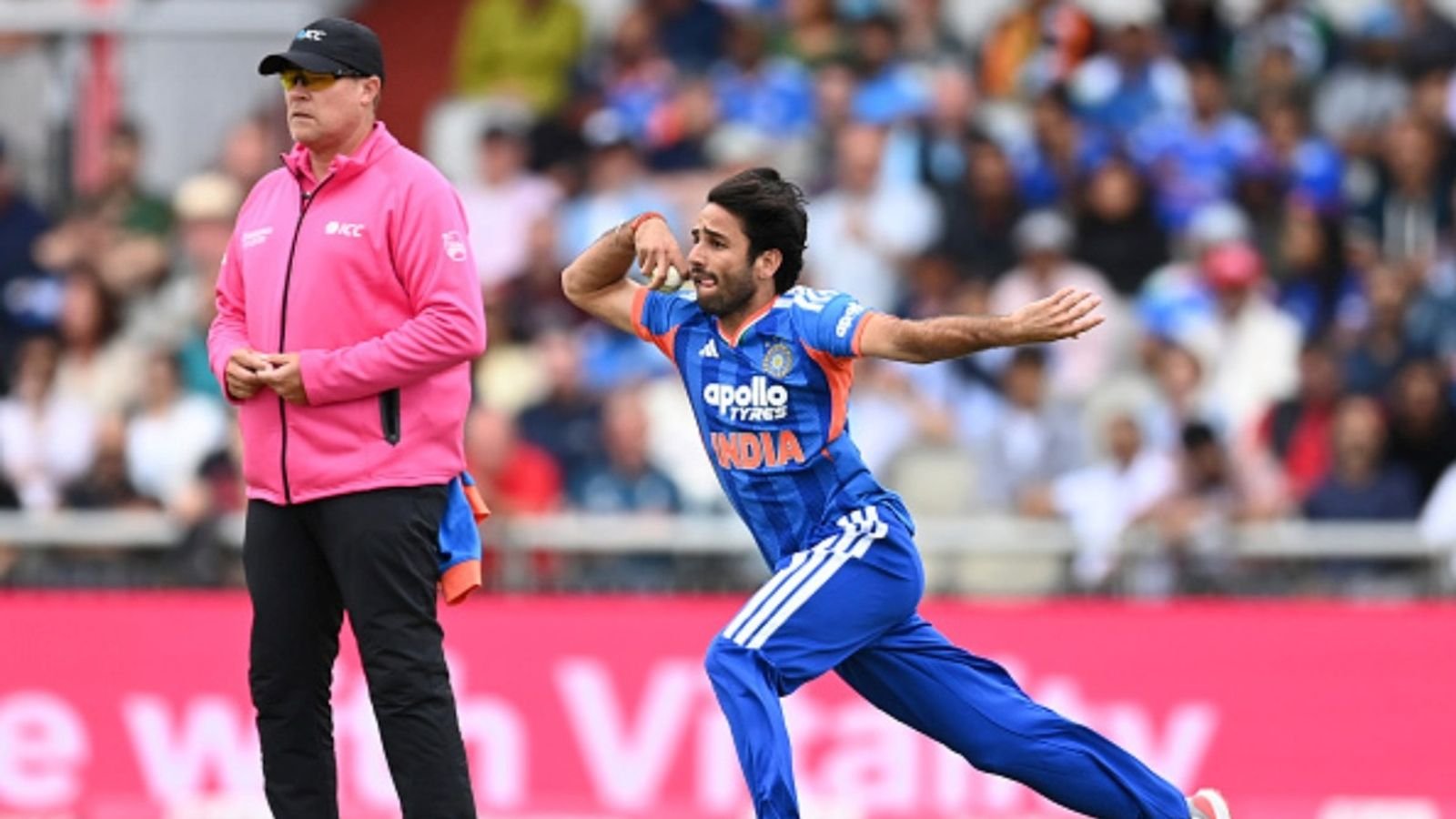
At the center of the discussion is leg-spinner Ravi Bishnoi, whose expensive 17th over dramatically shifted momentum in England’s favor. Two no-balls, multiple boundaries, and a total of 29 runs conceded in a single over transformed a manageable run chase into a straightforward path to victory for the hosts.
What followed was equally significant. Former India leg-spinner Laxman Sivaramakrishnan publicly criticized India’s spin-bowling setup, questioning whether technical flaws in Bishnoi’s action and run-up should have been corrected long before they surfaced in an international match.
The incident has opened a broader conversation about coaching standards, player preparation, and the evolving role of specialist bowling coaches within Indian cricket.
How One Over Changed the Match
T20 cricket often turns on a handful of deliveries rather than an entire innings. In Manchester, that reality was on full display.
England required 49 runs from the final four overs, a target that appeared challenging given the match situation. India’s bowlers had largely maintained control, and the pressure was mounting on England’s middle order.
However, the 17th over dramatically altered the contest.
Ravi Bishnoi delivered two no-balls, both of which resulted in free-hit opportunities. England capitalized immediately, attacking with confidence and converting mistakes into maximum damage. By the end of the over, 29 runs had been added, effectively swinging the match in England’s favor.
| Key Moment | Impact on Match |
|---|---|
| First No-Ball | Created free-hit opportunity and reduced pressure |
| Second No-Ball | Further shifted momentum toward England |
| Boundary Sequence | Allowed batters to dominate the over |
| 29-Run Over | Turned a difficult chase into a favorable position |
| Final Result | England completed a successful comeback |
While cricket matches are rarely decided by a single over, this phase proved decisive enough for captain Shreyas Iyer to identify it as the turning point after the game.
Why No-Balls Remain One of Cricket’s Costliest Mistakes
In modern cricket, especially T20s, a no-ball is far more damaging than simply conceding an extra run.
The batting side receives an additional delivery and, in most cases, a free hit. This combination removes much of the risk for the batter while increasing pressure on the bowler.
For spinners, the issue becomes even more significant because no-balls are generally considered avoidable technical errors rather than consequences of excessive pace or aggressive run-ups.
A spinner’s success is built on precision, rhythm, and control. Therefore, bowling repeated no-balls raises concerns about technique, preparation, and consistency.
At the international level, where margins between victory and defeat are incredibly small, such mistakes can become match-defining moments.
Laxman Sivaramakrishnan’s Criticism Goes Beyond One Match
The former Indian leg-spinner’s comments were notable because they focused not only on Bishnoi but also on the broader coaching structure.
Sivaramakrishnan argued that technical flaws should be identified and corrected during training sessions rather than becoming visible during high-pressure international encounters.
His primary concern centered on Bishnoi’s run-up and delivery stride, suggesting that the issue was not a sudden error but a technical vulnerability that had existed for some time.
The criticism highlights an important reality in professional cricket: coaches are expected not only to improve performance but also to eliminate recurring technical mistakes.
When such issues appear during crucial moments, questions naturally arise regarding the effectiveness of preparation and monitoring.
The Growing Importance of Specialist Coaches in Modern Cricket
Cricket coaching has evolved dramatically over the last two decades.
Teams no longer rely solely on a head coach. Modern international squads employ specialists for batting, pace bowling, spin bowling, fielding, strength and conditioning, performance analysis, and mental preparation.
The rationale is simple: elite players require highly focused guidance.
For spin bowlers, specialist coaching has become particularly important because success depends on a combination of technical accuracy, tactical intelligence, and psychological resilience.
A minor flaw in a bowler’s action can influence control, consistency, and effectiveness. Consequently, specialist coaches are expected to monitor these details continuously.
The scrutiny surrounding India’s spin-bowling setup reflects the growing expectations attached to these roles.
Ravi Bishnoi’s Development: A Talent Still in Progress
Despite the criticism, it is important to remember that Ravi Bishnoi remains one of India’s most promising white-ball spinners.
His rise through domestic cricket and the IPL showcased several qualities that make him valuable in T20 cricket:
- Ability to bowl attacking lines.
- Sharp variations and googlies.
- Confidence in pressure situations.
- Wicket-taking mindset.
- Adaptability across conditions.
However, young bowlers often experience periods of inconsistency while refining their craft.
Many elite spinners have endured difficult matches before developing into world-class performers. The challenge lies in responding constructively to setbacks rather than allowing them to become recurring patterns.
Bishnoi’s current situation may ultimately become a valuable learning experience if the technical issues are identified and addressed effectively.
Why Leg-Spinners Should Be Attackers, Not Defensive Options
One of the most interesting points raised during the debate concerns the role of leg-spinners in modern cricket.
Historically, leg-spin has been regarded as an attacking art form. Unlike defensive bowlers who focus primarily on restricting runs, leg-spinners are expected to create uncertainty and take wickets.
The very nature of leg-spin involves risk.
Because the ball spins away from most right-handed batters and offers greater variation, leg-spinners often concede boundaries. However, they compensate by creating wicket-taking opportunities.
Many of cricket’s greatest leg-spinners followed this philosophy.
| Legendary Leg-Spinner | Primary Strength |
|---|---|
| Anil Kumble | Relentless wicket-taking pressure |
| Bhagwath Chandrasekhar | Unpredictable turn and deception |
| Shane Warne | Attacking mindset and tactical mastery |
| Abdul Qadir | Creativity and variation |
In this context, critics argue that India’s management must ensure that attacking bowlers maintain confidence even after expensive spells rather than becoming overly defensive.
Captaincy Questions and Tactical Decisions
The aftermath of the defeat has also prompted discussions regarding tactical choices.
One notable talking point involved bowling options available during the death overs.
Several observers questioned whether alternative bowlers could have been used during the crucial phase of the innings. Given that all-rounders in the squad were capable of contributing overs, some analysts believe India had additional tactical flexibility.
However, captaincy decisions are often judged with the benefit of hindsight.
Before the costly over, Bishnoi had not appeared significantly out of rhythm. Trusting a frontline spinner in a key moment was a reasonable decision based on available information.
The real issue remains execution rather than selection.
The Centre of Excellence Debate: Building the Next Generation
An important aspect of Sivaramakrishnan’s comments involved his desire to work with younger players rather than the senior national team.
His emphasis on grassroots development reflects a growing belief that technical excellence must be established long before players reach international cricket.
India’s cricket ecosystem produces enormous talent, but converting potential into sustained international success requires structured coaching pathways.
Specialized development programs can help young bowlers improve:
- Technical consistency.
- Game awareness.
- Mental toughness.
- Match preparation routines.
- Adaptability across formats.
The discussion highlights how player development is increasingly viewed as a long-term process rather than something that begins after national selection.
Will Ravi Bishnoi Retain His Place for the Third T20I?
One immediate question concerns team selection for the next match of the series.
International cricket offers little time for recovery after disappointing performances. Teams must quickly decide whether to back struggling players or explore alternative options.
India possesses several potential replacements and tactical combinations, giving the management flexibility heading into the third T20I.
However, dropping a player immediately after one poor outing can sometimes damage confidence and hinder long-term development.
The decision will likely depend on how the coaching staff evaluates Bishnoi’s technical issues and whether they believe adjustments can be made before the next game.
A Bigger Lesson for Indian Cricket
Beyond the result and individual performances, this episode offers a broader lesson about elite sport.
Success at the international level depends on attention to detail.
Technical flaws that appear insignificant during training can become decisive under pressure. Whether it involves a batter’s footwork, a fielder’s positioning, or a bowler’s run-up, small details often determine outcomes in high-level competition.
The criticism surrounding Bishnoi and the spin-bowling setup should therefore be viewed as part of a larger conversation about continuous improvement rather than assigning blame.
The best teams use setbacks as opportunities to strengthen systems and refine processes.
Conclusion: More Than Just a Costly Over
Ravi Bishnoi’s difficult outing against England has become one of the biggest talking points of the series, but the conversation extends far beyond a single over.
The debate has highlighted questions about coaching accountability, technical preparation, player development, and the role of specialist support staff in modern cricket.
While criticism has focused on mistakes made during a crucial phase of the match, the bigger challenge now is ensuring those mistakes become valuable learning experiences rather than recurring problems.
For Bishnoi, the coming matches provide an opportunity to demonstrate resilience and growth. For India’s coaching staff, the situation serves as a reminder that even the smallest technical details can have enormous consequences at the highest level.
As the series continues, all eyes will be on how both player and management respond. In elite cricket, setbacks are inevitable. What ultimately matters is how quickly lessons are learned and improvements are made.
For breaking news and live news updates, like us on Facebook or follow us on Twitter and Instagram. Read more on Latest Sports on thefoxdaily.com.






COMMENTS 0